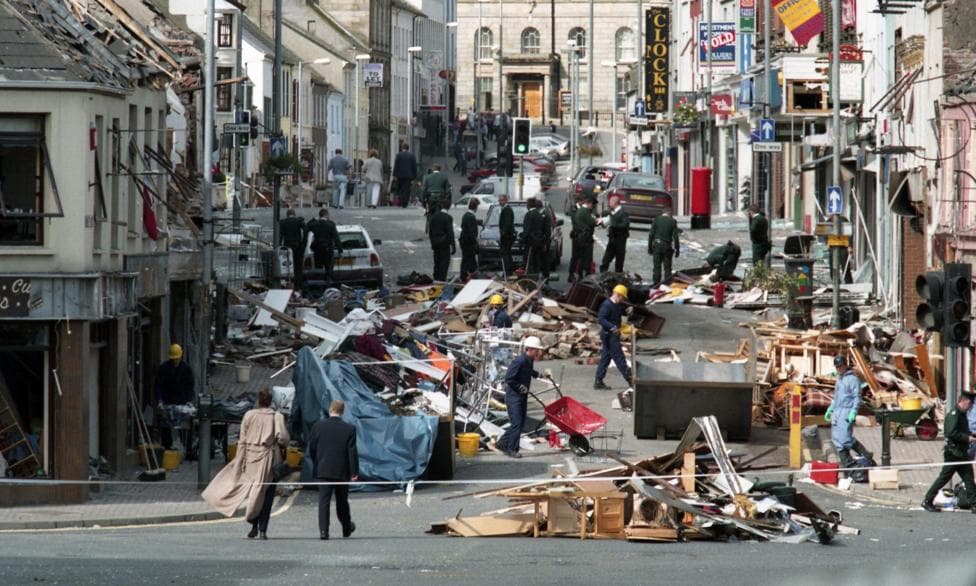
Twenty-nine people, including a woman pregnant with twins, died when a bomb detonated in Omagh town centre during the summer of 1998. The independent inquiry examining the attack has now viewed video documentation of the explosion itself and its immediate consequences, as part of its ongoing investigation into whether state authorities could have prevented the atrocity.
The inquiry was established to determine whether UK state authorities could have prevented the bombing. A 2023 judicial review found plausible arguments that there was a real prospect the atrocity could have been prevented, prompting calls for investigations in the UK and Ireland.
What the inquiry saw
Video footage captured inside McIlroy's shoe shop in the town centre documented the moment of detonation and the aftermath. Photographs showing the extent of the damage were also presented to the inquiry. The video presentation included audio from Royal Ulster Constabulary (RUC) radio transmissions recorded at the time, though the inquiry was told the original audio was distressing in nature.
At 15:04 BST on the radio transmission, an officer can be heard saying "send over" while another states "this has exploded". A third transmission requests "assistance to the bottom of the town". Mark Safranauskas, the inquiry's data analyst, determined that the RUC transmission originated from approximately 350 metres away from the blast site. The inquiry heard that the explosion itself caused significant disruption to the RUC's telephone and radio systems.
How emergency services responded
The first alert about the bombing came not from the public but from an alarm monitoring company. At 15:09 BST, the RUC contacted the Northern Ireland Fire Service (NIFS), and at 15:11 BST the Northern Ireland Ambulance Service (NIAS) received a 999 call. Counsel to the Inquiry Nicholas de la Pour KC acknowledged the scale of the response effort, stating:
I want to acknowledge the heroism of every single person, civilian, army or emergency services who after the bomb went to help.
The inquiry will publish a comprehensive document outlining the events that followed the bombing, including the responses from the army and emergency services, on its website.
What phone records reveal
The inquiry's focus then shifted to analysing mobile phone movements connected to the bombing. Safranauskas mapped a series of phone calls between what the inquiry describes as "key individuals". Almost 60 calls were made in the afternoon and evening of the bombing day.
The calls included exchanges between Seamus McKenna and Seamus Daly, who counsel de la Pour said in the "working hypotheses" of the inquiry were "fleeing the absolute devastation and atrocity they have caused". Calls involving Colm Murphy and Liam Campbell were also highlighted. The four men were tried in relation to the bomb attack in a civil case in 2009.
Pre-recorded evidence from Detective Superintendent Casserly of An Garda Síochána (Irish Police) used cell site data to track the movement of two mobile phone numbers linked to the bombers as they travelled back into the Republic of Ireland through County Monaghan and into Dundalk.
Critical gaps in CCTV evidence
The inquiry has encountered significant obstacles in reconstructing the bombers' movements through video evidence. According to reporting on the inquiry proceedings, a checkpoint that likely was used by the bombers had 22 minutes of CCTV footage missing. Investigators found no footage of the bomb car crossing into Northern Ireland despite gathering 237 CCTV tapes during the original RUC investigation.
At an army checkpoint in Aughnacloy, footage from 13:30 to 14:00 on the day of the bombing was paused, leaving approximately 8.5 minutes of passing traffic unrecorded. These gaps in surveillance coverage have complicated efforts to establish a complete timeline of the bombers' route and movements.
Scale of suspected involvement
The inquiry's working hypothesis suggests that as many as 14 people were involved in the bombing plot, indicating a far larger conspiracy than the four men who faced civil proceedings. This expanded scope of suspected involvement has shaped the direction of the inquiry's investigation.
What happens next
Chapter Three hearings began on 21 September 2026 and are expected to last around five weeks, examining how the bombing was carried out and who was responsible. The hearings will review evidence including the bomb's construction, warning calls, claims of responsibility, arrests and court proceedings. The inquiry continues to work through the complex evidence surrounding one of the deadliest attacks in the history of the conflict in Northern Ireland.