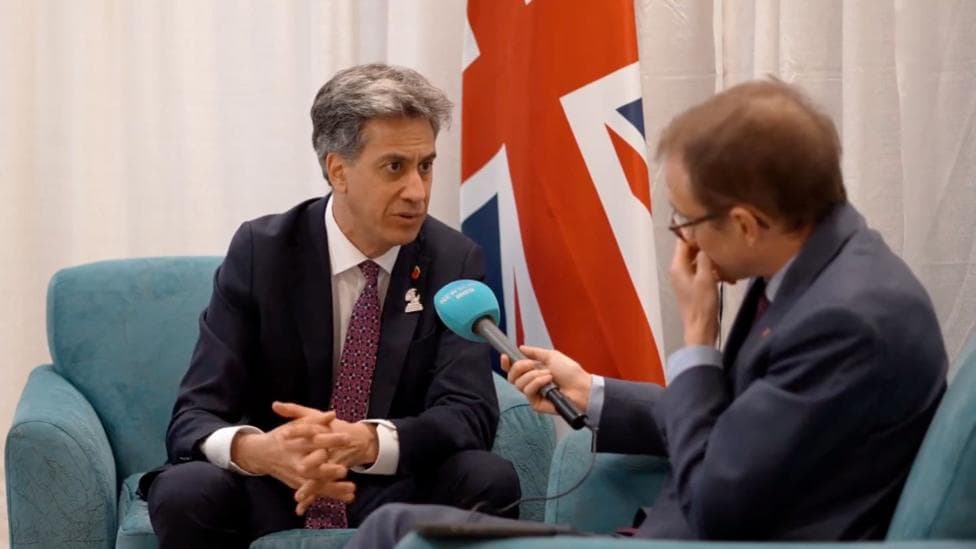
Foreign Secretary Ed Miliband has stated that the government's consideration of a formal apology for the UK's role in the transatlantic slave trade will not result in increased costs for British taxpayers. Speaking on the BBC's Newscast podcast, Miliband emphasised that while the government is prepared to confront this historical issue, any potential measures would not involve additional public spending.
According to BBC News, Prime Minister Andy Burnham has stated the UK will not pay reparations to affected countries, though he has not ruled out whether the government's new approach could involve redirecting existing funds. Government sources indicated that any financial assistance could be redirected from the existing overseas aid budget, with no additional spending, and would not be described as reparations.
Miliband criticised the approach taken by previous British governments, describing their stance as one that sought to "sweep it under the carpet" regarding the pain and consequences of slavery. He specifically referenced former Prime Minister Sir Tony Blair's handling of the issue nearly two decades earlier. In 2007, Sir Tony characterised the UK's involvement in the slave trade as a matter of "deep sorrow and regret".
"Tony Blair did sort of do a kind of sorry not sorry situation. He kind of expressed sorrow, and then said sorry, and then it was walked back by number 10," Miliband said.
Miliband noted that the former prime minister's approach continued to be referenced in recent diplomatic conversations, including a discussion between Andy Burnham and Barbados Prime Minister Mia Mottley. He also highlighted that he and Burnham inherited complications stemming from the Commonwealth Heads of Government Meeting (CHOGM) held in Samoa two years ago.
"On the second day as my time as foreign secretary, I was told, 'look, one of your tasks is CHOGM 2024, which happened in Samoa, didn't go well.' To use sort of diplomatic speak, it ended up in a sort of punch up, a sort of verbal punch up about this whole issue."
Miliband observed that the slavery issue had persisted within Commonwealth discussions for approximately two decades, but had intensified significantly over time. He explained that the government decided to address the matter directly rather than attempt to ignore it.
"This has really been hanging around as an issue for the Commonwealth for sort of 20 years, really. But it's grown and grown."
What alternatives to reparations are being considered?
Rather than financial reparations, Miliband described possible alternatives as "meaningful, practical cooperation," including educational and cultural exchanges, climate resilience, development and economic opportunity. This approach reflects the government's intention to address historical grievances while maintaining fiscal constraints.
How does this compare to previous government positions?
The current government's willingness to formally apologise represents a shift from earlier positions. The 2024 Samoa Communiqué called for a "meaningful, truthful and respectful conversation" about addressing the harms of slavery and other historical injustices, without committing the UK to financial reparations. Meanwhile, Caribbean nations have advanced more comprehensive proposals: CARICOM's 10-point reparations plan included a formal apology, debt cancellation, technology transfer, public-health assistance and efforts to eradicate illiteracy.
Why does Miliband believe this approach is necessary?
Miliband rejected the notion that acknowledging historical wrongs represents weakness. He argued that confronting past actions demonstrates national strength rather than fragility.
"Is it weak to do this? I think it's the opposite of weak. I think fragile weak countries can't face up to their past. I'm really proud of Britain, but being proud of your country is also being willing to face up to things you didn't do, right?"
To inform the government's position, Miliband requested a historical digest of the UK's involvement in the slave trade. The scale of this involvement is substantial: over three million people were shipped with British state complicity over a period spanning several centuries, with hundreds of thousands dying during the process.
"Over three million people shipped, really with the British state's complicity, over a long period of time, couple of centuries actually, hundreds of thousands of them didn't make it and died. Those who did make it had appalling conditions. Reading about the conditions on the ships and what happened to them when they arrived in the Caribbean and the Americas is really pretty harrowing."
What happens next?
The government is beginning what officials describe as a "structured dialogue" with affected Commonwealth nations. The UK is expected to consider a formal apology next year, when it holds the G20 presidency, with the reported target around the G20 summit in Manchester in November 2027. The government hopes that issuing an apology will create space for the Commonwealth to redirect its attention to other pressing matters and strengthen relationships across member nations.