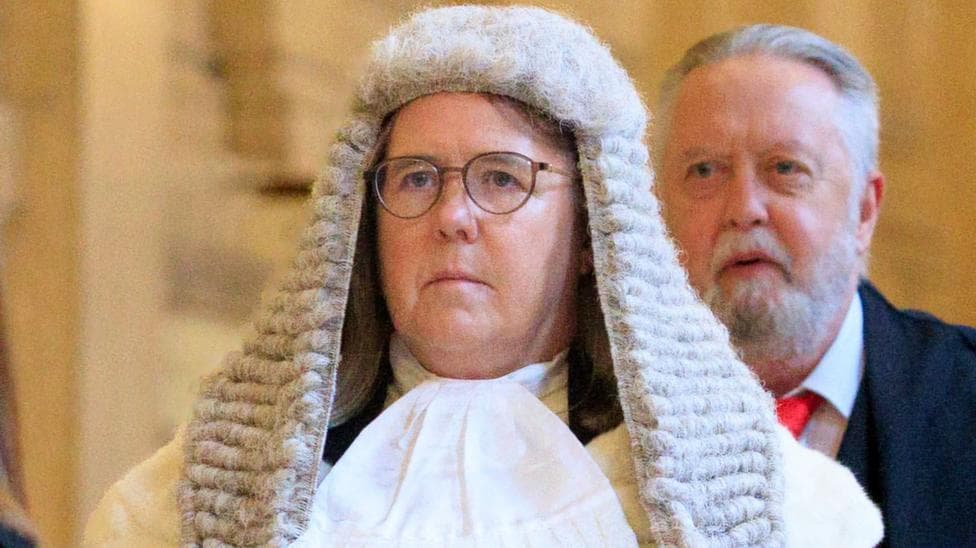
Dame Siobhan Keegan, Northern Ireland's Lady Chief Justice, has stated that it is "unwise" for members of the legal profession to provide character references in court cases. Speaking during a wide-ranging interview with a national broadcaster's radio programme, she outlined concerns about the practice and indicated plans to examine the issue more closely.
The remarks come amid significant controversy surrounding David Lavery, chief executive of the Law Society of Northern Ireland, who provided a character reference for his cousin William Lloyd-Lavery, who was convicted of serious sexual offences. According to reporting on the case, William Lloyd-Lavery was found guilty of indecently assaulting five girls at a south Belfast school in the 1970s. Lavery subsequently apologised for what he described as
a "serious error in judgement" in giving the character reference, and stated he was sorry for the hurt caused to victims.
According to available reports, Lavery was removed from his role as a human rights commissioner on 5 August 2026 following the controversy. The Law Society indicated it had completed an internal process but declined to release further public details citing confidentiality concerns.
Dame Siobhan said she intends to have her sentencing group examine character references more closely, particularly given concerns raised by victims that they have no opportunity to challenge such references during court proceedings. Members of the Law Society are expected to vote on whether they retain confidence in Lavery, with a Special General Meeting now scheduled.
What is the legal status of character references?
The law does not require judges to take character references into account when sentencing, Dame Siobhan explained. However, she acknowledged that such references regularly appear in cases and that the practice warrants closer examination. She stated:
"It's unwise for certain people to give character references to start with and I think that has come to pass in a number of circumstances."
Reflecting on the broader use of character references, Dame Siobhan highlighted transparency as a potential concern for victims.
"The 'transparency' of the process could be an issue for victims,"she said, adding that
"maybe we have to think about a better way of dealing with this issue".
According to campaigners and officials working on the matter, the Department of Justice has been actively developing reforms to the use of good character references, including exploring possible legislative changes to the system.
When will the Law Society address this controversy?
The controversy has prompted significant action within the Law Society. According to reports on the dispute, a Special General Meeting was triggered after 50 letters from Law Society members called for one to be held. The Law Society council held an unscheduled meeting to discuss the controversy on 11 August 2026, with a Special General Meeting now scheduled for 9 September 2026 in Belfast.

Should sentencing be tougher in Northern Ireland?
When asked about the severity of sentencing in Northern Ireland, Dame Siobhan cautioned against hasty reactions to individual cases. She said there can be a
"knee jerk reaction"to sentencing decisions, particularly when politicians and media commentary follow court verdicts.
Her comments follow calls from politicians for tougher sentences in specific cases. Ulster Unionist Party leader Jon Burrows asked the director of public prosecutions to review the sentence given to a carer who took and shared "demeaning" videos of patients. He also wrote to the director of public prosecutions after a man received a suspended sentence rather than immediate custody following a conviction for causing grievous bodily harm to his three-week-old daughter.
Dame Siobhan stressed the importance of measured public discourse about sentencing:
"I think there is actually an obligation on our politicians and our media and people to just step back and take a breath and think about the importance of maintaining public confidence in the system by accurately and reflectively commenting on sentencing."
How should courts handle political issues?
Dame Siobhan also addressed the role of courts in politically sensitive matters, noting that
"any court will be uncomfortable" with getting dragged into politics. She described the political arena as a
"difficult area for judges to navigate".
Recent examples of courts becoming involved in politically contentious decisions include a High Court ruling last month that quashed a decision by the Parades Commission to impose restrictions on a proposed Orange Order parade at Drumcree in Portadown. Earlier this year, the High Court also heard that the Department for Communities had no plans to implement an Irish language strategy before the next assembly election.
Despite these instances, Dame Siobhan emphasised that judicial involvement in political matters is not unprecedented.
"We're not involved in policy making. We interpret the law. But at the end of the day, the courts are here for people to have adjudication on issues that are important to them."She stressed that political issues
"really should be worked out in another arena", adding:
"Politicians should work this out. People should work this out but we'll do our job if we have to and we will answer the legal question, that's what we do, we answer the legal question."
What concerns does the Chief Justice have about violence against women and girls?
Dame Siobhan expressed concern about the volume of violence against women and girls cases appearing before the courts. She welcomed the existence of an executive policy on the issue but noted that the problem persists.
"I've always said it's a social issue, it's a cultural issue, I think it's a man's issue because the perpetrators are by and large men,"she stated.
She called for greater emphasis on education and community engagement to address the root causes of such violence.
"I honestly think that more needs to be done in terms of education about boundaries and relationships in local communities and I actually think local community leaders have the opportunity to help on this,"she said.
Dame Siobhan stressed the need for society-wide action against misogyny:
"We've got to weed out misogyny at every level and we've got to look at how we as a society stand up to this type of behaviour which is still part and parcel of the work I see every day."She suggested that misogyny in society
"must fuel some of this type of offending".
Key Facts
- Dame Siobhan Keegan, Lady Chief Justice of Northern Ireland, has called character references from legal professionals "unwise" and plans to have her sentencing group examine the practice
- The controversy centres on Law Society chief executive David Lavery providing a character reference for his cousin William Lloyd-Lavery, convicted of indecent assault against five girls in the 1970s
- A Special General Meeting of the Law Society is scheduled for 9 September 2026 in Belfast, triggered by 50 member letters calling for action on the matter
- The Department of Justice is exploring legislative reforms to regulate the use of character references in court proceedings
- Dame Siobhan emphasised the need for society-wide action on violence against women and girls, describing it as a social, cultural and educational issue requiring community leadership