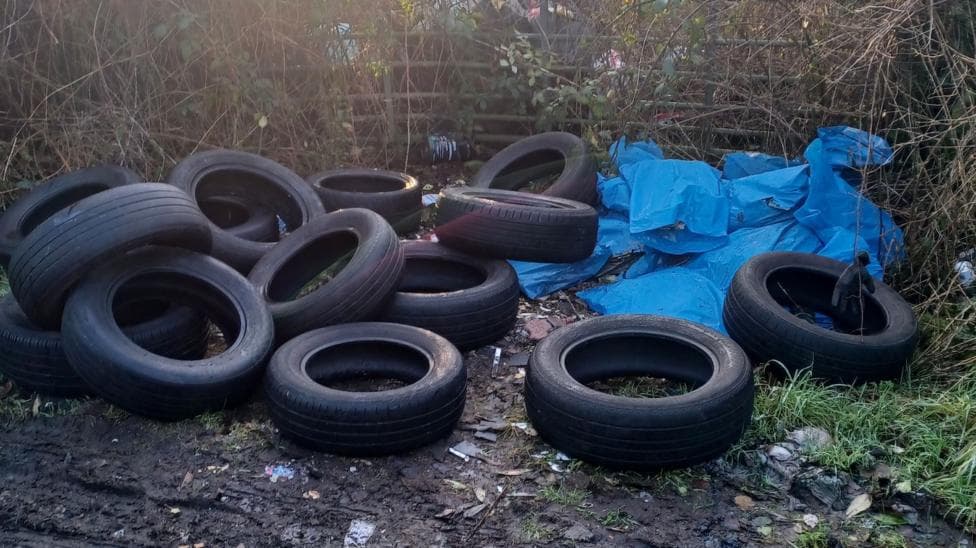
Fly-tippers operating in Cornwall face potential fines of up to £5,000 under a strengthened enforcement campaign launched by the local authority. The crackdown follows the council's identification of 17,500 fly-tipping incidents across the past five years, prompting officials to deploy new surveillance methods and community reporting initiatives to combat the persistent problem.
The council has begun using covert cameras to identify unlicensed waste carriers in the act of illegal dumping. Residents are being encouraged to submit photographic or video evidence of fly-tipping activity they witness, helping authorities build cases against offenders. Property owners and householders who knowingly employ fly-tippers also face financial penalties under the enforcement scheme.
The scale of the problem has intensified recently. According to fly-tipping statistics for Cornwall, the county recorded 3,931 incidents in 2024/25, representing a 27% increase from 3,101 cases the previous year. In 2023/24 alone, clearing fly-tipped waste from public land cost the council more than £450,000.
The council has established a tiered penalty system to address offences of varying severity. According to the council's enforcement guidance, fixed penalties of £500 apply to smaller-scale fly-tipping incidents, while large-scale or potentially hazardous dumping incurs £1,000 penalties, effective from 1 March 2025.
The enforcement strategy is already producing results. On 6 October 2026, Michael Richards, 35, was sentenced after covert camera footage recorded his van being used to dump tyres and roofing tiles in Bugle on two separate occasions. Richards pleaded guilty to allowing controlled waste to be unlawfully deposited from a vehicle under his control and was ordered to pay £2,409 in fines and costs. He claimed another man had rented the van, though the council was unable to trace that individual.
Why is the council taking action?
Officials emphasise that fly-tipping causes serious environmental and community damage. Councillor Thalia Marrington, the council cabinet member responsible for community safety and public protection, stated that illegal dumping harms communities, wildlife, and ecosystems while imposing substantial financial burdens on councils and landowners tasked with cleanup operations.
What is the council's message to residents?
Sarah-Jane Brown, group leader for community protection at Cornwall Council, said:
We work hard to identify those responsible for illegal dumping and will hold offenders to account wherever possible. We're asking people to play their part and work with us to prevent fly-tipping, and to share any information that may help us trace those responsible for dumping rubbish.
The council has made clear there is no justification for fly-tipping and pledges to pursue offenders through available legal channels.
Key Facts
- Cornwall recorded 17,500 fly-tipping incidents over five years, with 3,931 cases in 2024/25 alone—a 27% year-on-year increase
- Fixed penalties range from £500 for minor incidents to £1,000 for large-scale or hazardous dumping, with potential court fines reaching £5,000
- Clearing fly-tipped waste from public land cost the council over £450,000 in 2023/24
- Covert cameras and community reporting are now central to the enforcement strategy
- Householders and property owners who knowingly employ fly-tippers also face financial penalties