

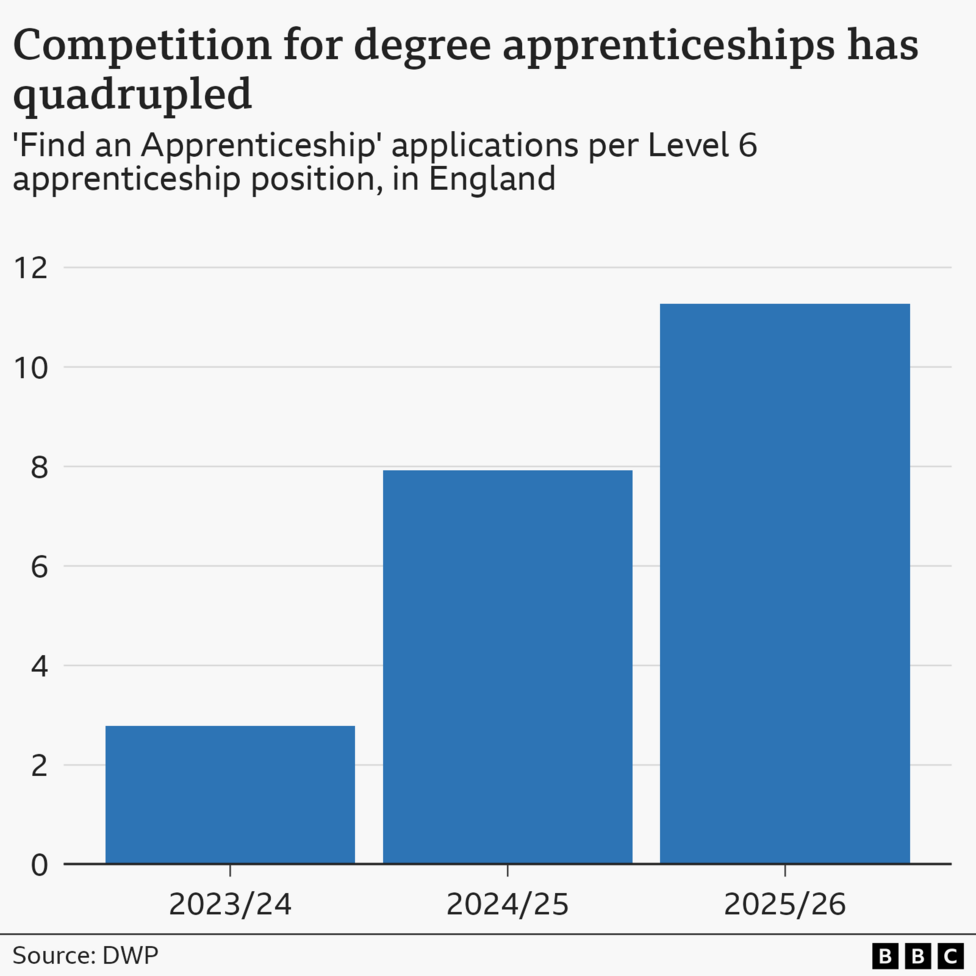
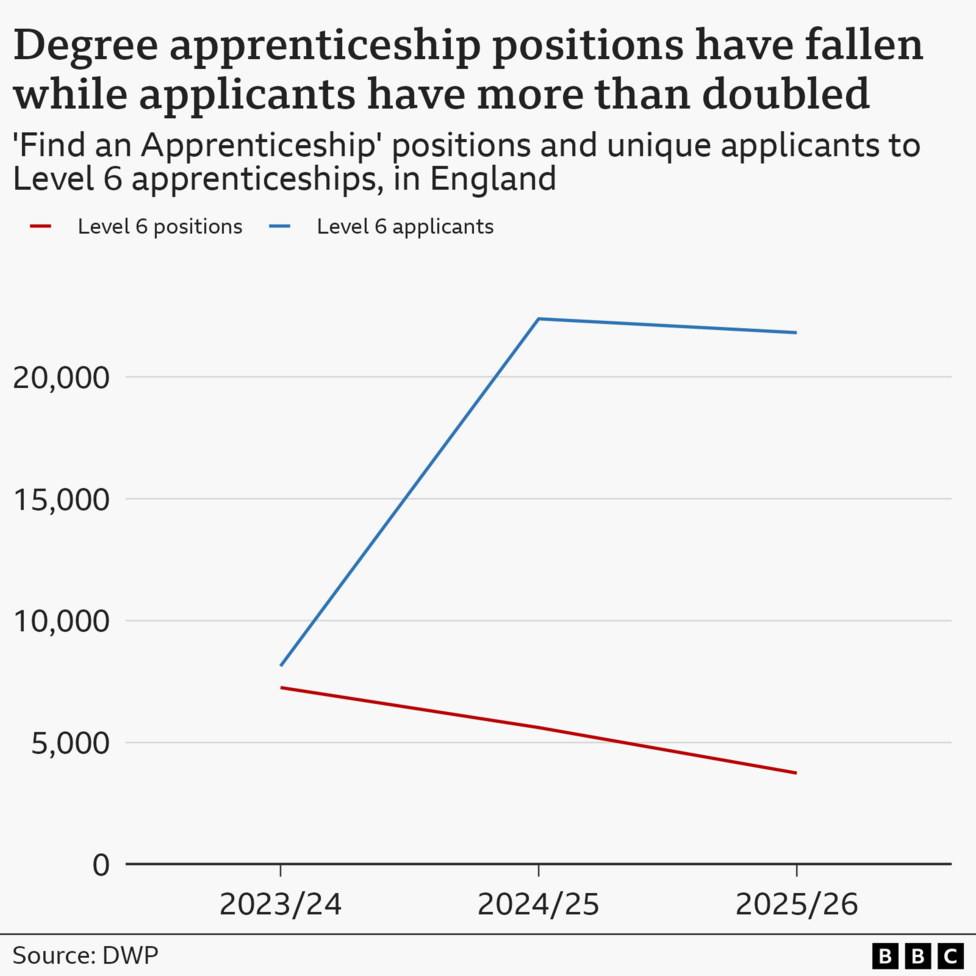
Competition for degree apprenticeships in England has quadrupled over the past three years, according to data obtained by the BBC through Freedom of Information requests. The number of applicants using the government's central Find An Apprenticeship platform nearly tripled, rising from 8,100 to 21,800, while the number of available positions fell by almost half, from 7,300 to 3,700. The squeeze has left many young people applying to university as a fallback option while they chase increasingly scarce apprenticeship places.
What do the new figures show?
The data reveals that competition has intensified sharply across higher-level apprenticeships. There were 11.3 applications for every Level 6 apprenticeship position in the current academic year, up from 2.8 in 2023-24. Across combined Level 4, 5 and 6 apprenticeships - roughly equivalent to the first three years of an undergraduate degree - there have been 10.6 applications per position, compared with 3.6 previously.
The figures only cover apprenticeships listed on the government-run Find An Apprenticeship website, since employers also recruit through their own channels and other platforms. Oliver Sidwell, director of the apprenticeship platform HigherIn, said searches for degree apprenticeships on his service had risen by more than 80% this year, with employer listings growing more slowly than applicant demand.
Why is demand for degree apprenticeships rising?
Interest in degree apprenticeships - which combine a funded university degree with a salary - has grown as the cost of a traditional university education comes under closer scrutiny. Average student debt in England stood at £47,730 in 2026, even as new lower-interest Plan 5 loans began entering repayment, a shift that has prompted wider questions about whether a degree still offers good value, as explored in our earlier coverage of graduate debt levels.
Prime Minister Andy Burnham said last month that he wanted teenagers to have technical routes into careers that could rival a university degree. His remarks came amid growing concern about both the immediate and long-term costs of higher education, with more students opting to commute from home to cut costs and calls mounting for reform of student loan repayment terms.
How are applicants experiencing the process?
Kieran McRae, 22, applied for a degree apprenticeship but was turned down. He went on to study computer science at the University of Birmingham, sharing lectures and labs with apprentices who had secured places on the very programme that rejected him.
"We all went to the same lectures and we had the same labs, the same tutorials," he said.
"[There] was, I think, always a bit of jealousy. Not to say that I wasn't happy for them... but I knew that I was not getting that same free degree or the same salary."

Kieran said he has since made peace with the path he took, particularly because his course offered industry placements - something the University of Birmingham said had become increasingly important to provide given how competitive apprenticeships have become. Still, he added a caveat about what he would choose given the chance again.
"If I was 18 and offered the degree apprenticeship, 100% I would have taken it."
Anna Helder, 18, submitted 35 apprenticeship applications while studying at Hereford Sixth Form College before finally securing a project management role in London, describing her relief as "ecstatic".
"I found it overwhelming the amount of stages that you have to go through," she said.
"You could go two months with zero contact from the company and then suddenly just an email saying: 'You've got an assessment centre next week.'"

Daniel Edwards, 21, applied for 11 apprenticeships before landing an engineering degree apprenticeship, having also applied to university through Ucas as insurance.

"University was more straightforward. It's one personal statement that you put out to all universities," he said.
"Your degree apprenticeship... you've got a cover letter, a CV. It's like applying for a real job. You've really got to convey your passion for that specific company."

What do careers advisers and employers say?
Vicky Orsmond, who advises students at Hereford Sixth Form College, said there was "significant concern" among students about the cost of university, fuelling interest in apprenticeships. She said her students often compete against far more experienced candidates for a limited number of places outside the South East.
"We have lessons where we say to them, 'It's more competitive than many, many university degrees,'" she said.

Employers, meanwhile, point to cost pressures as a barrier to hiring more apprentices. Hannah Larsen, policy officer at the British Chambers of Commerce, said demand for degree apprenticeships was climbing "at a time when businesses' operating margins are under increasing pressure".
"Higher employment costs, alongside wider economic uncertainty, mean recruitment is being paused, with younger and less experienced workers hit hardest," she said.
She added that there remained "considerable uncertainty over the future of apprenticeship funding". At the Yorkshire-based manufacturer Fives, most apprentices train at lower levels through nearby Keighley College, with only one currently on a degree apprenticeship. Jo Jackson, head of human resources, said she would like to take on more but that training costs are high and course content does not always keep pace with industry needs.
"Business needs are changing all the time, but it's very, very difficult to change the syllabus," she said.
"If we think about AI and how it's changing the world of work, the apprenticeships don't cover that. They can't change quickly enough to keep up."
Is the competition equally fierce for everyone?
Stephen Evans, chief executive of the Learning and Work Institute, said the odds are worse for some groups than others, noting that applicants are "less likely to get one if you're from a working-class family". The government has already moved to address some financial barriers: under a scheme reported separately, some parents receiving benefits could get up to £4,500 a year to encourage their children into apprenticeships. A Department for Work and Pensions spokeswoman confirmed a bursary is being introduced for apprentices whose families receive Universal Credit.
On the broader rise in demand, she said the government was continuing to support employers who take on younger apprentices.
"We're backing employers who take on young apprentices, including hiring incentives worth up to £8,000, and making apprenticeship training completely free for businesses for eligible young people aged 16 to 24."
How does this fit into the wider funding and starts picture?
Official statistics show degree-level apprenticeships, covering Levels 6 and 7, accounted for 17.1% of all apprenticeship starts in the 2024/25 academic year, according to the Department for Education's official statistics release. The same figures show degree-level starts rose from 50,110 to 60,350 that year, continuing a run of year-on-year increases in Level 6 starts since 2017/18.
Funding rules are also shifting. Under the 2026 to 2027 apprenticeship funding rules published by the government, employers whose levy funds are insufficient will face a 25% co-investment rate for new apprenticeships starting from 1 August 2026. Separately, a 2025 briefing on funding reforms noted that from 1 January 2026, levy-paying employers no longer receive additional co-investment for most learners aged 22 and over on Level 7 apprenticeships, a change flagged in a legal analysis of the reforms as one that could dampen employer appetite for higher-level routes.
Readers wanting a fuller breakdown of how the apprenticeship system works, including current pay rates that rose to £8 an hour from 1 April 2026, can consult our explainer on apprenticeship levels, pay and applications. Anyone who has recently completed, or is planning to start, an apprenticeship in England is also invited to share their experience with us.
What happens next?
Despite the fierce competition, some degree apprenticeship vacancies remain open for now. A Data Science & AI Degree Apprentice role listed on the government's Find An Apprenticeship service closes for applications on 25 August 2026 and is due to start on 28 September 2026, according to the official listing. A separate Level 5/6 Apprentice Chartered Surveyor degree apprenticeship in Worcestershire has a closing date of 24 August 2026 and a start date of 14 September 2026, per current listings on the same platform.
More broadly, the government's existing funding rules apply to apprenticeship starts up to 31 July 2027, meaning any further policy changes affecting degree apprenticeships would need to be incorporated into the next funding rules cycle covering 2027/28, according to the government's collected funding rules guidance.
Key Facts
- Applications for degree apprenticeships in England rose from 8,100 to 21,800 over three years, while positions fell from 7,300 to 3,700.
- Level 6 apprenticeships now attract 11.3 applications per position, up from 2.8 in 2023-24.
- Degree-level apprenticeship starts (Levels 6 and 7) rose from 50,110 to 60,350 in 2024/25, making up 17.1% of all apprenticeship starts.
- From 1 August 2026, employers with insufficient levy funds face a 25% co-investment rate for new apprenticeship starts.
- A live Data Science & AI degree apprenticeship vacancy closes for applications on 25 August 2026.


