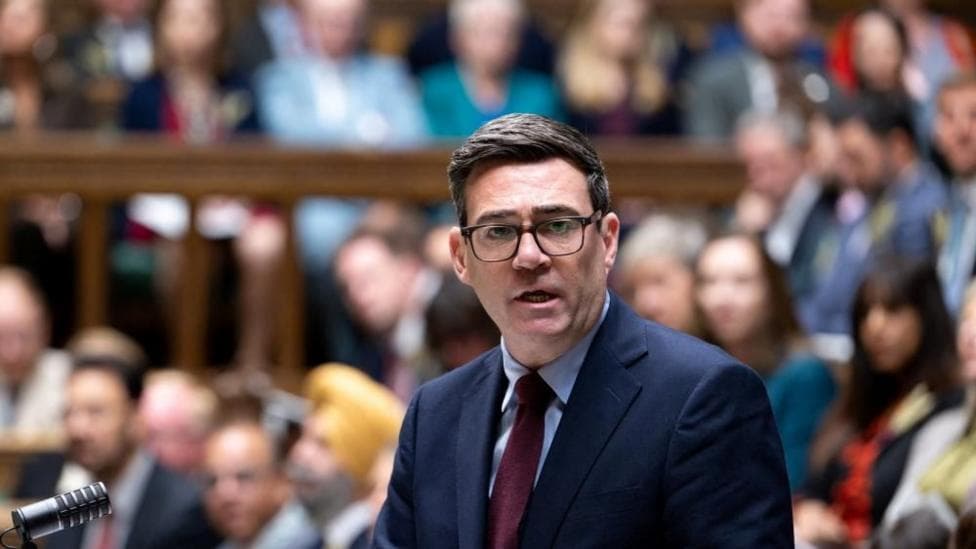
Prime Minister Andy Burnham has drawn repeated criticism from Commons Speaker Sir Lindsay Hoyle for delivering unusually long responses during Prime Minister's Questions, just three months into his tenure. According to BBC News, the Speaker has made multiple appeals for brevity across Burnham's first three PMQs sessions, most recently warning that the chamber risks running out of time to hear from backbench MPs.
Analysis of parliamentary records reveals that Burnham does indeed speak considerably longer than his recent predecessors. Over his first three PMQs appearances, the Prime Minister has averaged 22 minutes of speaking time per session—between three and six minutes more than the average for Sir Keir Starmer, Rishi Sunak, Liz Truss and Boris Johnson across comparable autumn sessions.
The disparity becomes even more pronounced when examining individual answer lengths. Burnham averages 51 seconds per response, compared to 33 seconds for Truss, 35 seconds for Johnson, 38 seconds for Starmer and 39 seconds for Sunak. This means Burnham speaks roughly a third longer than Starmer and Sunak on each question, and up to 50 percent longer than Truss.
Sir Lindsay's frustration emerged during Burnham's inaugural PMQs session.
Can I just say I admire the prime minister? At least he's answering detailed questions. My problem is I'm not going to get through the list, and both of us will be in trouble with the backbenches when we don't make it.The Speaker reiterated his concern in subsequent weeks, stating:
We really are going to have to try and speed up some of the answers.
The weekly PMQs session is scheduled for 30 minutes each Wednesday when Parliament is sitting, yet routinely extends 10 to 20 minutes beyond that timeframe. This overrun limits the number of backbench questions that can be addressed, creating scheduling pressures for both the Speaker and opposition frontbenchers.
Burnham's approach represents a departure from Westminster convention. His first PMQs revealed tensions between his promise of a new political style and Westminster's adversarial traditions, as he engaged in substantive exchanges with Conservative leader Kemi Badenoch over tax, borrowing and economic policy.
Number 10 has offered a straightforward explanation for the extended responses. A senior source from the Prime Minister's office told BBC News:
It's because he actually answers the questions.This characterisation suggests the administration views detailed answers as a deliberate policy choice rather than a procedural problem.
A spokesman for the Speaker responded to the controversy by reiterating institutional priorities:
The speaker is always keen to get in as many backbenchers as possible for any question session.
Has the issue persisted?
The tension has not resolved. At PMQs on 14 October, Lindsay Hoyle again warned that the Commons risked running out of time and urged Burnham to speed up his answers. That session covered benefits, Russian interference claims about the 2016 Brexit referendum, North Sea oil and gas decisions, and Manchester City's Premier League charges, with Burnham pledging to bring down the welfare bill. The 14 October PMQs included 26 questions, demonstrating the volume of backbench business competing for time.
What comes next?
The next scheduled PMQs is Wednesday 21 October at noon, where the pattern may well repeat unless the Prime Minister adjusts his approach to questioning.

Burnham's extended answers stand in contrast to his predecessors' more concise parliamentary style. The quantity of words spoken is straightforward to measure, though the quality and substance of those responses remains a matter of political interpretation. His administration's defence—that longer answers reflect genuine engagement with questions—highlights a fundamental tension between Westminster's time constraints and the desire for substantive parliamentary debate.