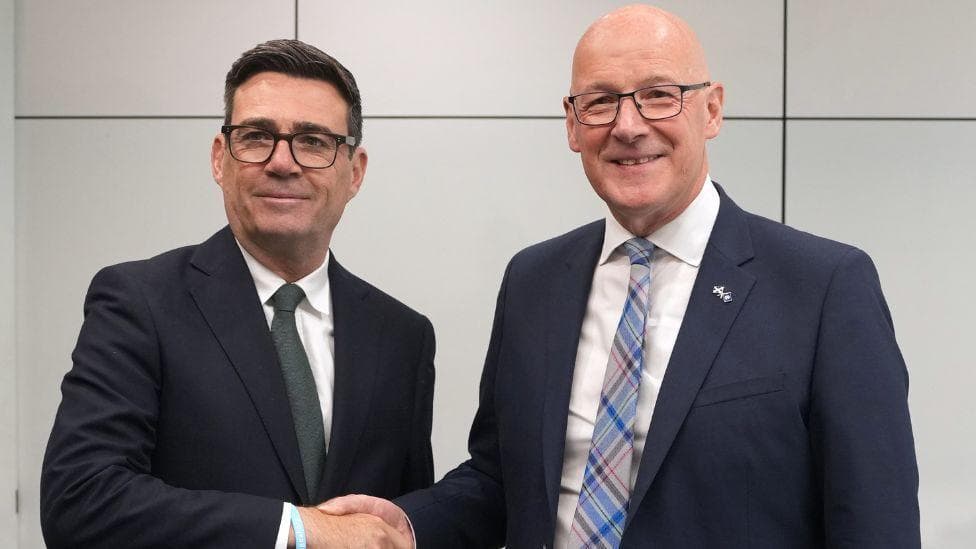
Prime Minister Andy Burnham has declared that Labour will not form a partnership with the Green Party while it maintains a policy defining Zionism as a form of racism. Speaking in the House of Commons on 14 October, Burnham described the motion—passed at the Green Party conference earlier that month—as "wrong" and "antisemitic," stating that Labour would have "nothing to do with it."
The contested motion characterised Zionism as an ideology supporting "an ethnonationalist Jewish state in historic Palestine to the exclusion and/or domination of the non-Jewish population." The policy has drawn sharp criticism from Jewish organisations, four of the five Green MPs, and two former party leaders, with one describing it as "dangerous" and "divisive."
The motion was adopted after members voted 1,022 to 813 in favour—a narrow margin representing just 0.4% of the party's 230,000-strong membership. According to the Green Party's official statement, the party also backs the Boycott, Divestment and Sanctions movement, a full arms embargo on Israel, and a single democratic state throughout historic Palestine.
Green Party leader Zack Polanski has characterised the motion as "imperfect" and indicated he had sought amendments. However, he has defended its core argument, asserting that "the displacement and genocide of the Palestinian people is clearly underpinned by racist ideology" was "obvious." Israel has repeatedly denied that its military operations in Gaza constitute genocide. According to reporting on the conference proceedings, two amendments Polanski favoured were rejected, and he did not participate in the debate or vote.
The issue came to the fore during Prime Minister's Questions when Conservative MP Dame Harriett Baldwin pressed Burnham to "rule out co-operating" with the Greens. Burnham responded with an unequivocal condemnation:
Can I condemn the motion that was passed unequivocally. It is wrong, it is antisemitic, and this side of the House will have nothing to do with it. We will always take the right response when it comes to any partnerships we have with other parties. We cannot support a partnership with a party that holds the position that has recently been adopted.
Burnham's 14 October statement marked a hardening of Labour's position. Earlier, on 8 October, Burnham had urged Green leaders to reverse the policy but had stopped short of ruling out a coalition entirely.
Labour currently maintains coalitions with the Green Party on several local councils, including Sheffield. A Downing Street spokesman declined to clarify whether the prime minister's position applies only to national government or extends to local arrangements.
International response and party divisions
The adoption of the motion has prompted international scrutiny. According to reports on the European Green Party's response, the continental federation said it would distance itself from the motion and seek clarity from the English and Welsh party's leadership on protections for Jewish people and self-determination. The European body said it would "immediately demand clarity" from the party's leadership, though no deadline was specified.
Israel's foreign ministry has taken its own action, barring Polanski from entering the country in response to the motion's adoption.
The vote has exposed significant divisions within the Green Party. Four of the five Green MPs opposed the motion, and several party figures have called for changes to the party's internal rules. MP Ellie Chowns stated that "if we have policy, such significant and damaging policy, made by a vote of just 0.4% of our members, that something isn't working in our structures and our policy-making process."
More than a dozen Labour MPs have referred the Green Party to the Equality and Human Rights Commission, with nine also requesting that Sussex Police investigate alleged antisemitic offences at the conference.
Defence and context
Lubna Speitan, a key backer of the motion, has defended it as aimed at opposing "racist systems of oppression," stating: "We stand united against all forms of racism and discrimination - no exemptions."
The Green Party received 6% of the vote in the 2024 general election and has polled at around 10% support in recent surveys, making it a potentially significant political force in future negotiations.
Although the motion has become official party policy following the member vote, it will not necessarily appear in the party's manifesto for the next general election. The controversy underscores the tension between the party's expanded membership base and its parliamentary representatives, with the latter largely opposing the position their members have endorsed.