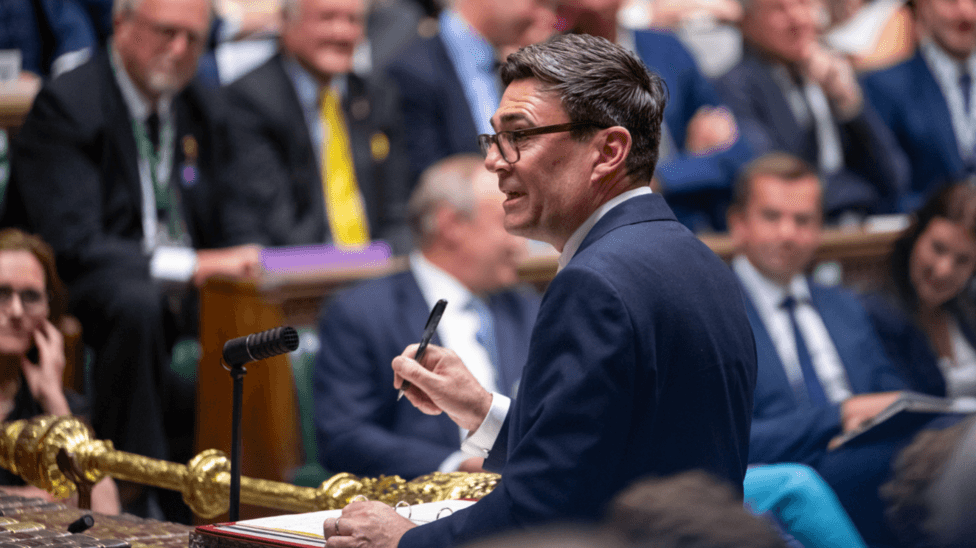
Andy Burnham has committed to establishing plans for enhanced public oversight of essential services during his first address to the House of Commons since becoming prime minister. The new leader told MPs that "a series of wrong turns" beginning in the 1980s had transferred economic power into private hands, citing the water industry as emblematic of this shift—describing it as "a leaking monument to that approach - a country run in the private rather than public interest".
Burnham reiterated his conviction that political authority had become overly concentrated at Westminster and signalled his intention to extend devolution powers to additional regions across England. He indicated that detailed proposals for achieving greater public control would emerge "later in the year", following months of discussion about potential solutions for the water sector and other utilities.
The prime minister took office on 20 July following Parliament's summer recess, and Tuesday's session marked both the opening of the new parliamentary term and his maiden opportunity to present his agenda to the chamber and respond to opposition questioning.
What is Burnham's diagnosis of Britain's problems?
Burnham told the House of Commons that "Britain is not where we would wish it to be", yet expressed determination to "build a new sense of optimism around the country". After a decade away from Parliament, he presented what he characterised as a "clear diagnosis" of the nation's difficulties.
From the 1980s, this country took a series of wrong turns. Political power was centralised, economic power privatised, the country deindustrialised, austerity followed, hollowing out councils and depriving them of the agency to act to reverse any of this. And then Brexit compounded the damage, ushering in a decade of low growth and stalled regeneration.
This assessment formed the foundation for his argument that reversing these trends requires both returning authority to local areas and reasserting public ownership or control over critical infrastructure.
How does Burnham plan to expand devolution?
Burnham's devolution strategy draws on his experience as Greater Manchester mayor, which he credits with demonstrating that transferring powers to regions outside London stimulates economic development. He stated his ambition for "every single place across our regions and nations to be able to do the same, creating the conditions for good growth in every postcode".
Concerns have emerged from some MPs that areas without elected mayors—and the accompanying powers—could face disadvantage, potentially creating a two-tier system. Cornwall's efforts to secure a devolution deal have stalled partly because the county has resisted forming a combined authority with Devon and establishing a mayor. Burnham appeared to acknowledge these concerns, pledging that his government would collaborate with Cornwall Council and its six MPs on a devolution arrangement "with or without an elected mayor". He extended this flexibility to all parts of England lacking devolved powers.
Beyond England, Burnham indicated interest in developing "a local model of devolution" tailored to Scotland, Wales and Northern Ireland.
The devolution agenda has expanded significantly since Burnham's initial parliamentary address. According to reporting on the government's economic strategy, Burnham announced that regional mayors will retain a substantially larger proportion of income and business tax revenue generated within their areas, characterising this as the "biggest transfer of power, funding and responsibility from Westminster in a generation".

What is No 10 North?
Burnham has established a significant institutional framework to support his devolution agenda through the creation of No 10 North, a Manchester-based government office launched on 23 July 2026. According to a national broadcaster's report, the office operates from Heron House in central Manchester, with a new dedicated government facility in Ancoats under construction and expected to open in 2032.
When addressing civil servants at the Manchester office, Burnham declared that
power is going to flow, energy is going to flow, new ideas are going to come through. A subsequent report from August 2026 indicated that the Manchester-based unit operates under the supervision of senior minister Louise Haigh and has been tasked with serving as the UK economy's "dominant driver". The concept was first outlined by Burnham in a speech on 29 June 2026, when he explained that the office would facilitate economic growth across all regions and redistribute authority away from Downing Street.
What is the Conservative response?
Conservative leader Kemi Badenoch mounted a forceful critique of Burnham's agenda, accusing him of proposing "more government control, more taxes and more politicians". She challenged his fundamental economic theory, stating:
His diagnosis is completely wrong, his theory of growth is completely wrong, he thinks that if government spends more money, we will all get richer - that is not how this works.
Badenoch also cautioned that Burnham's new position would prove "very different" from his previous role as Greater Manchester mayor, where he "did not have to make difficult trade-offs" at the national level. She pressed him on defence spending, to which Burnham responded that he had deliberately appointed John Healey as chancellor specifically because of Healey's "commitment to defence". Healey had resigned as defence secretary earlier in the year, criticising then-prime minister Sir Keir Starmer for failing to allocate sufficient resources to national security.
What other policy areas did Burnham address?
During his three-and-a-half-hour statement, Burnham outlined positions on several additional policy domains. On welfare, he suggested that expanding council housing and thereby reducing rental costs for more households would represent the "Labour way" of lowering the benefits bill. He also committed to introducing legislation enabling homeowners to transition more readily from leasehold to commonhold ownership arrangements.
Liberal Democrat leader Sir Ed Davey used his question time to contend that excessive power in the UK remained concentrated "in the wrong hands" and called for "fundamental change" to the political system. Burnham indicated willingness to examine the voting system but ruled out implementing any modifications before the next general election.
What happened to Sir Keir Starmer?
Shortly before Burnham's parliamentary address, Sir Keir Starmer announced unexpectedly that he would be stepping down as an MP, less than two months after resigning as prime minister. Burnham opened his speech by honouring his predecessor, telling the House of Commons that Sir Keir had "given this country a lifetime of public service" and established a "platform to change this country for the better".
What comes next?
Parliament is scheduled to reconvene for Urgent Questions or Ministerial Statements at 15:30 on 1 September 2026, with the first Prime Minister's Questions following the summer break due on Wednesday, 2 September 2026. These sessions will provide further opportunity for scrutiny of Burnham's agenda and his responses to opposition and backbench concerns.
Burnham's detailed proposals for public control of essential services remain forthcoming, with the prime minister indicating these will be unveiled later in 2026. The government's broader devolution framework, supported by the Manchester-based No 10 North operation, will shape how these commitments are implemented across the regions.

Key Facts
- Burnham became prime minister on 20 July 2026 and addressed Parliament for the first time on Tuesday following the summer recess
- He promised plans for stronger public control of essential services, particularly water and energy, to be published later in the year
- The government will extend devolution powers to all parts of England, with flexibility for areas that do not wish to establish elected mayors
- No 10 North, a Manchester-based government office, was launched on 23 July 2026 to oversee regional economic growth and devolution policy
- Regional mayors will retain a significantly larger share of income and business tax revenue from their areas under the new devolution framework