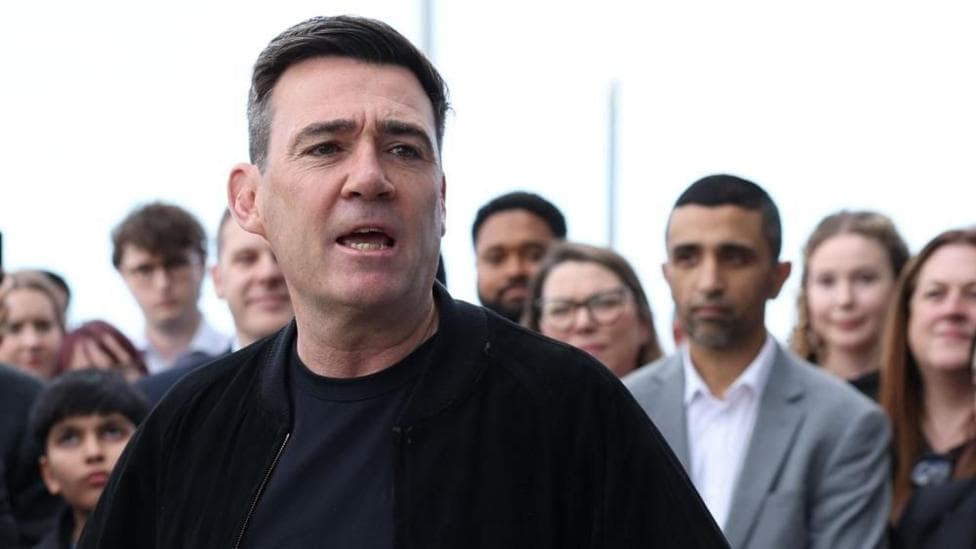
Prime Minister Andy Burnham is unveiling a new initiative designed to assist young people in purchasing their first home, addressing what he describes as a widespread struggle with housing affordability.
The "Your First Home" scheme will be available to first-time buyers across England who can provide a deposit of 2.5%. Under the programme, eligible purchasers will receive an equity loan equivalent to 20% of their new build property's value, bridging the gap between their deposit and the full purchase price.
Burnham highlighted that the scheme targets those without family financial support, often referred to as lacking access to the "bank of mum and dad." According to reporting on the announcement, the programme is specifically designed for buyers with regular income who can manage mortgage payments but struggle to accumulate a substantial deposit without family assistance.
Burnham stated:
"Too many young people are struggling with the cost of housing, with many giving up hope of ever having a home to call their own. So we will step in to help more first-time buyers onto the housing ladder."
The Prime Minister further expressed confidence that the scheme will encourage builders to construct the "high-quality new homes the country needs," potentially boosting residential development across the nation.
How will the scheme be funded and structured?
Funding for the initiative will come from reprioritising existing government budgets, with housing developers contributing fees to cover operational expenses. Developers will pay a fee linked to property values to help sustain the programme's running costs. Labour has confirmed there will be an initial interest-free period for the equity loan, though the exact duration and other specific terms remain to be confirmed.
Household income caps and a deposit cap will be used to target the scheme at lower- and middle-income buyers, with price caps expected to limit participation to "modest houses" rather than high-value properties.

What eligibility criteria will apply?
Ministers have not yet publicly confirmed whether an age restriction will be imposed on applicants, nor have they specified a maximum property value threshold. However, the targeting mechanisms suggest the scheme will focus on affordable segments of the housing market rather than premium properties.
The announcement represents part of a broader housing agenda under Burnham's leadership. Earlier this year, the government outlined plans to build 70,000 social and affordable homes in the first phase of a £39bn programme, with initial development concentrated in regions including Greater Manchester, the West Midlands, and London. Additionally, Burnham has pledged to end rough sleeping as a priority, backed by £340m for homes and support.
How does this compare to previous schemes?
The "Your First Home" scheme draws inspiration from earlier government interventions in the housing market. The coalition government introduced Help to Buy in 2013 under then-Chancellor George Osborne, which itself expanded an earlier initiative called FirstBuy that focused exclusively on first-time purchasers.
Help to Buy initially allowed all buyers to place a 5% deposit on newly constructed homes, with the government providing a shared equity loan covering up to 20% of the property cost. Crucially, this loan carried no interest for the first five years, providing borrowers with an initial period of reduced financial pressure before interest accrual began.
The new scheme operates on similar principles but with a lower initial deposit requirement of 2.5% rather than 5%, potentially making homeownership more accessible to those with limited savings.
What happens next?
Full details of the scheme are expected to be unveiled in next month's Budget, with Housing Secretary John Healey set to announce the programme. Pre-registration for eligible buyers is scheduled to open before the end of 2026, allowing prospective purchasers to express interest and prepare for participation once the scheme becomes fully operational.
Burnham made the announcement as he arrived in Liverpool for his first Labour Party conference since becoming prime minister, signalling housing affordability as a central priority for his administration.