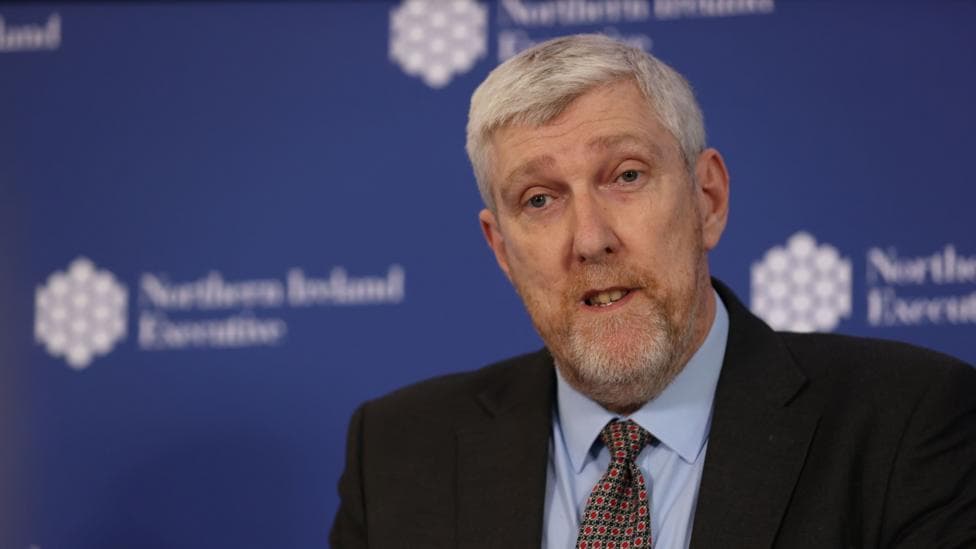
Finance Minister John O'Dowd has signalled that a critical moment is approaching in Northern Ireland's prolonged budget dispute, as executive parties prepare for fresh negotiations with the Northern Ireland secretary. According to BBC News, the parties are scheduled to meet Sir Chris Bryant on Thursday in a renewed effort to resolve the deadlock. Seven months into the financial year, the Northern Ireland Executive remains without an agreed budget, a situation that threatens public services and pay settlements for thousands of workers.
The impasse centres on funding adequacy. Stormont ministers contend that the UK's devolution funding formula no longer provides sufficient resources to balance their accounts. Although the government has offered an additional £525m this year, executive parties argue this leaves substantial shortfalls, particularly in meeting public sector pay commitments. O'Dowd has emphasised the need to avoid industrial action in the health sector and indicated he will present options to ministerial colleagues in the coming days.
The budget crisis has deepened over months of unsuccessful talks. On 3 November, Agriculture Minister Andrew Muir characterised the situation as "make your mind up time", urging the executive to reach a final decision within days rather than weeks or months. The government has already rejected a request to allow a larger portion of its three-year funding offer to be spent in the current year, a practice known as "front-loading".
What financial pressures are driving the dispute?
The underlying cause of the budget crisis is a structural mismatch between Stormont's spending obligations and available resources. The Executive's forecast overspend in 2025–26 was £467.6 million, primarily driven by public-sector pay awards. The Department of Education faces a projected deficit of £143 million and has instructed schools to reduce non-essential spending. More broadly, a spending watchdog has estimated that Stormont departments face a funding shortfall of up to £1.6 billion.
Individual departments are operating under severe constraints. In Assembly proceedings on 3 November, a minister disclosed that their department was projected to spend between £600 million and £800 million more than its allocated budget. These figures underscore the scale of the financial crisis confronting the executive and explain why parties have rejected earlier budget proposals as inadequate.
What happens if no budget is agreed?
The absence of an agreed budget forces departments to operate under emergency spending restrictions, limited to 95 per cent of the previous year's allocation. Officials have warned that funds could be exhausted by January under this arrangement. Additionally, the secretary of state has stated that a cost-of-living payment of £100 cannot be distributed to Northern Ireland households until an executive budget is finalised.
The government has signalled it is preparing contingency measures. Sir Chris Bryant has indicated he is exploring options to allow him to pass a budget bill at Westminster if negotiations at Stormont fail to produce an agreement. This prospect underscores the urgency of reaching a settlement and the government's determination to ensure public services continue to function.
What have executive ministers said about progress?
Deputy First Minister Emma Little-Pengelly has characterised recent discussions as "constructive" and noted that the executive's position has improved since O'Dowd published a draft budget for consideration in January. She acknowledged that the DUP rejected that earlier proposal, recognising it would have severely damaged public services, but stressed that a significant gap remains, particularly regarding public sector pay. Little-Pengelly emphasised that while the executive is committed to service transformation, such changes require time to implement properly.
Andrew Muir has taken a more urgent tone, stressing that resolution must come swiftly. He has called for the executive to move beyond extended deliberation and reach a binding conclusion that provides certainty to workers deserving proper compensation and to the public expecting investment in essential services. His comments reflect growing impatience among parties with the prolonged stalemate.
O'Dowd has stressed the importance of maintaining ministerial focus on the task at hand and has explicitly stated his desire to prevent industrial action in the health sector, a prospect that has loomed as negotiations have dragged on.
What is the broader context?
The budget crisis must be understood against the backdrop of earlier failed negotiations. The Northern Ireland Executive called an urgent meeting in early October as the budget stalemate entered its seventh month, with the UK government's £1.5bn offer having been rejected as insufficient. The government subsequently declined to increase its £1.5bn financial offer despite party demands for additional funding, setting the stage for the current round of talks.
The government's most recent budget announcement has provided some additional resources. Northern Ireland received an extra £270m for public services as a result of the Westminster budget announced last week, of which £131m can be deployed this year. However, parties have indicated this remains insufficient to close the funding gap.
What happens next?
Party delegations are scheduled to meet Sir Chris Bryant at Hillsborough Castle on Thursday, 5 November. The discussions are expected to include one-to-one meetings with representatives from each of the four executive parties. Senior civil servants from each Stormont department have also been invited to participate in the talks, suggesting the government intends to examine departmental spending pressures in detail.
The outcome of these negotiations will determine whether the executive can reach agreement on a budget before funds run out or whether the secretary of state must resort to contingency measures at Westminster. The timeline for resolution remains compressed, with ministers and officials alike emphasising that decisions must be made within days rather than weeks.