

UN Plans Evacuation of Stranded Sailors in Gulf
The United Nations' International Maritime Organization (IMO) announced plans to evacuate over 11,000 sailors stranded in the Gulf region due to the ongoing conflict involving the US, Israel, and Iran.
IMO Secretary-General Arsenio Dominguez described the operation as a "large-scale operation" that will be conducted in coordination with Iran, Oman, the United States, other coastal states in the area, and the maritime industry.
"We have secured the necessary safety guarantees and have thoroughly verified the conditions for safe navigation to support these operations," Dominguez stated.
Interim Deal and Ongoing Disputes
An interim agreement was signed last week aimed at ending the conflict, yet the US and Iran continue to dispute specifics of the Memorandum of Understanding (MoU).
The United States has asserted that the MoU includes provisions for inspections of Iran's nuclear weapons program by the International Atomic Energy Agency (IAEA).
US President Donald Trump posted on social media on Tuesday:
"Iran has fully and completely agreed to highest level Nuclear inspections long into the future (Infinity!!!). This will insure 'Nuclear Honesty.'"
Earlier on the same day, Iran stated that the UN watchdog would be unable to inspect nuclear sites that were bombed by the US and Israel last year.
In response, a US official remarked:
"The Iranians have agreed to robust IAEA inspections of the remains of their nuclear weapons programme. The Iranian regime will say what they have to say for their domestic audience."
During a visit to Pakistan on Tuesday, Iran's President Masoud Pezeshkian declared that Iran:
"will never negotiate with anyone, under any circumstances, ever, about our defensive capabilities".
US Secretary of State's Gulf Tour and Strait of Hormuz Tolls Warning
US Secretary of State Marco Rubio commenced a tour of the Gulf region on Tuesday, starting in the United Arab Emirates (UAE), with planned visits to Kuwait and Bahrain—both hosting US military bases—to discuss the deal with Tehran.
Rubio cautioned that no nation is permitted to impose tolls on the Strait of Hormuz, where Iran has sought to levy charges on passing ships.

"It's an international waterway. No country is allowed to charge tolls or fees on an international waterway. That's existing international law," Rubio said upon arrival in the UAE.
"I don't think we have anybody to convince around here in that regard. I think all the countries in this region would agree with us."
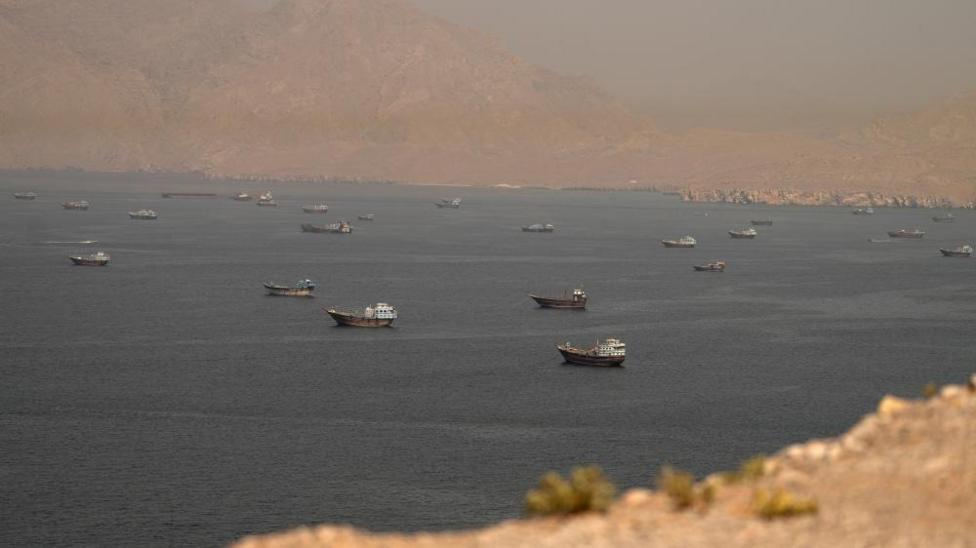
Importance of Strait of Hormuz Remaining Open for Evacuation
The evacuation of stranded sailors depends on the Strait of Hormuz remaining accessible.
IMO Secretary-General Dominguez emphasized that the agreement to facilitate the evacuation represents "a decisive step towards restoring maritime security and bringing to an end the unacceptable attacks against civilian shipping."
"After months of hardship and distress for thousands of innocent seafarers, and negative impact on the whole world, I welcome with deep satisfaction the peace agreement concluded between the United States and Iran," he said.
As part of the IMO's evacuation strategy, two temporary routes through the strait may be utilized, with vessels being contacted individually for further instructions, according to Oman's notice to mariners provided by the IMO.
The IMO also announced it would publish daily reports detailing the number of ships departing the region safely.
Impact of Strait Closure and Current Maritime Traffic
Following the initiation of attacks against Iran on February 28, the country effectively closed the Strait of Hormuz, leading to a surge in global oil prices beyond $100 (£75) per barrel of Brent crude oil.
The closure also disrupted shipments of energy and essential commodities such as fertilizer.
Since reopening, at least 172 vessels have transited the Strait of Hormuz, including 42 ships on Saturday alone, according to data from maritime intelligence firm Kpler.
However, the number of vessels passing through since June 18, the day after the agreement was signed, remains significantly below the pre-conflict average of approximately 138 crossings per day.
Ship-tracking data analyzed by BBC Verify indicates that more than 200 tankers were reportedly waiting inside the strait on Tuesday.


