
US presidential envoy Jared Kushner arrived in Israel on 17 August 2026 and is due to meet Israeli Prime Minister Benjamin Netanyahu, following a rare face-to-face round of talks with Hamas over the implementation of Washington's Gaza peace framework. The visit comes days after Israel formally rejected the 15-point plan put forward by President Donald Trump's Board of Peace, a decision that has drawn condemnation from several Muslim-majority nations.
Last month the Board of Peace announced it had secured agreement on the "complete disarmament" of Hamas and other armed factions in Gaza. That framework also calls for a phased Israeli military withdrawal and the creation of a new civilian Palestinian administration to oversee reconstruction. Netanyahu, however, has insisted that disarmament must come first before any Israeli pullback proceeds.
What was discussed during the Egypt meeting?
According to a Palestinian official who spoke to the broadcaster, Kushner met a Hamas delegation led by the group's newly named overall leader, Khalil al-Hayya, in Egypt on 16 August 2026. Board of Peace envoys Nickolay Mladenov and former UK Prime Minister Tony Blair reportedly joined the session, alongside representatives from Egypt, Qatar and Turkey, all of which have played mediating roles in the conflict.
It is described as the most senior direct engagement between Kushner and Hamas since the ceasefire agreement took effect last October. According to a report from NPR, discussions centred on the mechanics of how Hamas would surrender its weapons and how Israel would then begin its own phased withdrawal. The same report indicates the emerging plan would transfer Hamas's arsenal to a Palestinian technocratic committee tasked with running day-to-day administration in Gaza once fighting winds down.
Separately, reported that Trump's envoys were holding these talks with regional mediators even as Israeli strikes on Gaza continued, meaning the diplomatic push and active military operations were unfolding side by side. has also reported the broader roadmap envisions deploying an International Stabilization Force together with a newly formed Palestinian police unit to help secure Gaza once military operations cease, according to the same account. That same outlet has separately noted the framework is designed to progress only in verified stages, with each step contingent on confirmation that earlier commitments were fulfilled, according to a separate report.
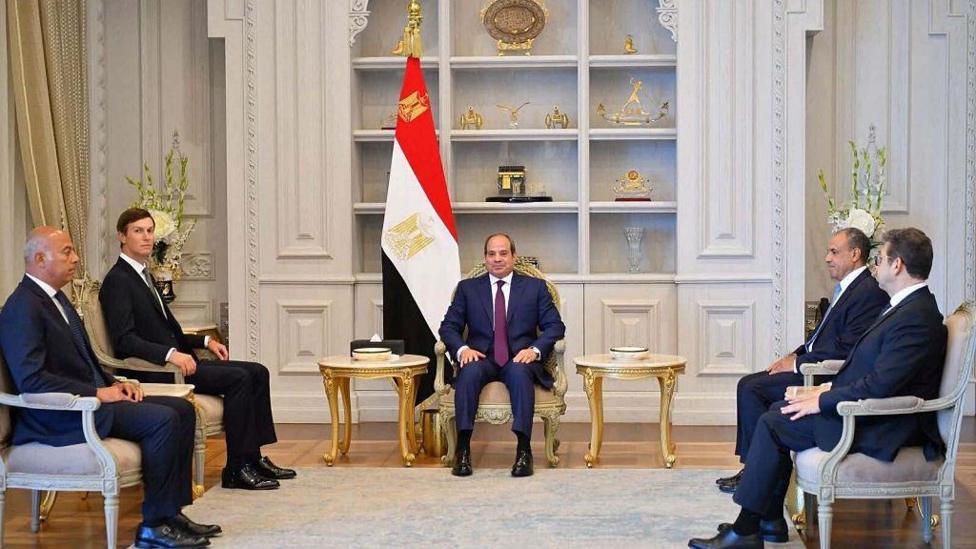
While in Cairo, Kushner also held talks with Egyptian President Abdel Fattah al-Sisi.
Why did Israel reject the 15-point plan?
Netanyahu has made clear he will not move forward with troop withdrawals until Hamas gives up its weapons in full. Last week he said:
Israel rejects the Board of Peace's 15-point document on Gaza. The IDF will not carry out any withdrawal until Hamas is genuinely disarmed.
With a general election set for October, Netanyahu is facing internal pressure from members of his own cabinet to keep military operations running in Gaza. Earlier this month, far-right National Security Minister Itamar Ben Gvir dismissed the draft plan as unacceptable. In a podcast interview broadcast on 15 August 2026 with Rom Braslavski, a former hostage held by Hamas after the 7 October attack, Ben Gvir was asked about scaling back operations in Gaza and responded:
It's no secret, I disagree with the prime minister.
He went on to argue in favour of intensified strikes, saying:
Targeted assassinations, taking down 30 to 40 every night. Not just those who pose an immediate threat – there are people there who are not worthy of life. They shouldn't live. They're not even people.
Those remarks, first carried by the Associated Press, were also reported by the Financial Times and the Times of Israel.
What is Hamas's position on the deal?
Hamas has signalled it will not move ahead with disarmament unless Israel first meets its side of the bargain. According to Al Jazeera, Hamas negotiator Ghazi Hamad said the group would not implement the agreement unless Israel halted its attacks and withdrew its forces from Gaza. The full text of the roadmap, which sets a time-bound process for decommissioning weapons and tunnels under a new Gaza administration, was published on 31 July 2026 by the Times of Israel. That version links any Israeli withdrawal to the disarming of all Gaza militias, not only Hamas, and calls specifically for the decommissioning of heavy weapons, weapons depots, production sites and tunnels, according to a separate report.
What has happened since the ceasefire took effect?
Eight predominantly Muslim countries — Egypt, the UAE, Qatar, Saudi Arabia, Jordan, Turkey, Pakistan and Indonesia — issued a joint statement on 16 August 2026 condemning Israel's rejection of the US-backed plan, warning it threatened Trump's broader peace efforts.
The ceasefire itself came into force on 10 October last year and technically remains in place, though the Israel Defense Forces have carried out near-daily strikes since then. More than 1,200 people have been killed in Gaza since the truce began, according to the Hamas-run Health Ministry, whose figures are considered reliable by the United Nations. UNICEF says at least 300 children are among those killed.
There was a brief lull in Israeli attacks — reportedly at Washington's request — even after Netanyahu's government rejected the 15-point plan, but strikes have since resumed. On 16 August 2026 the Israeli military said it had targeted Hamas and Islamic Jihad fighters in Khan Younis and Nuseirat; local medics said several people in a nearby tent camp were injured. Israel and Hamas continue to accuse each other of violating the ceasefire's terms.
How did the war begin?
The conflict was triggered by the Hamas-led assault on southern Israel on 7 October 2023, in which about 1,200 people were killed and 251 taken hostage. Israel's subsequent military campaign in Gaza has killed more than 73,000 people, including 21,280 children, according to the territory's health ministry — figures the UN also regards as reliable. The UN estimates roughly 1.9 million people, or 90% of Gaza's population, have been displaced since the war began.
What happens next?
Kushner's arrival in Israel had been expected for several days. According to , he was due to travel to Israel this week for talks with Netanyahu and other senior officials aimed at advancing the Gaza plan. Axios has reported that Kushner is expected to meet Netanyahu alongside Nickolay Mladenov as part of efforts to push the next phase of the roadmap forward, according to Axios. Bloomberg has similarly reported that the trip is intended to focus on implementation issues, including Hamas's disarmament and the timeline for an Israeli military withdrawal, according to Bloomberg.
Key Facts
- Jared Kushner met a Hamas delegation led by Khalil al-Hayya in Egypt on 16 August 2026, the first senior-level contact of its kind since the October ceasefire.
- Israel formally rejected the Board of Peace's 15-point Gaza plan last week; eight Muslim-majority nations condemned the move in a joint statement.
- More than 1,200 people have been killed in Gaza since the ceasefire began on 10 October, according to Gaza's Health Ministry.
- The reported roadmap includes an International Stabilization Force and a new Palestinian police force to help secure Gaza after fighting ends.
- Kushner is expected to meet Netanyahu and Nickolay Mladenov in Israel this week to discuss next steps on disarmament and withdrawal.


