

Nobel Peace Prize laureate Dmitry Muratov, the former chief editor of the shuttered Russian newspaper Novaya Gazeta, says President Vladimir Putin cannot claim any form of victory from the war in Ukraine, regardless of how the conflict eventually concludes. Speaking from the newspaper's now-silent Moscow offices, Muratov also warned that continued escalation could ultimately lead toward the use of nuclear weapons. He said the outlet he co-founded more than three decades ago effectively no longer exists after Russian authorities nationalised its printing presses and stripped its registration.
There is no newspaper anymore,
Muratov told an interviewer inside the paper's empty corridors.
Muratov co-founded Novaya Gazeta more than thirty years ago, and it grew into one of Russia's most prominent outlets for independent, hard-hitting journalism, regularly exposing human rights abuses and high-level corruption. In 2021 he was named joint winner of the Nobel Peace Prize for his work "to safeguard freedom of expression." The Nobel Committee highlighted that six of the paper's journalists had been killed, among them Anna Politkovskaya, who was known for her reporting on the war in Chechnya. The recognition, however, did nothing to shield the publication from the state.
Putin issued a decree and the newspaper's printing presses were nationalised. Its registration was revoked.
Novaya Gazeta still maintains a limited online presence, but its website has been blocked within Russia and can now only be reached from abroad or through virtual private networks that bypass state restrictions.
How has Russia's crackdown on dissent widened since 2022?
Muratov says the paper's collapse mirrors a much broader suppression of free expression that intensified after the Kremlin launched its full-scale invasion of Ukraine in 2022.
Most opinion leaders have been declared 'foreign agents', 'extremists' or 'terrorists'. Several hundred,
he said, adding that the true scale of political imprisonment now dwarfs anything seen even under the Soviet-era security apparatus.
Figures vary, but at a conservative estimate, since the start of Russia's 'special military operation' [in Ukraine] at least 1,500 people are now in prison having spoken out against current state policy. That's three times more than during the savage days of the KGB in the USSR.
For comparison, dissident Andrei Sakharov listed just over 120 known political prisoners in the Soviet Union in his 1975 Nobel Peace Prize lecture, and a decade later Amnesty International put the figure at more than 600 prisoners of conscience across the USSR.
The crackdown Muratov describes has continued to widen this year. In March 2026, a former pro-Kremlin lawyer, Ilya Remeslo publicly called for Putin's resignation and trial as a war criminal, an unusually direct break from someone previously aligned with the Kremlin. In July 2026, anti-war politician Boris Nadezhdin was detained by police shortly after announcing his candidacy for the Duma, having already been barred from running for president. And in August 2026, Russia's Supreme Court barred the anti-war Yabloko party from September's parliamentary elections following a legal challenge from the nationalist Rodina party.
Why does Muratov say the war cannot be won?
More than four years into a conflict the Kremlin had originally expected to resolve quickly, Putin continues publicly to predict Russian victory. Muratov rejects that framing outright.
There will never be 'victory'. Because what has been going on for nearly five years – no matter how it ends – can no longer be considered a victory.
It cannot be a victory when two Slavic nations have ripped a million people to shreds. Or more than a million.
According to a national broadcaster's report on Putin's Victory Day address, the Russian leader has described the war as "just" and cast Ukraine as an aggressive force backed by NATO. More recently, the same broadcaster reported Putin saying he believes the conflict is "coming to an end", even as he maintains his original war aims. Muratov's own assessment is starker still, framing the outcome not in terms of victory but of destruction.
It seems to me that the situation with Ukraine now is this: you can destroy it, but you cannot conquer it. What do I mean by destroy? Continued escalation all the way to the use of a nuclear weapon.
Could Putin actually resort to nuclear weapons?
Asked directly whether he believes the Kremlin leader would use nuclear weapons, Muratov was careful to separate speculation from evidence.
All those political experts who say 'Putin thinks this' or 'Putin is scared of that'…they're all charlatans. It's in the same league as astrology. Nobody knows what's going on in Vladimir Putin's head. And I don't know.
I see things only as a journalist. I study big data. And since the beginning of the year the need to use nuclear weapons has been mentioned more than 500 times. When wackos say this, I pay no attention. But I've heard it discussed on state TV. And at the St Petersburg International Economic Forum, a state-run event, one of the speakers talked up the use of nuclear weapons as something favourable, something good.
In a separate interview with the same broadcaster, Ukrainian President Volodymyr Zelensky said he believes Putin has already effectively started a third world war, arguing that halting Russia in Ukraine would amount to a victory for the wider world rather than for Ukraine alone.
Has the invasion actually made Russia safer?
Muratov questioned the Kremlin's original justification for the invasion, which Putin framed in February 2022 as necessary for "ensuring the security of Russia."
Tell me, has security increased? With Ukrainian drones now attacking warehouses of [Russia's largest online retailer] Wildberries; with the petrol crisis, the disruption to mobile internet, the political prisoners? Has security increased, or not?
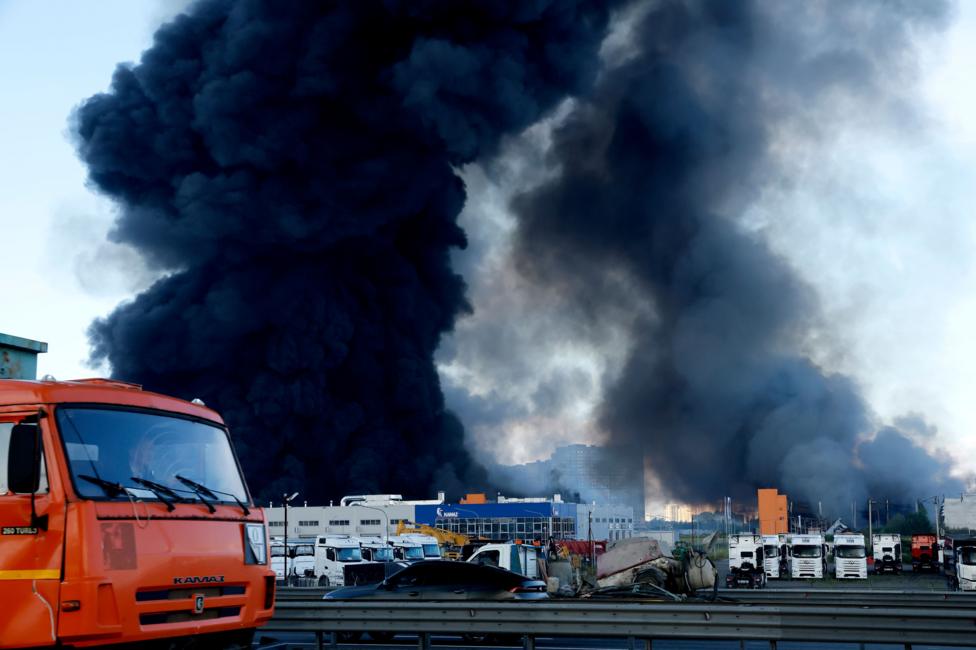

Who still controls power inside Russia?
Despite polling showing a decline in Putin's domestic approval ratings, Muratov argues the Russian president has not lost his grip on the machinery of state.
Sorry, I don't believe all this talk about a split among members of the elite, about secret conspiracies. The country is run by Vladimir Putin. They're frightened of him.
And this fear is reinforced in every way by his main support base: the Federal Security Service (FSB).
How does Muratov view Western governments?
Muratov is equally unsparing about European leaders, arguing that Putin sees through what he regards as their double standards.
[Putin] knows very well the true value of European leaders. On the one hand they talk to him about human rights. He laughs out loud because, with the other hand, they sign agreements – or used to sign agreements – with Russia on trading oil, gas, diamonds…all that stuff. When they talk to Putin about European values, he truly laughs out loud. He knows the true value of people who preached to him those values.
What has happened to journalists and other critics still in Russia?
Muratov himself has been designated a "foreign agent" inside Russia, a label the state frequently applies to silence critics. Those given the designation are barred from teaching and from standing in elections, and face restrictions on accessing assets such as proceeds from selling property. The label also serves a symbolic purpose, Muratov suggests, marking individuals out as internal enemies. Yet in conversation he steers attention away from his own situation and toward those imprisoned for opposing the invasion.
What worries me most right now is that no one in the world is interested in the political prisoners who were first to speak out against the land grab in our neighbouring country,
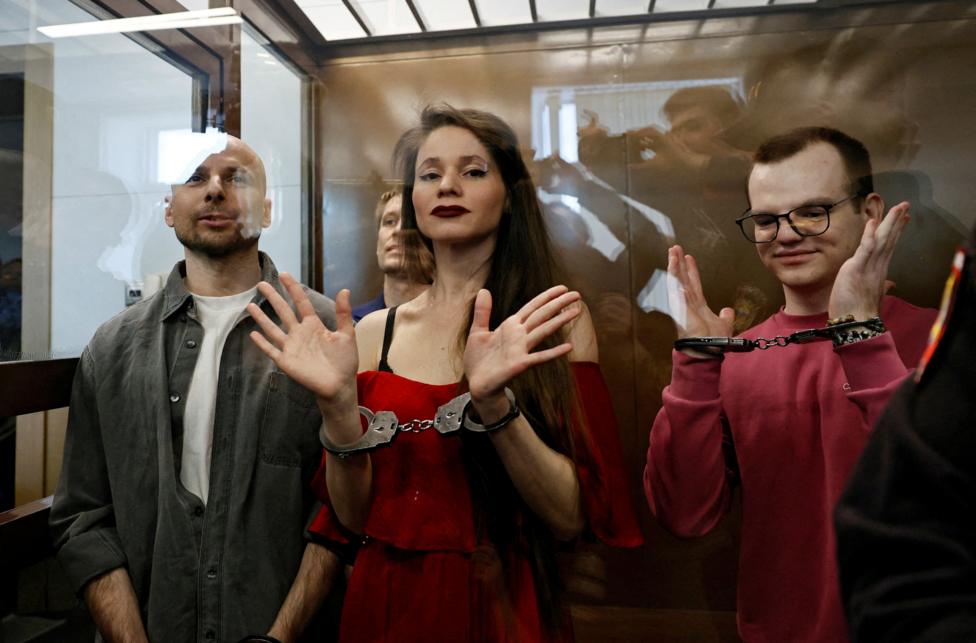
Muratov produced a folder of portraits documenting the human cost of the crackdown. Among them were journalists Antonina Favorskaya, Konstantin Gabov, Sergey Karelin and Artyom Kriger, convicted and jailed on extremism charges after being accused of links to the anti-corruption movement founded by the late opposition leader Alexei Navalny.
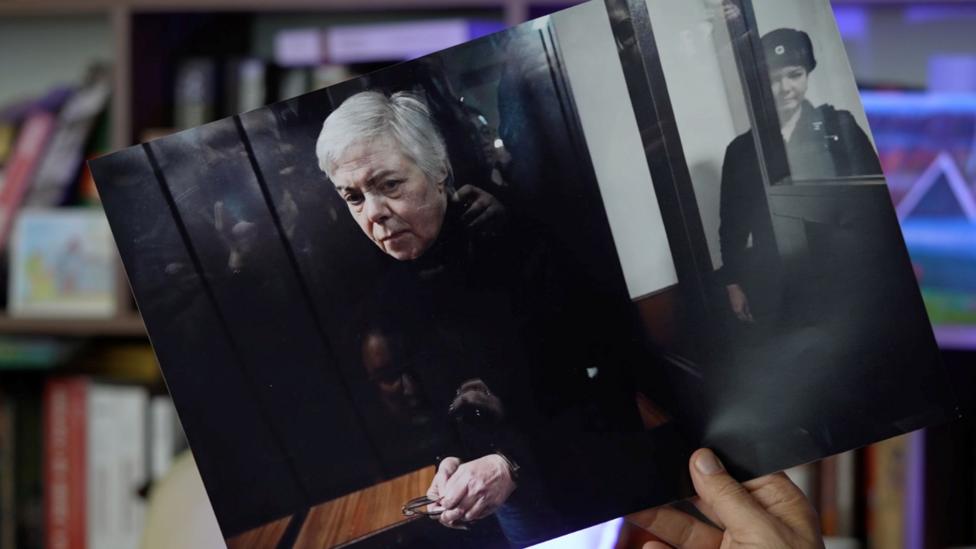
Another photograph showed Alexei Gorinov, a city councillor imprisoned for "knowingly spreading false information" about the Russian military after criticising the invasion. A further portrait was of paediatrician Nadezhda Buyanova, 68, sentenced to five and a half years in a penal colony over allegations she criticised the war while at work.
Muratov then turned to a photograph of pianist Pavel Kushnir, describing his musical talent before revealing what had become of him.
And here's a wonderful pianist, Pavel Kushnir. An outstanding performer of Rachmaninoff and Schubert.
Kushnir had been arrested after posting videos opposing the war. Muratov then held up a second image.
And this is him in his coffin.
Kushnir died in a pre-trial detention centre during a hunger strike at the age of 39. Asked whether his Nobel status offers him any personal protection to speak freely, Muratov deflected the question back toward the state.
This is not a question for me. Whenever you have the opportunity, ask the authorities that.
He described a further incident from April 2026, when police searched the newspaper's office for thirteen hours while barring lawyers from entering.
This is the newspaper's lawyer when she was waiting to get into the building. The police were searching our office. Thirteen hours it took. And they wouldn't let the lawyers in. Our managing editor Oleg Roldugin is now under house arrest.
Muratov described an atmosphere in which public criticism is largely confined to silence, even as private sympathy persists.
We live in a time when you stay quiet. But so many people support what we do. On the streets of Mocow, my colleagues and I hear only words of gratitude. They are spoken in a whisper. But what people think is very important.
How does this fit into the wider history of the Nobel Peace Prize and the war?
Muratov is not the only Nobel laureate linked to the conflict. The following year's Nobel Peace Prize, in 2022, was awarded jointly to Belarusian activist Ales Bialiatski, the Russian human rights organisation Memorial, and Ukraine's Center for Civil Liberties, recognised for what the Nobel Committee described as an "outstanding effort to document war crimes, human rights abuses and the abuse of power." Separately, Ukrainian human rights lawyer Oleksandra Matviichuk has pushed for the creation of a special international tribunal to prosecute Putin, Belarusian leader Alexander Lukashenko and other senior officials over the war, according to an international broadcaster's interview with Matviichuk.
Muratov's own Nobel medal was later auctioned in New York, raising $103 million, which he donated to the United Nations children's agency UNICEF to support child refugees fleeing Ukraine, according to a media profile of Muratov.
What happens next?
Putin is expected to continue demanding that Ukraine cede the entirety of the Donbas region, a position he has maintained publicly, according to a national broadcaster's coverage of his negotiating stance. Putin has also suggested that any eventual settlement would need to rebuild ties between Russians and Ukrainians over time, a comment that points toward prolonged negotiation rather than a swift resolution, according to further reported remarks from Putin. Meanwhile, Muratov continues to warn that the greatest immediate risk lies not in a battlefield breakthrough but in further escalation, including the possibility that nuclear weapons rhetoric moves from state television into policy.
Key Facts
- Dmitry Muratov co-founded Novaya Gazeta over thirty years ago and won a share of the 2021 Nobel Peace Prize for defending freedom of expression.
- Russian authorities nationalised the paper's printing presses and revoked its registration; its website remains blocked inside Russia.
- Muratov estimates at least 1,500 people have been imprisoned in Russia for opposing state policy since the invasion began, three times the figure attributed to the KGB era.
- Pianist Pavel Kushnir died during a hunger strike in pre-trial detention at age 39 after posting anti-war videos.
- Muratov's auctioned Nobel medal raised $103 million, donated to UNICEF for Ukrainian child refugees.


