

The Democratic Unionist Party has accused Sinn Féin of deflecting blame for the stalled A5 road upgrade after former MP Francie Molloy suggested that landowner obstruction tied to delays could be traced back to the Plantation of Ulster. The 58-mile (94km) scheme, first approved by Stormont ministers in October 2024, has faced repeated setbacks amid ongoing court proceedings. On Wednesday evening, a Sinn Féin spokesperson told a regional broadcaster's news service that Molloy "does not represent" the party's official position.
DUP MLA Tom Buchanan dismissed the historical framing outright, stating that the road's delays have nothing to do with events from four centuries ago.
"Reaching back more than 400 years to explain Sinn Féin's inability to deliver a road in 2026 is the hallmark of a party that is increasingly divorced from reality and becoming ever more ridiculous in its attempts to blame others," he said in a statement.
"The reasons for the delays are multifaceted, but the Plantation is not one of them," Buchanan said.
Buchanan, who represents West Tyrone, issued his statement shortly after Molloy faced questions about Sinn Féin's record on delivering major infrastructure. Appearing on BBC Radio Ulster's Nolan Show, Molloy was asked whether the party's supporters feel it has delivered on its promises, with presenter Stephen Nolan pointing out that neither the A5 nor Casement Park has been completed.
"Yeah it hasn't and that a regrettable situation and I think the responsibility, again, not just on the British government but on the other parties to ensure that those structures are put in place," Molloy said.
Molloy went further, stating that the underlying issue traces back to the Plantation of Ulster. According to a report from a regional Northern Ireland news outlet, Molloy specifically pointed to landowner obstruction as the source of delay, saying some land involved was "originally under strange circumstances" and that people were "using the courts to obstruct a political process," (the Irish News).
What was the Plantation of Ulster?
The Plantation of Ulster refers to the 17th-century policy under King James I in which English and Scottish settlers were granted land in the north of Ireland, much of it seized from the local Irish population and redistributed to new landholders, according to the Irish News. It is this historical episode that Molloy invoked when linking present-day landowner disputes to centuries-old land redistribution.
'Exercise their legal rights'
Political commentator and writer Newton Emerson called the claim "outrageous" in response to Molloy's remarks.
Buchanan elaborated on the practical grievances of landowners affected by the scheme, saying many farmers lost access to their property without compensation or even a preliminary offer.
"The department's approach to compulsory purchase and vesting has been appallingly poor. Landowners are entitled to exercise their legal rights without being attacked or having their ownership linked to events four centuries ago," he said.
"People in West Tyrone want the A5 delivered, not another Sinn Féin excuse."
Buchanan also raised separate concerns about what he described as "unattainable net zero targets" supported by Sinn Féin, alongside what he called serious failures in how landowners have been treated throughout the process, according to the Irish News.

TUV leader Jim Allister also weighed in on Wednesday, describing Molloy's remarks as containing a "deeply troubling element."
Has climate legislation played a role in the delays?
Independent fact-checkers have examined whether Northern Ireland's Climate Change Act, rather than landowner disputes, is responsible for holding up the A5 scheme. According to FactCheckNI, there is ongoing debate over the extent to which the climate legislation has contributed to the project's setbacks. Separately, commentary published by the Irish Times has explored why Sinn Féin has been reluctant to amend climate law in ways that might ease progress on the A5, framing the road scheme as entangled in a wider political dispute over environmental policy, according to the Irish Times.
What is the A5 and why does it matter?
The A5 forms a critical part of Northern Ireland's road network, stretching more than 58 miles (94km) and connecting to over 200 side roads. Much of the route remains single carriageway, with overtaking lanes provided only in certain stretches.
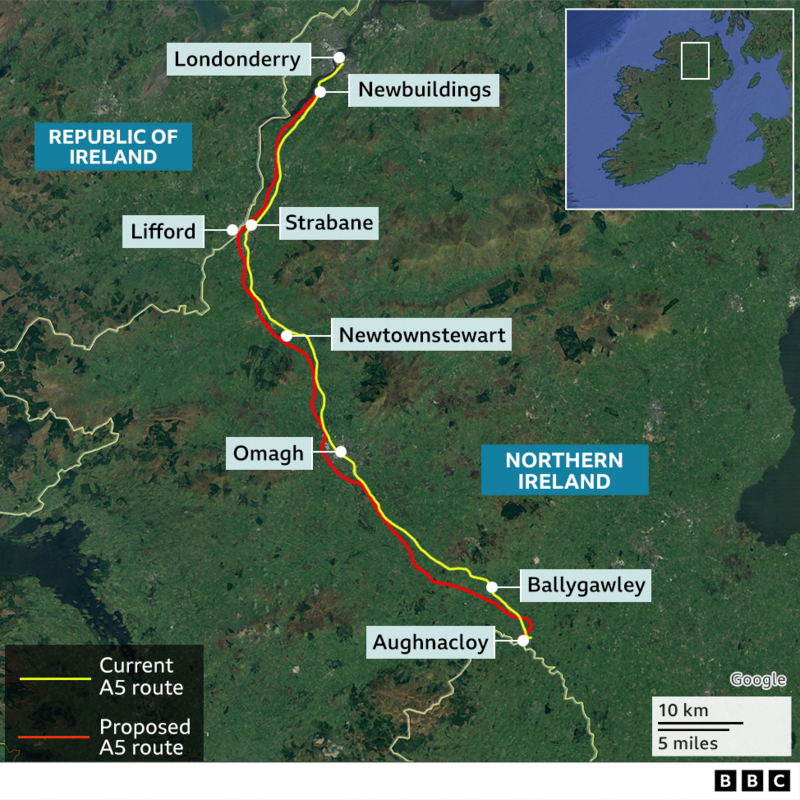
The road links Londonderry to Aughnacloy in County Tyrone, running through towns including Sion Mills, Omagh and Strabane. It serves as the principal north-south route through the west of Northern Ireland and connects County Donegal to Dublin via the N2 in County Monaghan. The dual carriageway upgrade was first announced in 2007 but has suffered repeated delays since. More than 50 people have died on the road since 2006, fuelling a long-running campaign for its improvement.
How does this fit into wider tensions at Stormont?
The dispute over the A5 comes amid broader strain within the Northern Ireland Executive. Sinn Féin's Conor Murphy recently warned that Stormont is in a precarious position following meetings with the new Northern Ireland Secretary, Sir Chris Bryant, while the DUP has defended its record in government, as detailed in our earlier coverage of tensions at Stormont. The exchange over the A5 adds to a series of pointed disagreements between the two largest parties in the devolved institutions.
What happens next?
No specific court date, ministerial decision or construction milestone for the A5 has yet been confirmed, based on currently available reporting. The dispute between the DUP and Sinn Féin over responsibility for the delays appears set to continue without an immediate resolution in sight.
Key Facts
- The A5 upgrade is a 58-mile (94km) scheme first approved by Stormont ministers in October 2024.
- Francie Molloy linked landowner obstruction on the project to the historical Plantation of Ulster.
- DUP MLA Tom Buchanan said delays stem from multiple factors, not historical land settlement.
- More than 50 people have died on the A5 since 2006.
- Independent fact-checkers have separately examined whether climate legislation contributed to the delays.


