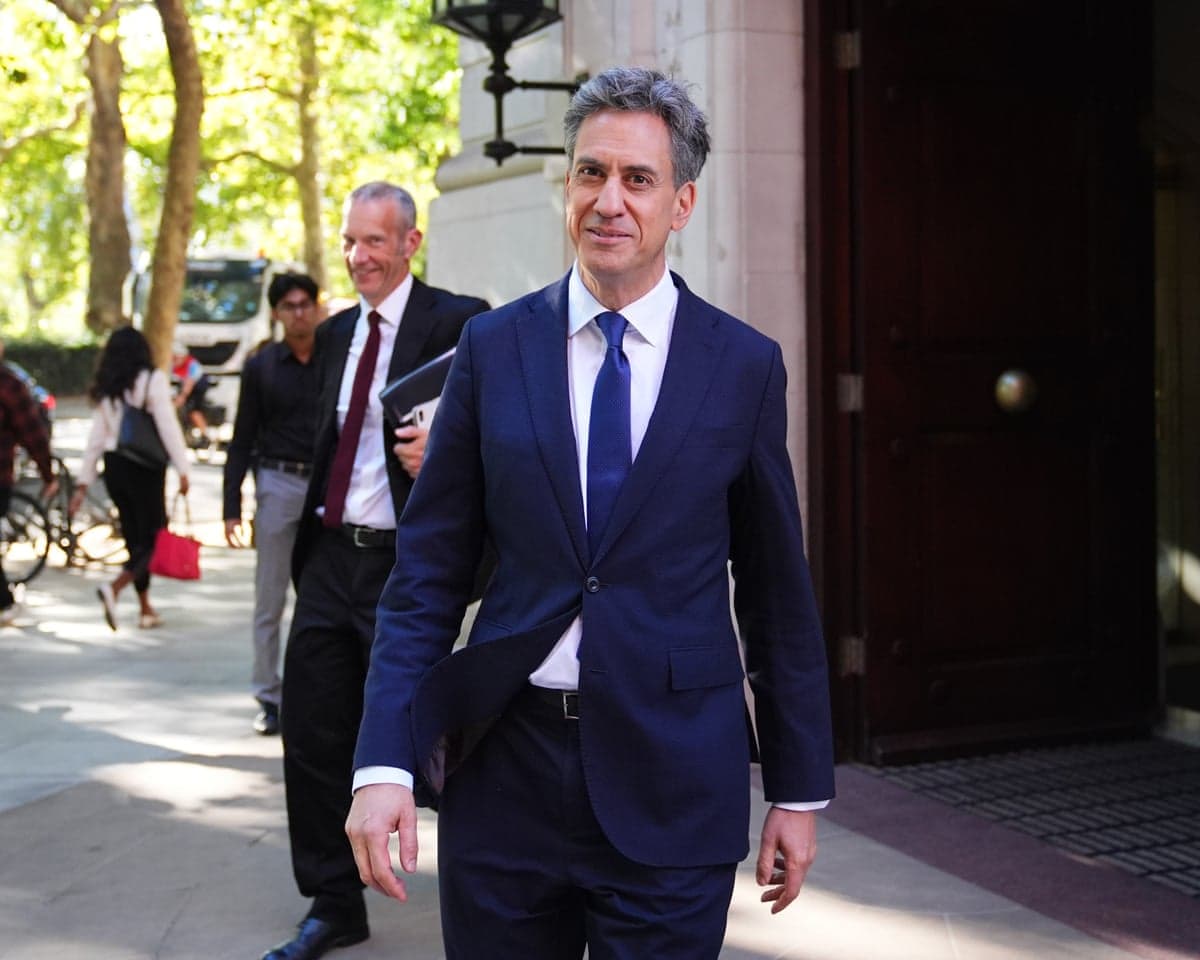
Foreign Secretary Ed Miliband has firmly rejected claims from the UK's chief rabbi that government sanctions targeting illegal Israeli settlements will endanger British Jews, insisting that ministers can hold the Israeli government accountable while simultaneously combating antisemitism.
The government announced a sweeping package of measures on Tuesday coordinated with France, Canada and nine other nations, all introducing sanctions in response to what they describe as unlawful expansion of settlements threatening a two-state solution. According to reports on the announcement, the UK's package includes an import ban on goods from Israeli settlements, plus sanctions on individuals and companies involved in settlement expansion, with implementation expected within six to nine months.
In a joint statement, leaders including Prime Minister Andy Burnham, French President Emmanuel Macron and Canadian official Mark Carney declared:
The time has come to take further action to uphold our commitment to protect the two-state solution, our interests and to stand up for our values, before it is too late.
Sir Ephraim Mirvis, the UK's chief rabbi, swiftly characterised the sanctions as a
dark day for British Jewsand warned they could embolden those who
use hatred as a weapon against Jews.

Miliband, who identifies as a proud British Jew, directly contradicted the chief rabbi's assessment. When asked on multiple occasions whether he disagreed with Mirvis, Miliband responded affirmatively:
Yes, I am saying I don't agree with the chief rabbi, somebody over whom I have great respect.
The foreign secretary emphasised the distinction between criticising Israeli government policy and targeting Jewish people. He stated:
I just want to be very, very clear. As I said it in my statement yesterday, anyone who holds British Jews, or indeed Jews around the world, responsible for the actions of the Israeli government is engaging in antisemitism, pure and simple. And it must be possible to stand up in our society for British values of freedom, dignity, and against oppression and injustice, and do so as I believe I did yesterday in a way that calls out antisemitism.
In further remarks, Miliband added:
I'm a proud British Jew, and I don't agree with the chief rabbi. I have great respect for the chief rabbi, but I don't agree with him, and I believe that it must be possible to do what we did yesterday, which is to stand up for British values of the rule of law, of dignity for people, of the prevention of injustice, and do so in a way, as I did yesterday, to say to anyone in our country who holds British Jews responsible for the actions of the Israeli government, that is antisemitism, pure and simple.
What measures are being introduced?
The UK is implementing a comprehensive sanctions regime that extends far beyond trade restrictions. According to reporting on the full scope of measures, the government will bar companies from providing settlement services including financing, construction, infrastructure, real estate and advertising. The package also encompasses an import ban on goods produced in the settlements themselves and introduces new restrictions on arms licences and other exports that materially contribute to the occupation.
Additional measures include personal sanctions against key individuals accused of promoting settler violence, and a ban on real-estate events in the UK promoting homes in West Bank settlements. The sanctions regime incorporates what officials describe as
appropriate religious exemptionsto ensure legitimate religious and humanitarian activities are not impeded.

How did Israel respond?
Israel's government reacted swiftly and severely to Tuesday's announcement. The Israeli authorities ordered the closure of the British consulate in Jerusalem and banned 12 British MPs and activists from entering the country. Washington's ambassador to Israel, Mike Huckabee, warned that the US could pursue retaliatory trade measures, though US Secretary of State Marco Rubio stated the United States would not follow the UK's approach, without elaborating on whether it would take independent action.
Miliband told reporters he would
let our American friends speak for themselvesbut stressed that the international community had grown
quite frustrated to put it mildly, with some of the actions of the Israeli government. He acknowledged that the closure of the British consulate would prove
damagingbut maintained the government had
weighed up the costs and benefits in advance if this.
When pressed on the consulate closure, Miliband stated:
I regret what the Israeli government has announced, but I'm proud of what we did yesterday and it was the right thing to do. It will be damaging, that's true, but we weighed up the costs and the benefits in advance of this.He noted that the government had consulted with Palestinian representatives before acting, saying:
We talked to the representatives of the Palestinian people, the Palestinian prime minister, the representative here, and they both said to us with a very clear voice, you need to act from our point of view.
What was the government's justification?
Miliband delivered an impassioned statement in Parliament on Tuesday, recounting accounts from Palestinians in the West Bank whose homes had been demolished and from doctors in Gaza treating children who died while awaiting medical care. He characterised the sanctions as necessary to uphold British values and international law.
Prime Minister Andy Burnham endorsed the decision, describing the sanctions as
the right thing to doand emphasising they targeted
not at the Israeli peoplebut at specific government policies and actors. Burnham is scheduled to face parliamentary questioning on the issue at prime minister's questions.
The foreign secretary expressed pride in the government's actions, stating:
I'm proud of what we did yesterday and it was the right thing to do.He also noted that the UK, France and Canada were coordinating their approach to ensure consistency among allied nations.
What was the international response?
Ministers had expressed concern about a potential backlash from the United States. However, according to reports, when Prime Minister Andy Burnham spoke to US President Donald Trump on Monday, Trump did not push back or ask the UK to change course. US officials told their British counterparts they shared concerns about the Netanyahu government's West Bank policy, even if they disagreed with the specific sanctions approach being taken.
When will the measures take effect?
The implementation timeline varies across the different components of the sanctions package. Trade restrictions on goods from settlements are expected to come into force within six to nine months, allowing businesses time to adjust their supply chains and compliance procedures. Miliband's measures were set out in Parliament and are expected to be further detailed in the coming weeks as the government develops the regulatory framework and guidance for enforcement.
A broader package of sanctions and policy changes is anticipated in the near term, with officials indicating that additional measures targeting settlement expansion could be announced within weeks. The government has signalled that this represents an initial phase of what may become a more comprehensive approach to West Bank policy.
Key Facts
- The UK sanctions were coordinated with France, Canada and nine other countries, representing a multilateral approach to settlement expansion
- The measures include import bans on settlement goods, restrictions on services including financing and construction, personal sanctions on individuals, and a prohibition on UK-based real-estate promotion of West Bank properties
- Implementation of trade restrictions is expected within six to nine months, with further details to be provided in coming weeks
- Israel responded by closing the British consulate in Jerusalem and banning 12 British MPs and activists from entry
- Miliband rejected the chief rabbi's claim that the sanctions endanger British Jews, emphasising the distinction between criticising government policy and targeting Jewish people
- US officials indicated they shared concerns about Israeli settlement policy but did not push back when informed of the UK's decision