

Five years after the Taliban seized full control of Afghanistan, hundreds of Afghans who were resettled across Yorkshire say they are still grappling with trauma, uncertainty and the loss of the lives they once knew. Families who fled in 2021 have described how their circumstances have changed since arriving in the UK, even as the humanitarian crisis inside Afghanistan continues, particularly for women and girls.
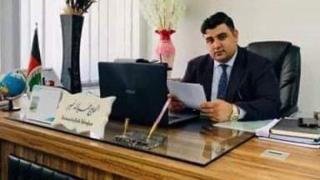
Hamidullah Khyber, who now lives in York and helps other refugees with resettlement, recalls 15 August 2021 as the day the Taliban returned to power. He arrived in York just six days later, having had, in his words, no choice but to leave Kabul because of his former role as director of Afghan borders.
dark day in the Afghan history
Before that position, Hamidullah worked as a translator for British armed forces in Afghanistan, an assignment during which he was injured when the helicopter he was travelling in was struck.
So that was the first time I got shot in the head. I still have fragments in the head.
He now lives with post-traumatic stress disorder as a result of the attack, and says returning to Afghanistan would put his life at risk because of his past work for British interests.
I cannot live there, I will be targeted and I will be killed because of... the work that I've done for the interests of this nation (UK).
It is a very tough life, it is full of pain, not only for me, for every single Afghan that lived in that country or has run away from that country and lives somewhere abroad.
Hamidullah says many Afghans shared hopes for a better future that have since been dashed, and although he says he wants to remain hopeful, he fears for his daughters' access to education and for basic freedoms under Taliban rule.
People were hoping for a bright future in that country. Our people deserve better. I don't want to be hopeless. I would like to return today if possible. The problem is my daughters won't be able to go to school. I will have no right of freedom of speech. There is no government. Our embassies around the world are shutting down every day. The government is not recognised by international community.
How did the Taliban return to power?
An international coalition completed its withdrawal from Afghanistan on 30 August 2021, bringing a 20-year military campaign to an end. US-led forces had entered the country in 2001, ousting the Taliban after the 11 September attacks, which were attributed to the militant group al-Qaeda. The UK deployed troops as part of that campaign but ended combat operations in 2014, retaining hundreds of personnel to train Afghanistan's national army. A withdrawal agreement was signed between the Taliban and the United States under President Donald Trump in February 2020, and his successor, Joe Biden, upheld the deal a year later. As US troops departed and military support for Afghan forces diminished, the Taliban advanced rapidly, taking control of the entire country by the middle of August 2021.
What happened to those who worked with British forces?
Hossain Saeedi left Afghanistan because his work at the British Embassy made him a target, given what he describes as the Taliban's intolerance of anyone associated with Western nations.
in the Taliban's view people who work with Westerners should not be tolerated
Hossain says he avoids dwelling on the past as a way of coping with what he calls the highest degree of trauma. He now works for the British Red Cross's Refugee Services in Leeds, supporting asylum seekers with issues including destitution support, finding legal representation and advocacy around homelessness. He hopes people in Leeds will recognise Afghan refugees simply as fellow humans, pointing out that his family maintains a routine much like any other, including school runs, while raising children across two cultures.
We have children, we have dreams, we do school runs. So we make sure that we are raising our children between two cultures,

What was life like for Afghan women before they fled?
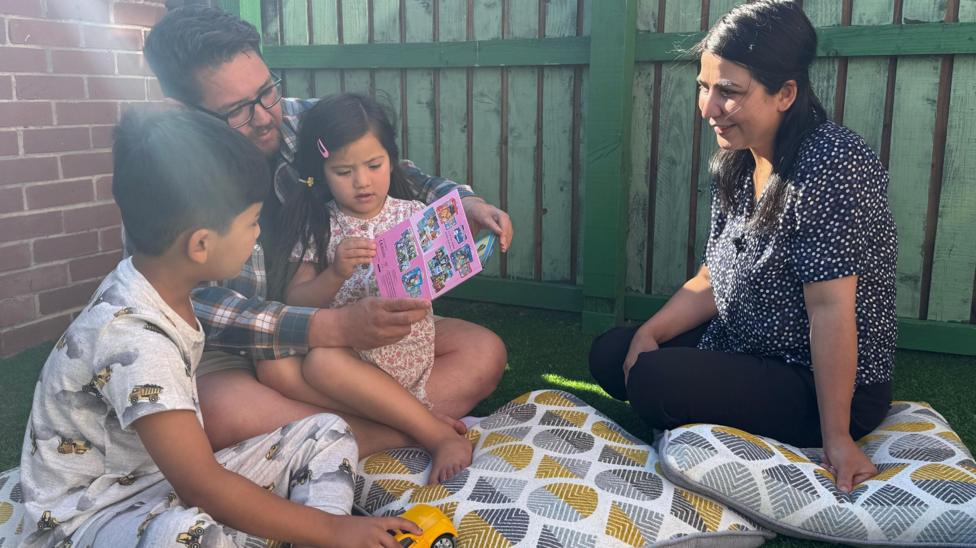
Hossain's wife, Fereshta Hussaini, worked as a journalist for a local Afghan newspaper before the Taliban takeover. She says conditions for female reporters had already begun deteriorating six months before the Taliban's full takeover, with threats made against those who continued working.
if we see you to go to a newspaper, we kill you
Her employer introduced safety measures such as remote working and contingency plans for encounters with Taliban fighters. Fereshta recounts an incident in which a colleague, reporting just outside Kabul, brought her brother along for protection, only for him to be killed by the Taliban. She describes that period as a nightmare, and explains her decision to seek a different future for her children.
I can't live somewhere that my children can't get education and be like a normal person.
When we came here I didn't know English at all and I started my college and learned English and I did my GCSE, and I will start a new course in college in creative media.
Since the Taliban took power in 2021, girls over the age of 12 have been prohibited from attending school, and women have been barred from many forms of employment. In 2020, only 19% of Afghan women were part of the workforce, roughly a quarter of the male participation rate, and that proportion has fallen further under Taliban rule.
How has resettlement affected livelihoods?
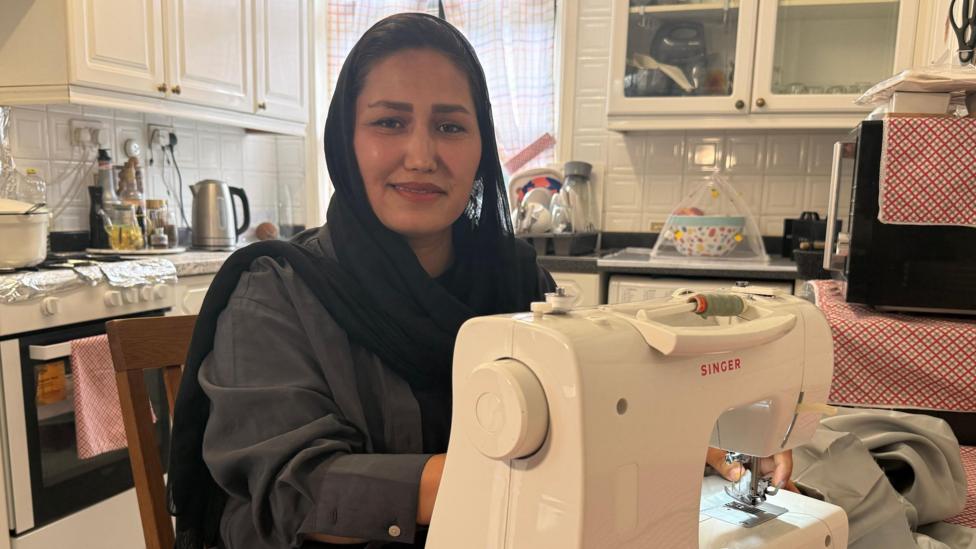
Khadija, a tailor who once ran her own business in Afghanistan, says she was forced to abandon her livelihood the moment the Taliban returned.
I took out any poster from my shop and closed it.
They don't want the women working and they don't want women and girls to go to school or university. Just stay at home.
I lost my job in one day, I was crying inside and I lost my hope. Any woman doesn't have any future because of the Taliban.
In my country... when I woke up, I didn't know if I'd be alive or not by night.
She moved to Doncaster in November 2021, a transition she describes as the loss of her former life.
Everything changed - my language, my job, my education and everything new for me.
Since arriving, Khadija has learned English and now volunteers at a sewing group run by the Refugee Council, with hopes of eventually building a design business of her own. Her wish for Afghanistan is that women will one day be able to work freely and pursue what they want.
one day, very soon, women work freely and they do what they want
How has the wider resettlement system changed?
Separately, a Commons committee has found that the Ministry of Defence's breach of Afghan relocation data was a foreseeable systemic failure, one that exposed the details of more than 18,500 applicants, according to an inquiry into the MoD Afghan data breach. The finding has raised further questions about how personal information belonging to Afghans who worked with British forces has been safeguarded.
The resettlement landscape itself has also shifted considerably since these families first arrived. As of 31 March 2026, 38,617 people had been supported under the Afghan Resettlement Programme, with 31,835 already moved into permanent homes and a further 254 matched to a home and awaiting the move, according to government operational data. However, the government closed all existing Afghan resettlement schemes to new applications or referrals from 1 July 2025, according to a National Audit Office investigation. In Yorkshire and Humber specifically, the programme now operates under a new regional model, with Migration Yorkshire managing transitional and settled accommodation following a pilot launched in April 2025, the same investigation notes.
According to the Migration Observatory, Leeds is among the top three local authorities hosting people resettled under the Afghan schemes, alongside Crawley and Birmingham, each having received more than 500 people. The Local Government Association says councils can now receive a single tariff of £24,110 per arrival, with time in transitional accommodation limited to nine months, according to Local Government Association guidance. Government figures show 3,234 people remained in transitional accommodation at the end of March 2026, more than half of them children.
What happens next?
The government estimated in February 2026 that it may need to resettle between 46,582 and 47,691 people in the UK by December 2029, according to the National Audit Office investigation. Transitional accommodation under the Afghan Resettlement Programme remains time-limited to a maximum of nine months, after which households are expected to move into settled housing, according to official programme guidance. The National Audit Office says this estimate implies resettlement activity could continue through to December 2029.
Key Facts
- The Taliban regained full control of Afghanistan on 15 August 2021, with the international military withdrawal completed on 30 August 2021.
- Girls over 12 have been barred from education and women from many jobs since 2021, with female workforce participation falling well below the 19% recorded in 2020.
- As of 31 March 2026, 38,617 people had been supported under the Afghan Resettlement Programme, with 31,835 placed in permanent homes.
- The UK closed existing Afghan resettlement schemes to new applications from 1 July 2025, shifting to a new regional model including a Migration Yorkshire pilot from April 2025.
- The government estimates it may need to resettle up to roughly 47,700 people by December 2029.


