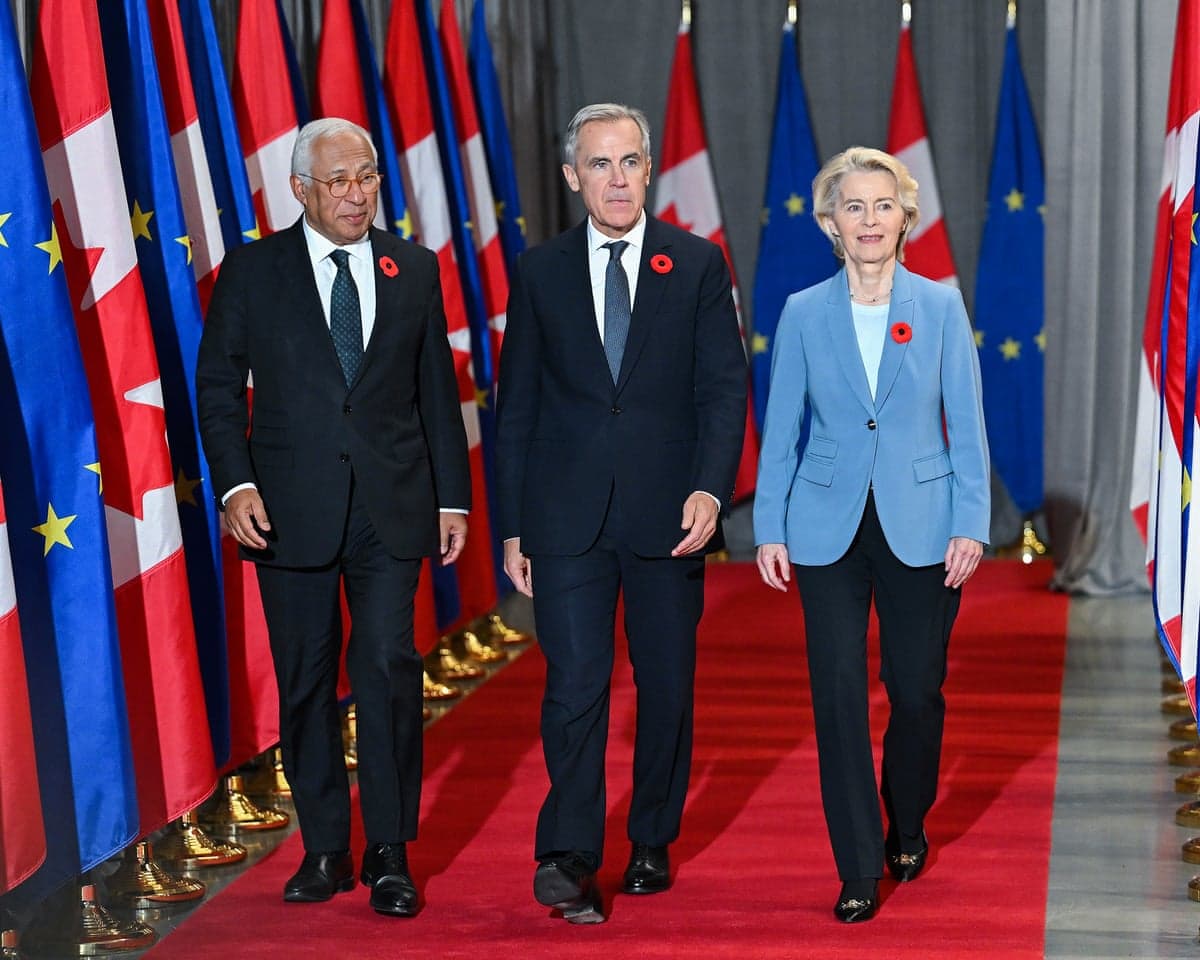
Canada and the European Union have established a new partnership framework designed to provide stability and economic opportunity for member nations while remaining open to other like-minded countries. Unveiled at a two-day summit in Montreal that concluded on 30 October 2026, the Alliance for the Future represents what leaders describe as an unprecedented deepening of ties between Ottawa and the 27-nation EU bloc. According to The Guardian, Prime Minister Mark Carney and European Commission President Ursula von der Leyen jointly announced the partnership as a response to mounting global instability.
"Our societies have been shaken by new storms,"Carney told reporters, encompassing the climate crisis, deterioration of democratic institutions, and the weaponization of international trade. Von der Leyen characterised the relationship as one built on shared values and mutual strength.
"This [association] is a partnership not against anyone else, but for our common strength,"she stated, emphasizing that the initiative was not directed at any particular nation.
The summit produced several concrete commitments. Canada pledged to contribute €500 million to a broader €90 billion EU support loan for Ukraine, with the Canadian funds specifically earmarked to enable Ukraine to purchase military equipment from Canadian defence manufacturers, according to Agence France-Presse. Beyond Ukraine assistance, the two sides agreed to negotiate a Digital Trade Agreement and established a framework allowing the European Investment Bank to finance Canadian critical-minerals projects.
The backdrop to this alliance reflects months of escalating tensions between Canada and the United States. A trade war with Washington has prompted Carney to cultivate alternative geopolitical partnerships, while Canada's vulnerability to American corporate and political pressure has become increasingly apparent. Last month, Elon Musk throttled the speeds of Starlink and Starshield over Ukraine in mid-October, severely disrupting Ukrainian military and defence operations—an incident that underscored Canadian concerns about reliance on American technology providers whose loyalties may not align with national interests. Musk, a dual Canadian citizen, has been a vocal critic of Canada's Liberal government and has publicly advocated for provincial separation.
Carney has repeatedly flagged the risk that Canada's defence and technology sectors could become hostage to decisions made by American political figures or corporations with conflicting interests. To address this vulnerability, he pointed to a planned merger between Canadian artificial intelligence company Cohere Inc and Germany's Aleph Alpha GmbH as a model for reducing dependence on American AI dominance. The combined entity will maintain dual headquarters in Berlin and Toronto, and Canada's federal government has committed to acquiring a stake in Cohere valued at up to C$1.6 billion.
"We are not waiting for the future of AI to be decided somewhere else by those we don't know, or by whom we don't trust,"Carney declared on Thursday.
The summit also produced agreements on digital infrastructure and artificial intelligence cooperation. Canada will gain access to Europe's supercomputing network, enabling Canadian researchers and companies to train AI models on European machines. According to the Canadian Prime Minister's Office, the partners committed to collaborating through the EU's Destination Earth initiative on artificial intelligence applications for wildfire detection, extreme-weather response and climate modelling. Both sides also signed memoranda addressing AI governance, digital credentials, identity wallets and trust services.
How will this affect ordinary households?
Leaders framed the alliance as a direct response to cost-of-living pressures facing residents on both sides of the Atlantic.
"When trade becomes a tool of economic pressure, it's the families that pay the price, from the supermarket shelf to the cost of a new car,"von der Leyen observed, noting that energy suppliers, critical mineral producers and semiconductor manufacturers have increasingly become instruments of geopolitical coercion. The partnership aims to build resilience in supply chains and reduce vulnerability to such weaponization. Carney suggested that deeper integration would generate
"more competition, more choice,"and help both economies
"withstand shocks, together."
Negotiations are underway on expanded market integration worth tens of billions of dollars, reduced trade and travel restrictions, and new educational pathways for young people. The two sides plan to begin discussions on broadening Canadian participation in Erasmus+, the EU's flagship student and youth exchange programme, and will explore mechanisms to facilitate cross-Atlantic study and work opportunities.
What about Canada becoming an associate member?
The question of Canada's formal status within the EU framework remained unresolved at the summit, though leaders reaffirmed their commitment to the concept. Von der Leyen and Carney both referenced "associate membership" as an unprecedented arrangement that would require creative definition. However, according to Capital Gazette, the final summit declaration did not formally include the term "associate membership"; instead, leaders agreed to define an "ever-closer association" by their next summit in 2027. This shift reflected resistance from some EU member states, including Germany, which had worked behind the scenes to remove the phrase from draft documents, fearing it would confuse other nations seeking full membership.
Von der Leyen, who originally proposed the concept, acknowledged the uncharted territory.
"We have the ambition, trust, and creativity to shape it together,"she said. European Council President Antonio Costa characterised Canada as
"by far the most European of the non-European countries,"reflecting a conviction that despite geographical distance, the two sides share fundamental values and interests. Costa pledged that the two sides would pursue
"the most closer, the most deepest, the most stronger association ever between [the EU] and a non-European country."Carney indicated he expects negotiations on associate membership to conclude by June 2027.
What additional agreements emerged from the summit?
Beyond the headline announcements, the summit produced several technical and infrastructure agreements. The leaders agreed to explore linking instant-payment systems between Canada and Europe, study the feasibility of Canadian liquefied natural gas exports to the EU, and consider new undersea cables connecting Canada, Europe and Asia. These initiatives reflect efforts to deepen economic integration and reduce reliance on third-party intermediaries for critical transactions and energy flows.
Arctic cooperation also featured prominently in discussions. The EU's pre-summit agenda identified the Arctic as a priority area for joint projects, stronger supply chains, space cooperation and support for Arctic communities—reflecting shared interests in a region of growing geopolitical significance.
How has this been received domestically in Canada?
The summit has generated friction in Quebec, where the separatist Parti Québécois recently won a minority government. Premier Paul St-Pierre Plamondon boycotted the event after the federal government declined to grant him a public speaking role. In a social media post, he accused Ottawa of marginalizing Quebec's interests.
"The federal government would have us believe that the premier of Quebec being granted permission to serve shrimp cocktails at a reception constitutes an acceptable and sufficient form of influence for representing Quebec's interests,"he wrote, characterizing the arrangement as an insult. He demanded a seat at the head table, framing the dispute as a broader question of Quebec's voice in federal foreign policy.
What happens next?
The two sides have committed to a follow-up summit in 2027, at which the scope and legal framework of Canada's "ever-closer association" with the EU will be clarified. Carney has signalled that negotiations on formal associate membership status should conclude by June 2027. In the interim, working groups will advance negotiations on the Digital Trade Agreement, critical minerals financing, AI cooperation, and expanded educational exchange programmes. The timeline suggests that the architecture of the Canada-EU relationship will continue to evolve significantly over the coming months, with the 2027 summit serving as a checkpoint for progress on all fronts.