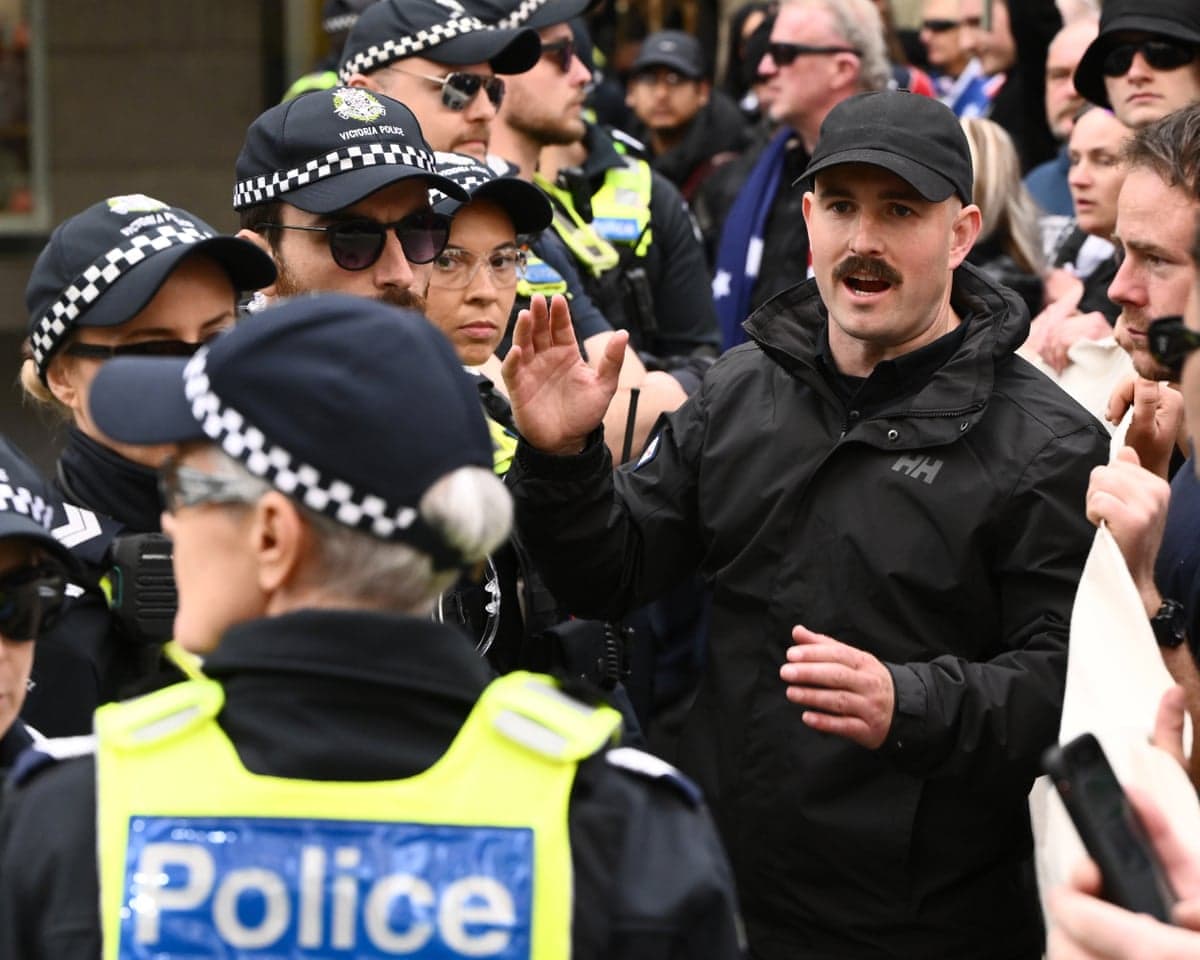
The White Australia party represents a contemporary incarnation of Adolf Hitler's Nazi ideology and poses a genuine risk of inciting hate crimes against vulnerable communities, the commonwealth argued during high court proceedings on Wednesday.
The organisation, which previously operated under the name National Socialist Network (NSN), was designated a prohibited hate group on 15 May 2026 following a recommendation from the Australian Security and Intelligence Organisation (Asio) to Home Affairs Minister Tony Burke. The group is now mounting a constitutional challenge to overturn the ban, contending that the legislation violates the implied freedom of political communication and that vesting the decision in a minister breaches the separation of powers doctrine.
The White Australia party was incorporated as an association on 20 December 2025 and filed its High Court challenge through solicitor Matthew Hopkins after the government's listing took effect. The case, listed as M50/2026 on the High Court's current docket, centres on whether the prohibited-hate-group regime under Part 5.3B of the Criminal Code is constitutionally valid.
The group's legal representatives argue that the commonwealth lacks the power to ban political parties, citing a landmark 1951 cold war-era high court decision that struck down a prohibition on the Communist Party of Australia. They also contend that the legislation's scope is excessively broad and operates in an "authoritarian" manner.
What does the commonwealth say about the group's nature?
Commonwealth lawyer Brendan Lim told the court that the White Australia party rebranded itself as a political entity to evade consequences after anti-hate legislation was introduced in the wake of the Bondi terror attack. The group maintained identical objectives and membership despite the name change, Lim argued, and sought to exploit the guise of political activity to circumvent the law.
When Justice Robert Beech-Jones directly asked whether the commonwealth regarded the group as a "modern manifestation" of Hitler's Nazi movement, Lim responded affirmatively. He cited inflammatory rhetoric designed to provoke communal violence, participation by members in Camp Sovereignty activities in 2025, and public statements by the group's leader, Thomas Sewell, as evidence of the organisation's extremist character.
"There are few legitimate reasons, outside of history books and museums, that warrant the use of Nazi symbols,"Lim told the court.

Drawing on briefings from Asio and public remarks by its director general, Mike Burgess, Lim argued that the prohibited hate group listing was essential because the organisation operated with security awareness and tactical sophistication sufficient to navigate legal boundaries. He contended that the group's very existence constitutes a source of harm.
How does the commonwealth characterise the risk posed by the group?
Lim explained that stochastic terrorism—the deliberate use of media and public discourse to demonise sections of the community—creates conditions under which isolated individuals or fringe members may commit racially motivated hate crimes. The commonwealth maintains that the anti-hate laws are calibrated to remove this specific harm and go "no further than necessary" to achieve that objective.
The prohibited hate group listing criminalises supporting, funding, training, recruiting for, joining or directing the organisation, with a maximum penalty of 15 years imprisonment. This framework was introduced by the Combatting Antisemitism, Hate and Extremism (Criminal and Migration Laws) Act 2026, which commenced on 22 January 2026.
What is the group's legal argument?
Barrister Shahed Sharify, representing the White Australia party, characterised the total prohibition as akin to deploying a "sledgehammer on a nut" and argued that the law breaches the implied freedom of political communication in a manner that is "authoritarian in nature." He suggested the legislation could potentially be weaponised to outlaw any political party whose members have engaged in or threatened hate crimes with organisational assistance.
Sharify contended that the decision to designate a group as prohibited should rest with a judge rather than a minister, arguing that a "busy minister who flicks through a brief and decides in two hours" cannot provide adequate procedural fairness. He emphasised that the current framework offers no judicial avenue to challenge the minister's determination.
What is the constitutional significance of this case?
The case raises fundamental questions about the scope of commonwealth power and the balance between national security and political freedom. The High Court hearing was scheduled for 8 and 9 September 2026, with judgment expected weeks or months later. The court must determine whether the legislation impermissibly burdens the implied freedom of political communication and whether it infringes Chapter III of the Constitution, which delineates the judicial power of the commonwealth.
The group previously attempted to have the ban suspended pending the outcome of the constitutional challenge. Chief Justice Gageler dismissed an interlocutory application to pause the ban on 4 June 2026, allowing the prohibition to remain in force during the proceedings.
What is the broader political context?
This case arrives amid growing concern about far-right political movements in Australia. Prime Minister Anthony Albanese has previously called on Labor to counter One Nation and other hard-right populist parties as they consolidate electoral support. The government's introduction of the prohibited-hate-group regime reflects a policy determination to address extremism through criminal law rather than relying solely on existing hate speech provisions.
Key Facts
- The White Australia party was designated a prohibited hate group on 15 May 2026 under legislation that commenced on 22 January 2026.
- Membership, funding, training or recruitment for the group now carries a maximum penalty of 15 years imprisonment.
- The group's constitutional challenge centres on whether the law violates the implied freedom of political communication and the separation of powers.
- The High Court heard arguments on 8–9 September 2026, with judgment expected in the following weeks or months.
- The case raises questions about whether the commonwealth possesses the power to ban political parties, an issue last addressed by the High Court in 1951 when it struck down a ban on the Communist Party of Australia.