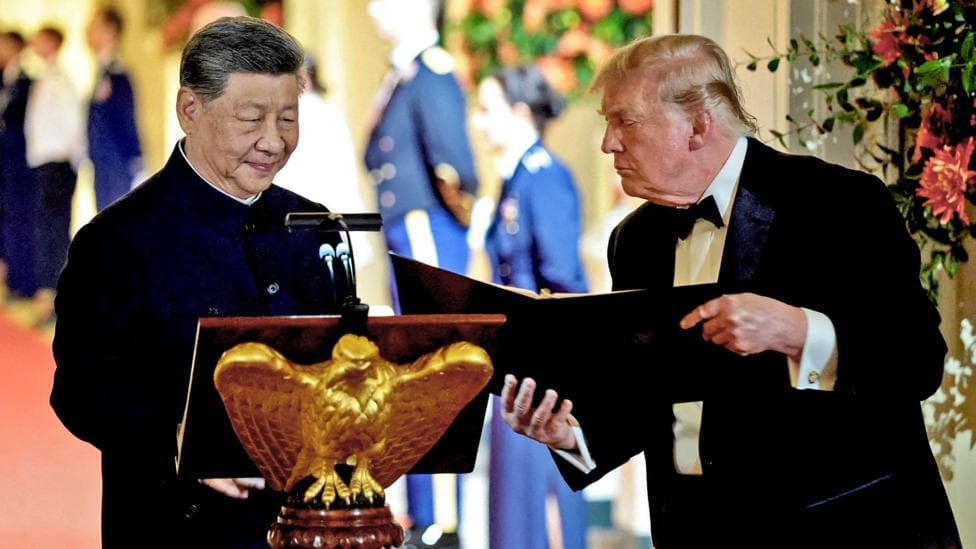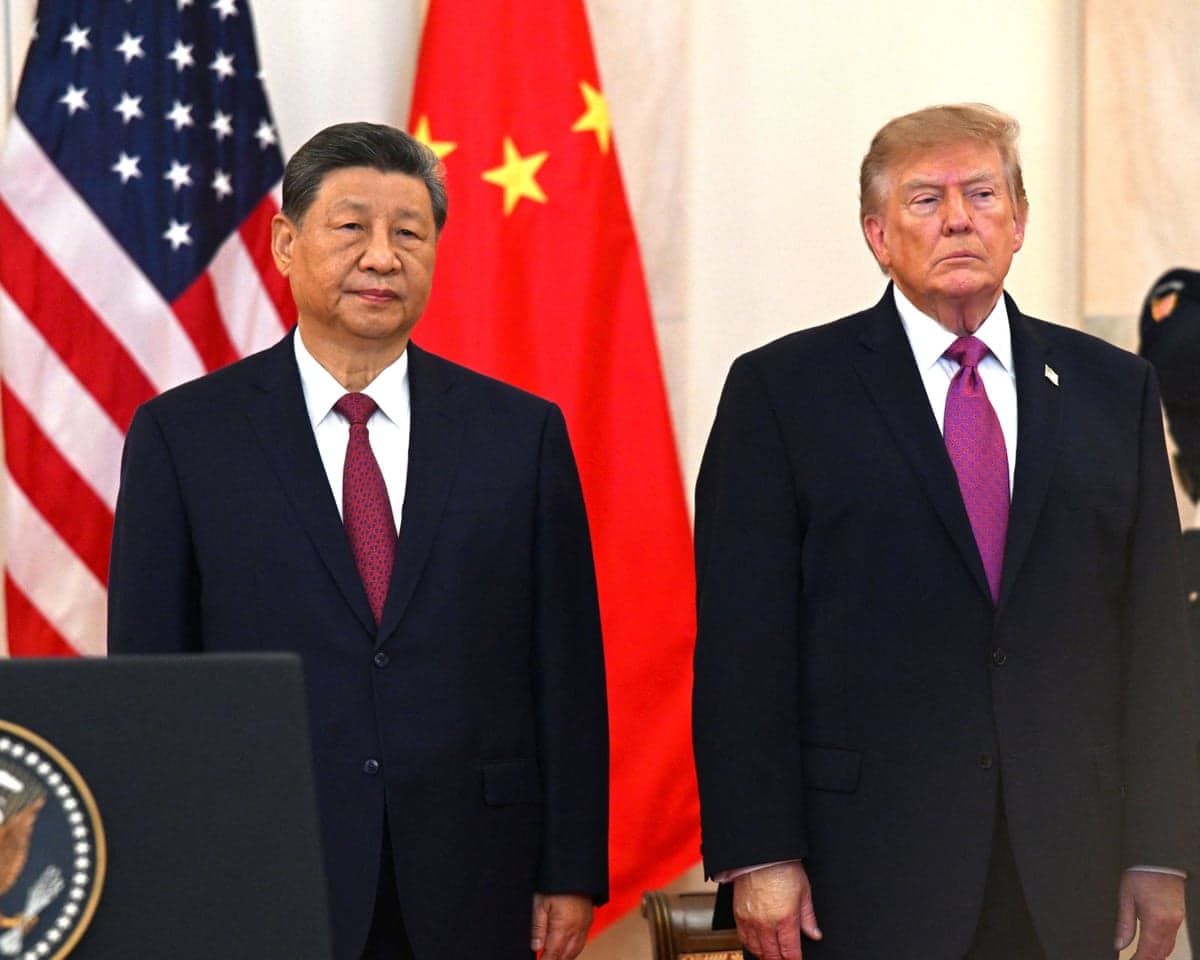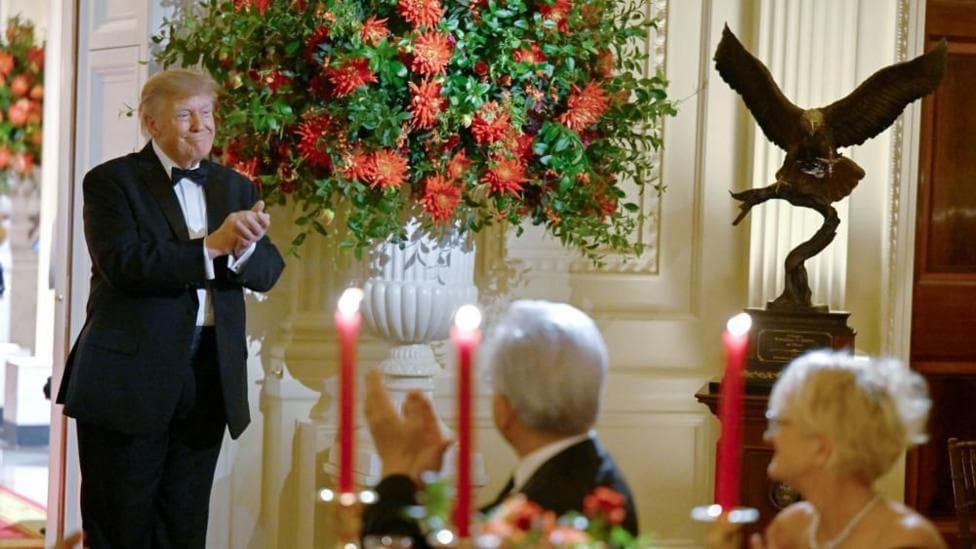
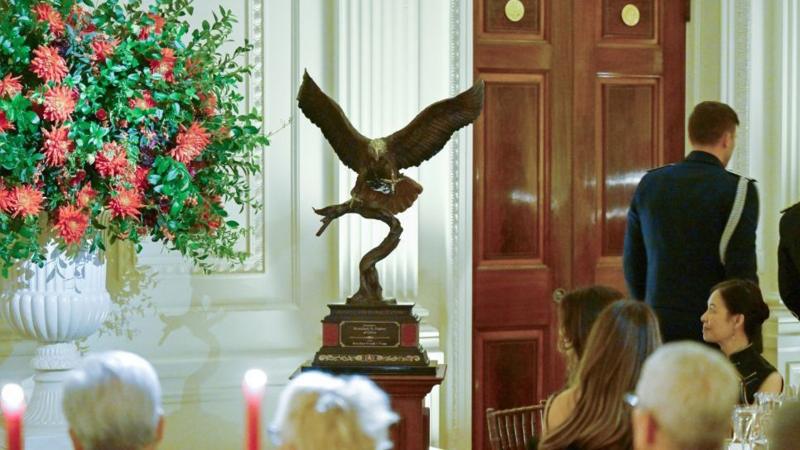
During a lavish state dinner in Washington, US President Donald Trump presented Chinese President Xi Jinping with a sculpture of a bald eagle—a bird native to North America and the United States' national symbol. The gift, unveiled before VIP guests on Thursday evening, was crafted by what Trump described as
an extraordinary American artist, with Trump and First Lady Melania Trump participating directly in its design. According to reports from the dinner, the statue stood roughly three feet tall and was displayed on a podium, and Trump expressed hope that the sculpture would eventually find a place in Beijing.
Trump characterized the gift as embodying
the free and soaring spirit of America. The presentation represents a carefully orchestrated element of international diplomacy—one where symbolic gestures between world leaders carry weight beyond their material value. This three-day summit between the two superpowers aims to forge personal relationships alongside discussions of substantive geopolitical issues.
Daniel Kritenbrink, a partner at The Asia Group and former US diplomat with more than 30 years of experience primarily in Asia, emphasized the significance of such exchanges.
They're going to discuss all of these complicated issues,he noted,
but at the end of the day, these are still two human beings. So that personal relationship means something. I think the gift exchange is one key part of that.Kritenbrink believes the direct Trump-Xi relationship serves as the foundation holding together what he calls
the most complex and the most consequential relationship in the world. He also observed that Trump, like Xi, places considerable value on what he terms
leader-level diplomacy.
How do gifts function in modern diplomacy?
Gift-giving has assumed a particularly prominent role during the Trump presidency. The US president has received a luxury jumbo jet, an engraved gold bar, a diamond-and-jewel encrusted gold ring, and numerous other valuable items from foreign leaders. Ole Jacob Sending from the Norwegian Institute of International Affairs observed that
gift giving, certainly broadly defined, is very much part of how he operateswhen considering Trump's approach to international relations.
The practice of exchanging lavish gifts today remains most common in Gulf states and autocratic governments. Morten Skumsrud Andersen, who co-authored research on diplomacy and gift-giving with Sending, noted that
autocracies like China give much more expensive gifts. In Western democracies, by contrast, the tradition has been substantially constrained by legal and institutional safeguards.
The US Constitution includes an emoluments clause that establishes a dollar-value ceiling on gifts a president may accept from a foreign government. The current limit stands at $525 (£397). Any gift exceeding this amount becomes federal property unless the president personally purchases it back with his own funds. Additionally, when presenting a gift beyond a certain threshold, a US president must either obtain congressional approval or fund the gift personally.
Sending emphasized the complexity surrounding these exchanges:
There are a lot of rules and protocols involved. A lot of thought and process relating to what type of gift to give, where should the gift exchange happen? How should it happen? When? All of this is highly scripted, and involves negotiation at lower levels that goes on for weeks and weeks in advance.Andersen added that
this is not a last-minute purchase at the airport.

What did Xi give in return?
On Thursday morning, Xi announced a gift of two giant pandas to Zoo Atlanta, marking a significant restoration of conservation cooperation between China and the American zoo. According to reports on the panda agreement, the two pandas—identified as Ping Ping and Fu Shuang, one male and one female—will arrive at their new home within days. Xi stated that
the giant panda have been an envoy of friendship between the Chinese and the Americans.
The panda gift carries particular significance given the history of the partnership. The China–Zoo Atlanta panda partnership, which had operated for 25 years, ended in 2024 but is now being renewed through 2034, extending the conservation cooperation for another decade. Beyond the pandas themselves, Xi also announced a new student exchange programme that will welcome 100,000 US students to study in China over five years.
What do past gift exchanges reveal about diplomatic protocol?
Historical precedent demonstrates both the potential and the pitfalls of high-level gift-giving. During Xi's state visit to the United States in 2013, then-President Barack Obama presented him with an inscribed bench crafted from California redwood—the wood native to the state where the two leaders had met. The two subsequently sat together on the bench for photographs, creating a memorable symbolic moment.
Not all exchanges have succeeded so gracefully. In 2009, then-British Prime Minister Gordon Brown gifted Obama an ornamental desk pen holder made from the timbers of a historic anti-slave ship, while Obama gave Brown a set of DVDs that were reportedly not formatted for UK DVD players. Sending characterized this as
one example of a kind of an embarrassing exchange. However, because Brown and Obama were allied leaders rather than strategic rivals, the misstep carried limited consequences.
The stakes surrounding the Trump-Xi gift exchange are considerably higher. Sending cautioned that
you don't want to mess up, noting that an inappropriate gift could potentially undermine larger diplomatic objectives. The summit occurs amid intensifying competition between the two nations over artificial intelligence dominance, and follows a bitter US-China trade war that has been only partially resolved through a temporary truce extended during this visit.
Kritenbrink framed the gift exchange within the broader context of diplomatic pageantry and protocol.
It's protocol and it's optics and it's gift giving all as a means to an end, which is stable US-China relations. I'll take a fragile truce over a white-hot trade war any day of the week.The bald eagle statue and panda gift thus function as symbolic gestures designed to reinforce personal rapport between the two leaders while they navigate the complex terrain of bilateral relations.
What happens next?
The two pandas are expected to arrive at Zoo Atlanta within days, marking the beginning of a renewed chapter in conservation cooperation between China and the United States. The new panda conservation agreement will run through 2034, providing a decade-long framework for ongoing collaboration on wildlife preservation and scientific research.
Key Facts:
- The bald eagle statue was designed in collaboration with Trump and First Lady Melania Trump and created by an American artist, standing approximately three feet tall.
- Xi announced two giant pandas—Ping Ping and Fu Shuang—for Zoo Atlanta, along with a new student exchange programme welcoming 100,000 US students to China over five years.
- US law limits gifts from foreign governments to $525 unless the president purchases them personally or Congress approves; gifts exceeding this amount become federal property.
- The China–Zoo Atlanta panda partnership, which operated for 25 years before ending in 2024, is being renewed through 2034 as part of the diplomatic agreement.
- Gift exchanges at this diplomatic level involve weeks of advance negotiation and protocol planning at lower governmental levels before the formal presentation.