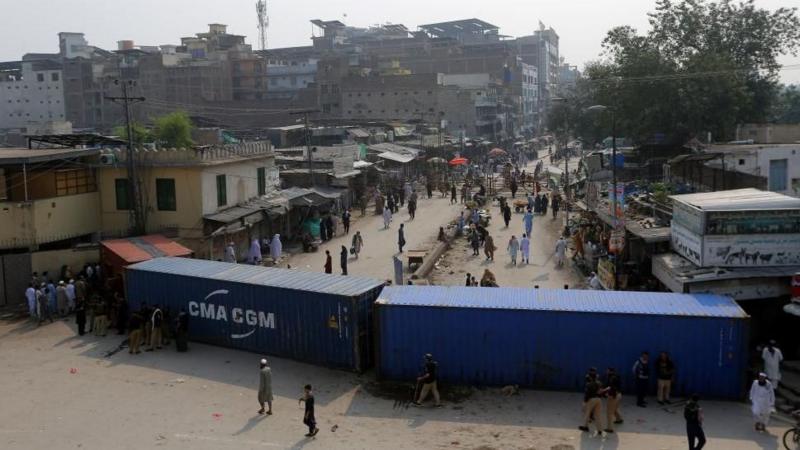
Imran Khan's provincial stronghold in Khyber Pakhtunkhwa has been placed under emergency rule, with schools closed, internet services partially shut down, roads blocked by shipping containers, and military personnel deployed to the region. The suspension of the provincial government marks a dramatic escalation in the confrontation between supporters of the former prime minister and Pakistan's federal authorities, raising concerns among analysts that the move could deepen instability rather than resolve it.
The federal government justified the action by citing constitutional provisions and claiming a need to protect the province's population from terrorism threats.
The PTI KPK government was hand in glove with the terrorists,stated Attah Tarrar, the federal information minister, in remarks to journalists on Sunday, though he offered no supporting evidence and pledged to provide documentation at a later date.
Two days after the announcement, schools had reopened in Peshawar and most areas of the province, and internet connectivity had been restored. However, a security crackdown appeared to be underway to suppress demonstrations. According to police sources, 278 PTI members had been detained in Khyber Pakhtunkhwa since emergency rule took effect. Most PTI leadership figures in the province have disappeared from public view.
On Tuesday, dozens of PTI supporters demonstrated in Bara, a district in Khyber where provincial Chief Minister Sohail Afridi hails from. Witnesses reported that law enforcement deployed tear gas against the gathering.
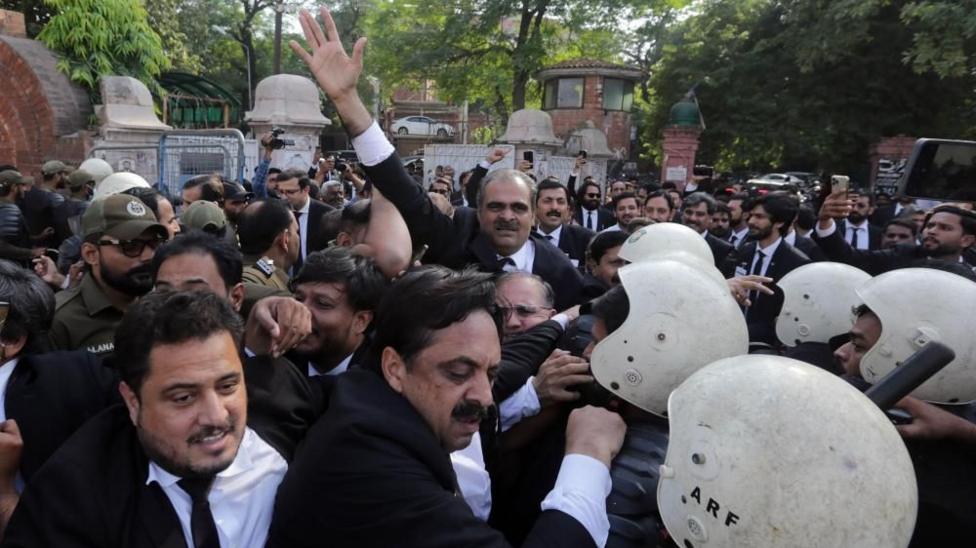
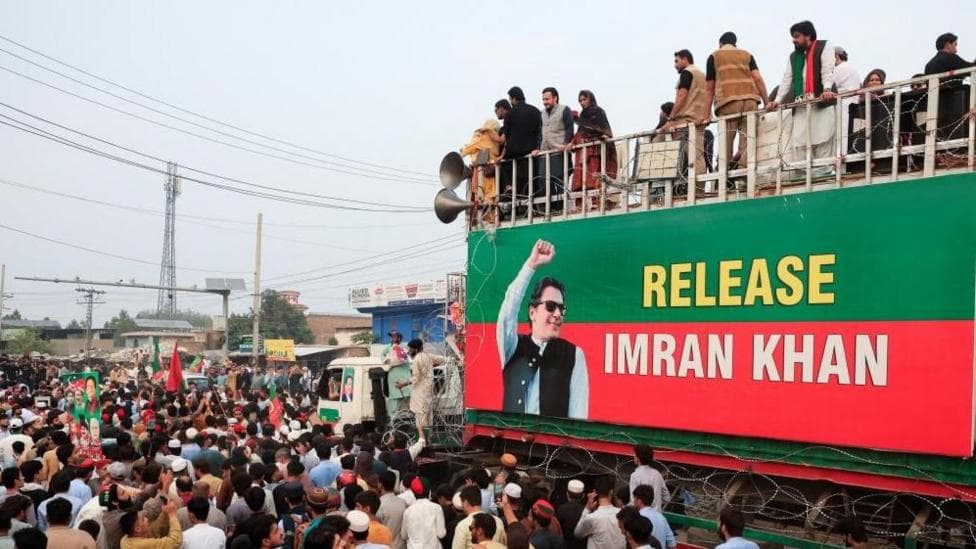
The timing of the emergency declaration, announced on Sunday, appears deliberately coordinated with the political situation. For the preceding seven days, tens of thousands of Imran Khan's supporters had been conducting marches across Khyber Pakhtunkhwa, where the PTI has governed for 13 years, calling for Khan's release from detention.
The emergency proclamation invoked Articles 232 and 234 of Pakistan's Constitution, with federal authorities asserting that the provincial government had demonstrated insufficient commitment to combating terrorism. The governor will now administer the province with an 11-member advisory council, with the federal government stating that normal provincial administration would remain suspended until security conditions improve.
The march itself had been rescheduled from late September to allow for negotiations between the PTI and federal government, but those discussions failed to produce a resolution. The demonstrations were spearheaded by Chief Minister Afridi, whose current whereabouts remain unclear—his party claims he has been arrested, while the government maintains he is in protective custody.
Why is the government taking this step?
Observers and analysts question whether terrorism concerns genuinely motivated the emergency declaration or whether it represents a political maneuver against an opposition party.
The charitable response would be to say that it sounded disingenuous,remarked Farzana Sheikh, an associate fellow at Chatham House. Arifa Noor, a journalist and political commentator, expressed skepticism about the terrorism justification, suggesting instead that the federal government may have simply decided it no longer wished to tolerate a province governed by its political opponents.
The crackdown had begun even before the march commenced. In September, three of Khan's sisters were arrested on charges including mobilizing supporters and have remained in detention. Khan himself has had minimal contact with family members and legal representatives over the past year; his sisters last saw him in August—one visit occurring in prison and another at a hospital where he was examined following Supreme Court concerns about his health, before being returned to incarceration where he has remained for over three years.
Khan, who lost power following a reported rupture with Pakistan's military establishment, has been imprisoned since August 2023 and faces convictions in multiple corruption cases that he characterizes as politically motivated. Michael Kugelman, a senior South Asia fellow at the Atlantic Council, suggests that the party's rank-and-file membership has grown increasingly restless in recent months amid health concerns about Khan, and that authorities may be attempting to send a forceful message to the party and constrain its ability to pressure the government.
The federal government has previously contended that Khan violated prison regulations by using visitation time to discuss political matters. Tarrar asserted that the emergency declaration carried no political motivation and that the government had attempted dialogue, pointing to pre-decision negotiations as evidence of good-faith efforts.
However, critics interpret the measure as another step in a pattern of suppressing Khan and his party.
The government has less and less space for disagreements or dissent and they do not want to negotiate their way out of any kind of conflict,Noor observed. Zahid Hussain, an Islamabad-based author and defense analyst, attributes the decision directly to Pakistan's military institution.
The balance of power is completely shifted to the military establishment,he stated.
Sheikh theorizes that Pakistan's military leadership feels emboldened by what it perceives as a strong relationship with the United States, with its international standing enhanced by involvement in U.S.-Iran peace negotiations.
The mode is very much, this is the moment, let's seize it. There is a sense that, we have all the cards in our hands. We can ride this out internationally.
What are the risks of this approach?
Pakistan faces substantial security and geopolitical challenges that could be exacerbated by the emergency measure. The nation ranked first in the Global Terrorism Index 2026, indicating it has experienced the most significant impact from militant activity of any country. Simultaneously, Pakistan maintains tense relationships with two neighboring states: it has conducted repeated air strikes against Afghanistan, accusing the Taliban government of harboring militant organizations—accusations the Taliban denies—and maintains a historically volatile relationship with India that could reignite with minimal provocation. Additionally, Pakistan has committed to assisting Saudi Arabia in defending against attacks as the conflict with Houthi forces has intensified.
Multiple analysts have cautioned that the emergency declaration could generate additional complications rather than resolve existing ones. The measure risks heightening political instability, leaving the federal government directly accountable for provincial governance without an intermediate provincial administration to deflect blame.
I would argue that this could actually backfire. You're playing with fire because if this move ends up adding to the anger and the discontent among so many there, then you have a very big problem on your hands,Kugelman warned.
Hussain characterized the decision as reckless given Pakistan's multiple concurrent challenges and expressed concern that similar emergency powers could be deployed across other provinces.
It is reckless, given the challenges, multiple challenges the country is facing.Sheikh cautioned that if the military pursues more aggressive counterterrorism operations, it must prepare for potential casualties among armed forces personnel, and significant losses could generate internal institutional questions.
Pakistan's historical experience with military interventions provides cautionary precedent. Previous instances of removing elected governments—whether at provincial or national levels—have produced negative consequences.
It's not that senior people in the PML-N [the party in federal government] don't realise that some of these things can come back and haunt them in the future,Noor observed. She added that the PTI similarly understands it cannot secure Khan's release through protest, yet all parties appear to be proceeding despite recognizing the trajectory.
Everybody realises that this is a train crash but somehow you can't stop it.
What happens next?
The PTI announced it would mount a legal challenge to the emergency declaration and governor's rule, with a petition drafted by a legal committee led by party Secretary-General Salman Akram Raja, though the party had not yet disclosed which court would hear the case. The PTI indicated it would challenge the federal takeover on Tuesday, October 13. The party has rejected accusations against its provincial government and called for a counterterrorism strategy developed through consensus rather than unilateral action.
Separate sessions of Pakistan's National Assembly and Senate were scheduled for October 13 to address the emergency declaration and its implications.