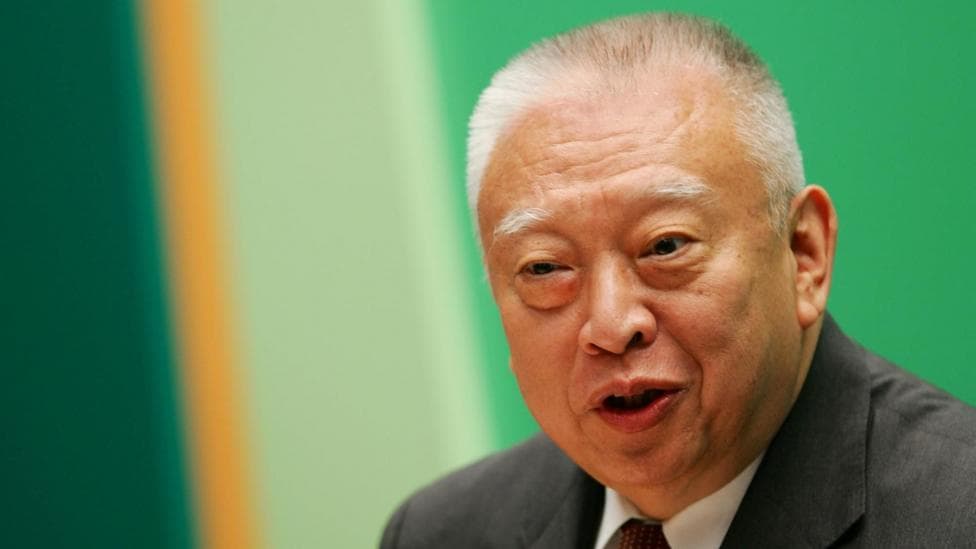
Tung Chee-hwa, who led Hong Kong as its first chief executive following the territory's return to Chinese sovereignty in 1997, has died at the age of 89. According to reports from regional media, he passed away peacefully in a Hong Kong hospital on 8 September 2026 at approximately 10 p.m., surrounded by family members. The Hong Kong government expressed profound sorrow over his death in an official statement released on 9 September 2026.
Tung assumed leadership when the United Kingdom transferred Hong Kong back to China in July 1997, concluding more than 150 years of British colonial rule. His office released a tribute describing him as an "upright and incorruptible" man "devoted to his country and its people," noting that his character and spirit would long be remembered.
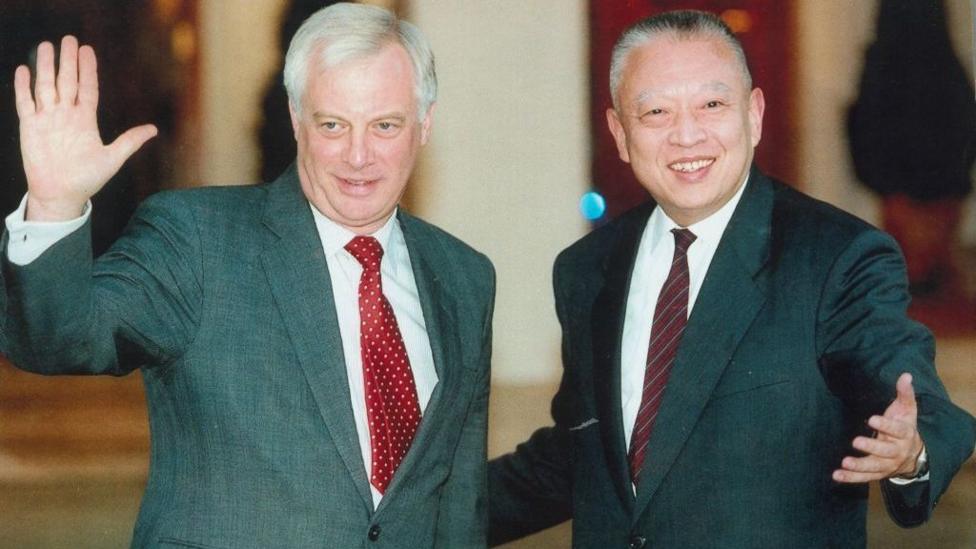
Born in Shanghai in 1937, Tung obtained a mechanical engineering degree from Liverpool University before relocating to the United States, where he spent nearly a decade employed at General Electric. In 1969, he moved to Hong Kong to join his father's shipping conglomerate, Orient Overseas, which he eventually led from 1979 onwards. His entry into politics came in 1992 when he was appointed to the executive council under the final British Governor, Chris Patten.
Despite his limited political background, Tung was widely believed to have been selected by Beijing to govern Hong Kong after the handover. He cultivated a reputation as a loyalist, particularly after Chinese state-owned banks assisted in rescuing his family business during a global economic downturn in the mid-1980s. During a reception at the Great Hall of the People in January 1996, China's then-president Jiang Zemin crossed a crowded room to shake Tung's hand—a gesture captured by photographers that signalled Beijing's endorsement of his candidacy for the leadership position.
What challenges defined his tenure?
Tung's administration faced multiple crises that tested his leadership and ultimately contributed to his departure from office. The Asian Financial Crisis emerged shortly after he took the helm, causing residential property values to plummet across the territory. His government also confronted a succession of public health emergencies, including a bird flu outbreak spanning from 1997 to 2002 and the 2003 Severe Acute Respiratory Syndrome (SARS) epidemic, both of which strained the city's healthcare systems and public confidence.

His most significant political crisis occurred in July 2003 during his second term, when approximately half a million Hong Kong residents marched through the streets to oppose a proposed national security law they believed would undermine their civil liberties and freedoms. Following the unprecedented public demonstration, Tung's administration withdrew the legislation. This episode, combined with mounting pressure, led to his resignation in March 2005. While declining health was cited as the official reason at the time, observers suggested that Beijing may have pressured him to step down.
What happened after his resignation?
The proposed national security law that triggered the 2003 protests remained dormant for years before Beijing ultimately imposed such legislation on Hong Kong in 2020. Authorities have maintained that the law is essential for preserving stability in the territory. However, critics have characterized it as "the end of Hong Kong" and contend that it has fostered an atmosphere of apprehension among residents and restricted freedoms that were previously protected.
Tung's final public appearance occurred in July 2021 at a ceremony commemorating the centenary of the Chinese Communist Party's establishment. According to reports, he underwent heart surgery several months later. He remained active in advisory roles, serving as one of several vice-chairmen of the Chinese People's Political Consultative Conference, China's principal political advisory body, for four consecutive terms.
How have leaders responded to his death?
Former Hong Kong chief executives have issued statements honoring Tung's legacy and contributions to the territory. Leung Chun-ying, who served as chief executive from 2012 to 2017, characterized him as a "benevolent" leader who "won people over with reason." Carrie Lam, who held the position from 2017 to 2022, stated that Tung's leadership represented "a historic contribution with lasting benefits" to Hong Kong.
China's state news agency Xinhua described Tung as a "renowned patriot, distinguished social activist, and close friend of the Communist Party of China." The agency also highlighted his role as a vice chairman of the Chinese People's Political Consultative Conference and characterized him as an outstanding contributor to the "one country, two systems" framework that has governed Hong Kong's relationship with mainland China since the handover.
Tung is survived by his wife and three children.
Key Facts
- Tung Chee-hwa served as Hong Kong's first chief executive from July 1997 until his resignation in March 2005, overseeing the territory's transition from British to Chinese rule.
- His tenure was marked by the Asian Financial Crisis, bird flu and SARS epidemics, and the 2003 mass protests against a proposed national security law that led to his eventual departure.
- Before entering politics, Tung built a career in shipping, eventually leading his family's Orient Overseas conglomerate after joining it in 1969.
- He maintained prominent advisory roles in China's political system after leaving office, serving multiple terms as a vice chairman of the Chinese People's Political Consultative Conference.