

Former Chinese Premier Zhu Rongji, who died on 12 August 2026 at the age of 97, was cremated in Beijing on 18 August 2026 in a tightly controlled ceremony that produced no public footage. National flags were lowered to half-mast at government buildings across the country, and security vehicles were stationed throughout central Beijing as authorities sought to manage displays of public grief.
According to official state reporting, flags were flown at half-mast not only at Tiananmen Square and the Great Hall of the People but at government buildings nationwide and at Chinese diplomatic missions abroad. reported that security around the funeral site was noticeably tightened as flags were lowered at government headquarters on the day of the ceremony. In Hong Kong, according to local broadcaster RTHK, national and regional flags were flown at half-staff at government headquarters, Government House, border crossings and the airport.
Zhu led China as premier from 1998 to 2003 and is widely regarded as one of the country's most consequential economic reformers. State media has praised him as an "outstanding member of the Chinese Communist Party" and a "time-tested and loyal Communist fighter," even as officials remain wary that nostalgia for his era of reform could be read as implicit criticism of the current leadership under Xi Jinping.
Why is China restricting public mourning?
The Communist Party has a long history of anxiety over how the public reacts to the deaths of senior leaders, since grief has previously spilled over into political protest. The deaths of former premier Zhou Enlai in 1976 and former party general secretary Hu Yaobang in 1989 both triggered mass outpourings of mourning that evolved into demonstrations against the government of the day.
That history appears to explain why commentary about Zhu's legacy has been curtailed online. An essay by economist Zhao Jian describing Zhu's era as a period when people were "properly poor" but had a clear sense of the future was removed from the messaging platform WeChat the day after it was published. In it, Zhao wrote:
There were no smartphones then, no short-form videos and no screens filled by the purveyors of anxiety.
The sky was blue, life moved slowly and people could say what they really thought.
Zhu's death came just days before the Communist Party leadership convened to mark the birth centenary of former President Jiang Zemin, who died in 2022. State media identified Zhu as a former member of the Politburo Standing Committee in addition to his role as premier, according to the government's own account. The near-simultaneous commemorations of two towering figures from the same political era have stirred nostalgia among many Chinese people for a period when the country's trajectory toward openness and expanded personal freedom seemed far less certain to reverse.
What set Zhu and Jiang apart from today's leadership?
Zhu, who had previously been purged during Mao Zedong's rule, was rehabilitated after Mao's death in 1976. He went on to serve as premier alongside Jiang Zemin, who led the Communist Party from 1989 and served as president from 1993. Together, from 1998 to 2003, the two men guided China through a period of rapid economic expansion and its formal entry into global trade structures.
Their tenure was defined by painful but transformative changes: the closure of persistently unprofitable state enterprises, the dismantling of the old state housing system in favour of a commercial property market, navigating the Asian financial crisis of the late 1990s, and securing China's accession to the World Trade Organization in 2001. A obituary noted that Zhu championed that WTO entry and pushed reforms that moved China closer to Western market principles, according to the news agency's earlier reporting. separately described him as a "no-nonsense reformer" in its coverage of the funeral arrangements.
Part of what continues to draw public affection, however, is less about policy than personality. A state media documentary about Jiang Zemin shows him alternating between banging on tables and bursting into laughter, while Zhu was known for blunt remarks — once branding corrupt bankers "half-wits" and describing flood defences along the Yangtze River as "flimsy and porous as tofu dregs."
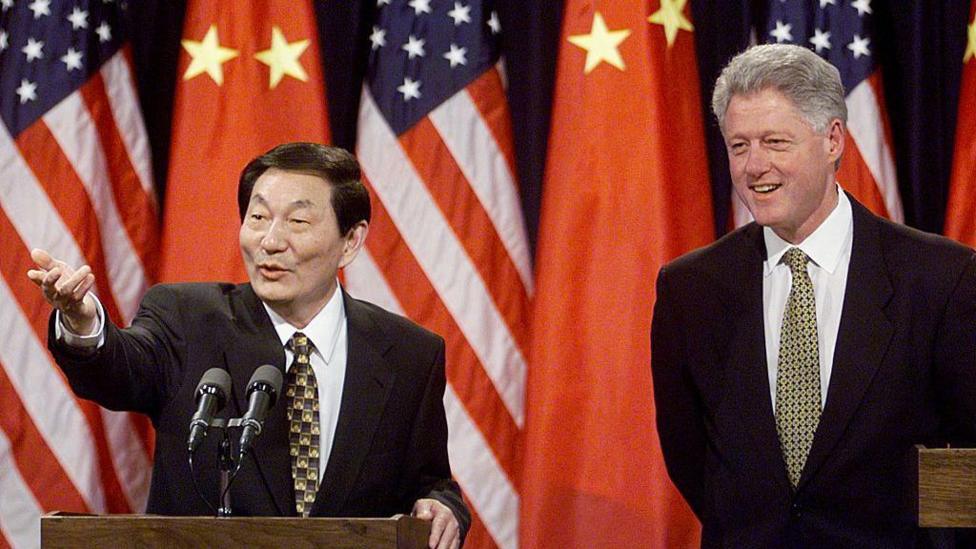
Zhu's dry humour was on display at a joint news conference with then US President Bill Clinton in 1999, when he was pressed on allegations that China had made donations to Clinton's Democratic Party. He responded:

If the political contribution were to be really that effective, and I have $146 billion of foreign exchange reserve, I can put out at least $10 billion for that purpose. Why just $300,000? That would be too foolish.
The remark drew laughter from the assembled press. On the day of his death, a documentary about Jiang featured Zhu recalling how he had convinced colleagues to accept difficult reforms, saying:
I'm not here to talk about pros and cons. I am here to talk about how to get things done.
A photograph circulating on Chinese social media showed Jiang and Zhu laughing together, accompanied by a caption praising their candour:
They told the truth, shouldered the responsibility and spared no effort in serving the people.
That style, according to observers, stands in sharp contrast with the more tightly managed public image cultivated by China's current leadership. A separate obituary from an American broadcaster reported that tributes circulating after Zhu's death portrayed him as a straight talker and an independent thinker, according to a report from an American newspaper. Zhu is survived by his wife and two children, according to an obituary published by an American news network.
How is Xi Jinping shaping the narrative around this era?
The deaths of Zhu and Jiang mark a definitive close to the chapter of breakneck reform that ran through the 1990s and early 2000s, an era marked by private entrepreneurship and rapid wealth creation. That approach differs markedly from President Xi's emphasis on centralised control and a state-driven economic model centred on technological self-reliance and strategic industry.
In a 40-minute address delivered on 17 August 2026, Xi called on the party to carry forward Jiang's legacy, framing the current leadership as a direct continuation of Jiang's political and ideological project. He told the gathering:
On the new journey ahead, we must heighten our sense of vigilance against potential dangers.
With an indomitable fighting spirit and superb skill in struggle, we must proactively meet the major tests posed by high winds and rushing waters, or even by raging storms.
Xi also praised Jiang's decision to shut down a reformist Shanghai newspaper in 1989 after it expressed support for the pro-democracy demonstrations that ended in the deadly Tiananmen Square crackdown in Beijing.
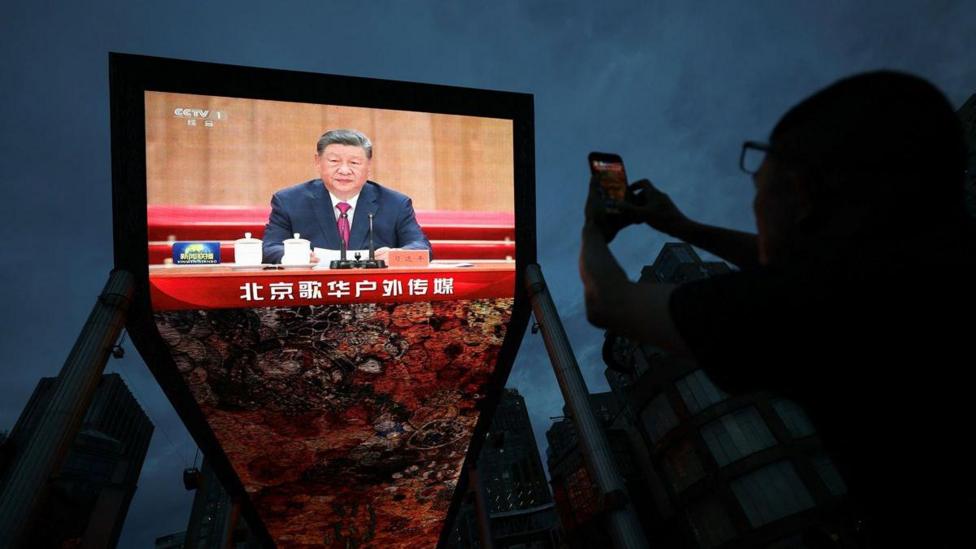
Kerry Brown, Professor of Chinese Studies and Director of the Lau China Institute at King's College London, said Xi is intent on presenting a single, unifying account of China's modern history.
He's trying to put forward a unified historic narrative - any idea that their leadership offered or suggested a different future path will not be allowed a public airing.
Instead, their lives will be knitted into the narrative that everything they did transformed China into what it is now, rather than dwell on any other 'What If's'.
What challenges does Xi face now?
Xi is contending with a considerably harder economic backdrop than the one Zhu and Jiang managed. Growth has slowed, the population is ageing, property prices have fallen sharply, youth unemployment remains elevated and factory output has weakened. The double-digit growth rates that characterised the Zhu-Jiang years are gone.
Much of the current wave of public nostalgia, commentators suggest, is really mourning for a time when ordinary Chinese families believed that hard work would reliably translate into a better life — a certainty that has since eroded for many. As Zhao Jian put it in his essay:
life was hard, but it was hardship sustained by hope.
He acknowledged that many in China today enjoy far greater material comfort, describing "skylines bristling with high-rises and streets teeming with traffic," but posed a pointed question about the cost of that progress:
do we feel so empty inside?
What happens next?
Zhu's cremation on 18 August 2026 in Beijing concludes the formal, state-organised mourning period for the former premier, and no further official ceremonial events have been reported. The commemorations for Zhu came directly on the heels of the party's centenary events marking Jiang Zemin's birth, meaning the two leaders' legacies are likely to remain closely linked in official state messaging in the coming weeks as authorities continue shaping the historical narrative around China's reform era.


