From Taiwan to the US, activists are lobbying for China to pass laws against animal cruelty after videos of the killing of a stray dog and her puppies triggered outrage online in June. Beijing’s censorship apparatus moved quickly, but the response has helped push China’s animal lovers to take their campaign offline and abroad.
Authorities said they were concerned about the four boys involved, all of them younger than 14, and urged people to stop discussing the case. Even so, the incident has continued to generate anger, sorrow and demands for animal-cruelty laws in China, which currently has none.
Why did the online backlash grow?
The backlash intensified because officials cited the boys’ age while asking the public to withhold comments and remove posts about the case. China’s Communist Party regime tightly controls media and the internet to suppress criticism of the state and manage public anger, but in this instance the authorities’ approach appeared to deepen public frustration.
“We urge the public not to disseminate related information, to reject cyberbullying, and to work together to create a good environment for the growth of minors,” reads an official statement.
Rather than quieting discussion, the restrictions seemed to spur it. Posts about the incident were still drawing thousands of comments across social media three weeks later, and Chinese animal lovers have now taken their fight offline and overseas, even putting up billboards in New York to seek support.
Disturbing footage showing the boys in the city of Jieyang, Guangdong province, hitting three puppies with sticks before setting their mother on fire emerged online at the end of June. The dog, named Wang Wang, was seen burning while the boys laughed.
Jieyang authorities said last month that the boys would not face criminal charges and would instead be sent to a “specialised school”, although they did not explain what that meant.
Some reports suggested the boys filmed themselves and uploaded the video online, but police have not commented on that. Censors have tried to block the video to protect the boys’ identity, although some people argue that it should stay available.
The boys’ identities have not been revealed, but snippets of the video with their faces visible continue to circulate online. Unverified posts also claim to show close-ups of the boys’ faces, raising the risk that other children could be wrongly identified.
Animal cruelty is not punishable by law in China.
How are child identity rules being applied?
Countries around the world restrict information about child offenders or set a high bar for identifying them. Media coverage and public access to juvenile court documents are often restricted to minimise psychological harm caused by undue publicity.
In this case, Chinese authorities have not completely banned the discussion. Keywords such as “Wang Wang” and “animal protection” appeared as trending search terms on Monday, but posts related to them began disappearing towards the end of this week. Some users also reported that their ability to share others’ posts had been restricted.
It is unclear whether the deleted or restricted content named or identified any of the four boys. Officials have not said anything more on the matter.
Posts by several celebrities, including Chinese actor Du Jiang and Taiwanese actress Joe Chen, who had called for China to strengthen protection for animals, also disappeared. It is not clear whether those posts were removed by the celebrities themselves.
Chinese users have refused to back down, and some have turned to advocates abroad to share Wang Wang’s plight.
Why has this case mobilised so many people?
It is difficult to say why this, of all the sensitive issues censored in China, has generated such pushback. Part of the reason may be that it is the latest in a series of animal-abuse cases that have made headlines recently, and the footage appears to have had a visceral impact.
Animal lover PL told BBC Chinese that she found it “affecting in a particularly severe way”.
“We can't make our voices heard, so many people [outside China] are actively helping us to message,” the woman in eastern China says.
The Italy-based International Organisation for Animal Protection says it has received more than 100 reports from people around the world calling on the organisation to intervene. It said it had also sought more information from Chinese authorities.
China’s animal lovers have taken their fight global, with some putting up billboards in places as far away as New York.

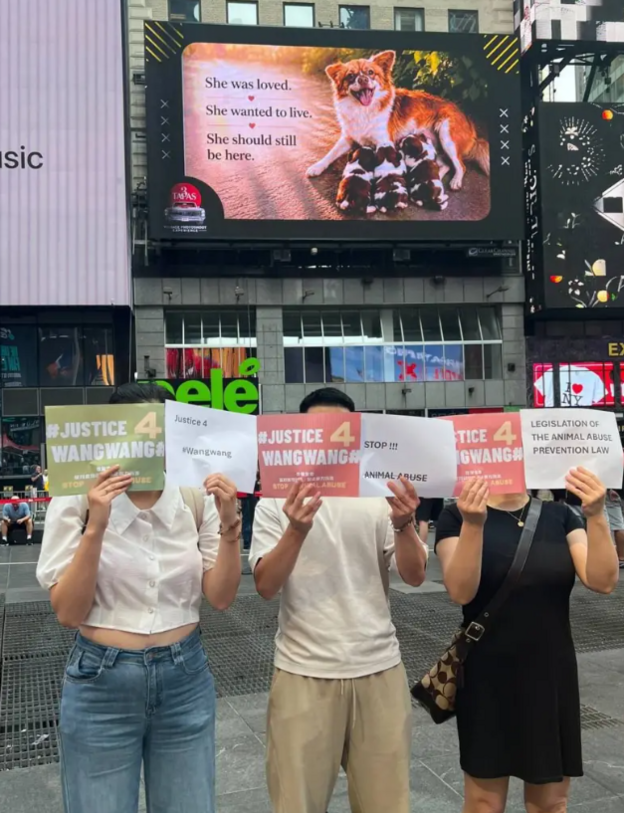
In New York City’s Times Square, one of the busiest pedestrian intersections in the world, photographs of Wang Wang appear on a gigantic digital screen every 35 minutes.
“She was loved. She wanted to live. She should still be here.”
A similar billboard has been placed on a building near Taipei 101, the iconic 101-floor skyscraper in Taiwan. It includes a picture of Wang Wang nursing her puppies.
“This planet is their home too. Justice for Wang Wang,”
CK, a Taiwanese woman who spent NT$30,000 ($930; £692) on the billboard, said she hoped it could foster “a sense of unity”.
“It makes everyone feel like we're speaking out together on this issue, rather than airing our individual opinions online,” she tells BBC Chinese.
CK has also set up accounts on platforms like Reddit and X to share the animals’ plight.
“The world need to know about the cruelty these dogs have been subject to,”
CK added that she could not sleep or eat properly for days after seeing a clip of the brutal killing.
Elara, another Taiwanese woman, used AI to translate a summary of the incident into more than 10 languages, including Japanese, Portuguese and Russian, and those versions have been circulated online.
Residents in Hong Kong and Macau have raised funds to put up posters on buses and trains.
How is the debate continuing inside mainland China?
Within mainland China, the debate continues, with much of the conversation centred on creating awareness to demand laws against animal cruelty.
A striking cartoon of Wang Wang and her puppies drew the attention of many football fans during a domestic game at a stadium in Dalian on Saturday. The cartoon was shown on a huge screen before the game and carried the message, “Every life deserves respect and kindness,”.
Homegrown businesses, such as beauty brand Amortals and streetwear label Wah Yan Ching Nin, have also placed ads outside shopping malls across the country calling for an end to animal abuse.
Stickers and car decals featuring Wang Wang and her puppies have also been put on sale on China’s largest e-commerce platform Taobao.
Some of these efforts have met roadblocks. Wan Jia Li, a mall in the city of Changsha, was reportedly instructed to remove billboards featuring Wang Wang.
“We can't do animal-protection billboards anymore... My boss told me so. I'm not sure if the notice came from the government, or why we have been asked to take them down,”
an employee in the mall’s management team told the BBC.
Still, people have continued to rally online.
“Let's keep posting. Don't let the heat of discussion cool down,”
reads a comment on Weibo.
“Constantly speaking up does not mean disturbing social order. [We're doing this] to let more people see it and realise it's such an important thing that we do not mistreat animals,”
reads another.
In China, the incident has also renewed calls for legislation, with activists arguing that the absence of animal-cruelty laws leaves abuse unpunished. The debate has now spread far beyond the original online outrage, reaching billboards, public screens and fundraising efforts across several places and platforms.