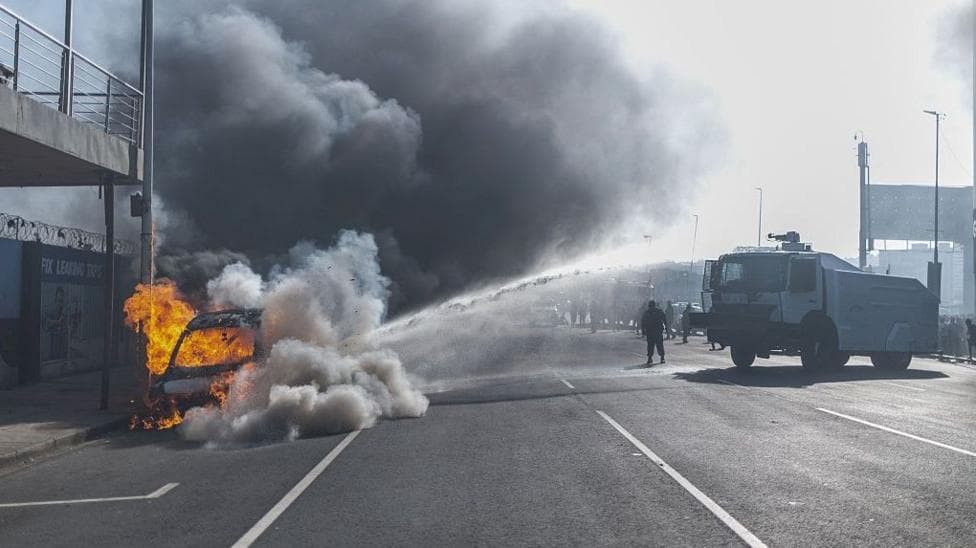
At least 24 vehicles have been destroyed by fire and numerous foreign-owned businesses have been ransacked across South Africa following violent clashes in two major urban centres, according to police reports.
Rioting began on Thursday in Soweto, an expansive township adjacent to Johannesburg, and in Durban, a significant port city on the eastern coast. The unrest was triggered by escalating tensions surrounding a Constitutional Court decision that would permit certain migrants who entered the country without authorisation to lodge asylum applications.
The court judgment, handed down on 7 July by South Africa's highest court in a case brought by the Scalabrini Centre of Cape Town, eliminated procedural obstacles that had previously prevented undocumented arrivals from submitting asylum claims. This decision prompted hundreds of people to queue at refugee reception centres, fuelling alarm among anti-immigration activists concerned that the ruling would accelerate undocumented migration flows.
How did the violence unfold?
In Durban, located in the eastern province of KwaZulu-Natal, the demonstration escalated into violence following claims that a foreign national had attacked one of the protesters. Police apprehended three foreign nationals in relation to the alleged assault.
Crowds assembled outside a government refugee reception office, demanding its closure. Officers deployed rubber bullets to break up gatherings as retailers in the city centre locked their premises. Senior local police officer Xolani Fihla stated to state media that
there were clashes between foreign nationals in the area and South African nationals, while noting that
at the present moment, I can confirm that no injuries have been reported.
In Soweto's Orlando West neighbourhood, residents had organised to demand the shutdown of small convenience stores operated by foreign traders, commonly referred to as spaza shops. Demonstrators forced foreign business owners from certain locations, vandalised shops and ignited a building, according to local reporting. Gunfire was also heard during confrontations between residents and foreign shopkeepers.
Police documented 14 vehicles set alight in Durban and 10 in Soweto. Acting national police commissioner Lt Gen Puleng Dimpane publicly condemned the destruction of property, while authorities pledged to identify and prosecute those responsible.
Reinforcements were deployed to both cities to prevent additional violence. The government withdrew its asylum-processing order on Friday following the clashes, and the Durban refugee reception office was subsequently closed due to security concerns after days of protests outside it.
What does the court ruling actually mean?
The Constitutional Court judgment requires asylum seekers to be permitted to submit applications regardless of how they entered South Africa or whether they missed immigration deadlines. This means undocumented arrivals can now lodge claims, though applications remain subject to individual assessment and immigration checks.
Government spokesman William Baloyi told a news agency that individuals had deliberately circulated false claims about the judgment, creating the false impression that undocumented migrants would be automatically granted legal status. Baloyi clarified that the ruling does not automatically confer refugee status or permanent residence rights on migrants. Officials emphasised that each application will be evaluated separately and applicants will continue to undergo immigration screening.
The Department of Home Affairs acknowledged that the current policy had left its personnel
overwhelmed, while
serious threats to public safety and order had emerged. The department committed to implementing a new policy that would still comply with the Constitutional Court ruling.
What is the broader context of xenophobic violence in South Africa?
South Africa has endured recurring cycles of xenophobic violence for nearly two decades. Major waves of attacks began in Alexandra in 2008, when more than 60 people were killed and tens of thousands displaced, with further violence erupting in Durban and Johannesburg in 2015. These attacks have predominantly targeted migrants from neighbouring nations.
Anti-immigration activism has intensified in recent years. Operation Dudula, an organised movement that emerged in Soweto in 2021, has staged marches and raids targeting undocumented migrants and foreign-operated businesses. Earlier this year, anti-immigration groups conducted weeks of demonstrations demanding that undocumented foreign nationals depart by 30 June, which prompted tens of thousands of migrants to flee, with some returning home through repatriation schemes organised by their governments.
The current unrest occurs within a context of widespread poverty, severe inequality and unemployment affecting roughly a third of the workforce. Migrants are frequently blamed for taking employment, contributing to criminal activity and straining public services, though researchers contend that such broad assertions lack empirical support.
Despite its economic challenges, South Africa remains a primary destination for migrants across the continent seeking employment, refuge and improved living conditions.
What measures is the government taking?
The government has announced a series of reforms to address the crisis. The Inter-Ministerial Committee said it would expand asylum-processing capacity, strengthen identity checks and biometric screening, and accelerate decisions on claims. The committee has also recommended that President Cyril Ramaphosa extend a Special Investigating Unit proclamation to cover all refugee reception offices.
The government plans to relocate refugee reception offices from inland locations to areas closer to the country's borders, a shift intended to manage processing flows more effectively and reduce the concentration of asylum seekers in major urban centres.
Key Facts
- At least 24 vehicles were set on fire and foreign-owned shops looted in Soweto and Durban on Thursday
- A Constitutional Court ruling on 7 July permits asylum applications from migrants who entered without authorisation, triggering the unrest
- Government officials clarified that the ruling does not automatically grant refugee status or permanent residence
- South Africa has experienced repeated xenophobic violence since 2008, with Operation Dudula emerging as an organised anti-immigration movement in 2021
- The government is implementing reforms including expanded processing capacity, enhanced biometric screening and relocation of refugee reception offices to border areas