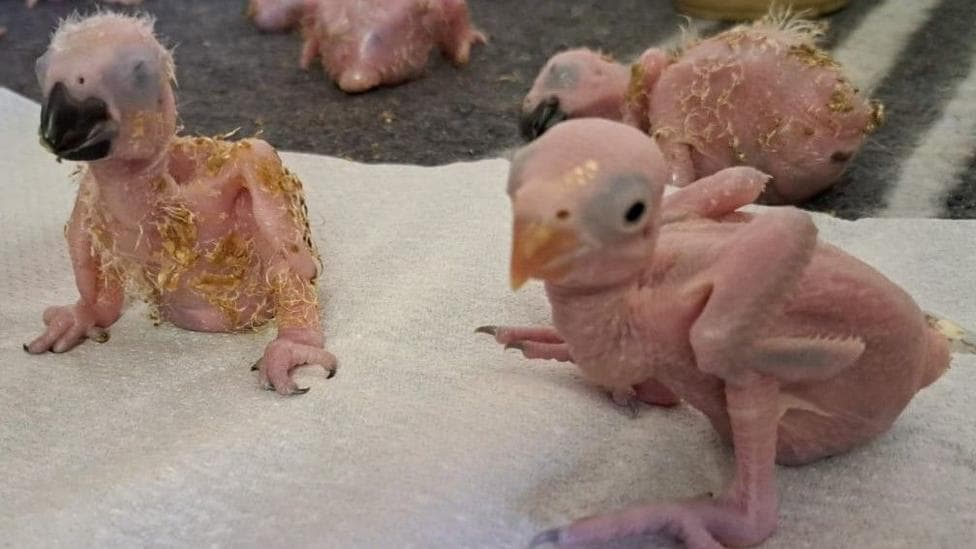
Fifty eggs believed to belong to endangered parrot species were discovered during a security screening at South Africa's primary international airport in Johannesburg on 20 August. A 50-year-old Thai national was detained on suspicion of attempting to transport them illegally in a makeshift incubator bag carried as hand luggage. Many of the confiscated eggs have since hatched, and the chicks are now receiving specialized care from staff at the National Zoological Garden in Pretoria to enhance their survival prospects.
The Department of Forestry, Fisheries and the Environment (DFFE) confirmed that the eggs fall under protection granted by the Convention on International Trade in Endangered Species of Wild Fauna and Flora (Cites). According to local reporting on the case, the arrest was conducted as part of an intelligence-driven operation involving the DFFE, SAPS Crime Intelligence, Border Police, and the Stock Theft and Endangered Species Unit.
If found guilty, the suspect faces potential penalties of up to 10 million rand ($626,000, £461,000) in fines, imprisonment for up to 10 years, or both.
How are the hatchlings being cared for?
The newly hatched chicks are receiving intensive specialized care at the National Zoological Garden, with staff working to maximize their chances of long-term survival. Environment Minister David Maynier publicly acknowledged the dedication of the zoo's personnel, stating they have been
"working tirelessly to incubate the seized eggs and provide specialised care to the hatchlings". The minister also commended all agencies involved in the operation, emphasizing that
"illegal wildlife trafficking can only be challenged by a co-ordinated defence of our natural heritage".
What is the pattern of wildlife trafficking at this airport?
The 20 August seizure represents the second major parrot egg smuggling case at OR Tambo International Airport in recent months. On 16 July, authorities apprehended a 23-year-old Thai citizen attempting to transport 418 parrot eggs concealed in two homemade incubator bags. According to reports on both cases, the pattern demonstrates the growing sophistication of transnational wildlife trafficking networks that exploit the airport as a transit point for endangered species. The DFFE stated that these arrests underscore
"the importance of co-ordinated, intelligence-led law enforcement efforts"in combating organized trafficking operations.

Why are parrot eggs targeted by smugglers?
The illegal collection and trafficking of parrot eggs represents a serious threat to wild bird populations and animal welfare, according to the DFFE. Officials explained that such eggs are frequently smuggled in improvised incubators and under conditions that jeopardize the health of developing embryos and young birds. The practice reflects broader patterns in South Africa's wildlife trafficking crisis, where criminal networks target high-value species for sale on international black markets.
What is South Africa's response to wildlife trafficking?
Wildlife trafficking remains a significant challenge in South Africa, one of the world's most biodiverse nations. Criminal organizations regularly target animals including elephants and pangolins for illicit international trade. To address this threat, the country implemented a comprehensive strategy six years ago designed to strengthen coordination among government institutions, law enforcement agencies, conservation authorities, customs officials, prosecutors, and international partners. This framework aims to dismantle criminal networks engaged in the illegal wildlife trade.
The joint operation that led to the 20 August arrest involved multiple specialized units working in coordination. According to official statements on the operation, the Green Scorpions—a specialized environmental enforcement unit—collaborated with the DFFE and various police divisions to intercept the smuggling attempt.
What happens next in these cases?
Investigations into both the August and July airport trafficking cases remain ongoing, with no court dates or sentencing timelines currently announced. The DFFE has indicated that the cases will proceed through the legal system, where the suspects will face charges under South African wildlife protection legislation. The outcomes of these prosecutions are expected to send a signal about the country's commitment to prosecuting wildlife trafficking offenses.
Key Facts:
- Fifty endangered parrot eggs were intercepted on 20 August at OR Tambo International Airport in Johannesburg, with many subsequently hatching
- A 50-year-old Thai national was arrested for allegedly attempting to smuggle the eggs in a homemade incubator bag carried as hand luggage
- Conviction carries potential penalties of up to 10 million rand or 10 years imprisonment, or both
- The arrest follows a similar case on 16 July involving a 23-year-old Thai citizen caught with 418 parrot eggs at the same airport
- The eggs are believed to belong to species protected under international trade agreements, and hatchlings are receiving specialized care at Pretoria's National Zoological Garden