Starlink satellites operated by Elon Musk's SpaceX deliver high-speed internet connectivity that has become essential to modern military operations. Ukraine has integrated the system into its battlefield communications infrastructure and weaponry, particularly for drone operations that depend on stable, long-range data links to maintain control and coordination across contested territory.
The network serves as what analysts describe as the backbone of Ukrainian military communications, supporting naval, land, and air forces with real-time data transmission. However, overnight speed restrictions imposed on Tuesday by SpaceX have disrupted critical drone operations, prompting alarm from Ukrainian officials and military experts about the implications for the country's defensive capabilities.
How did Starlink become central to Ukraine's military operations?
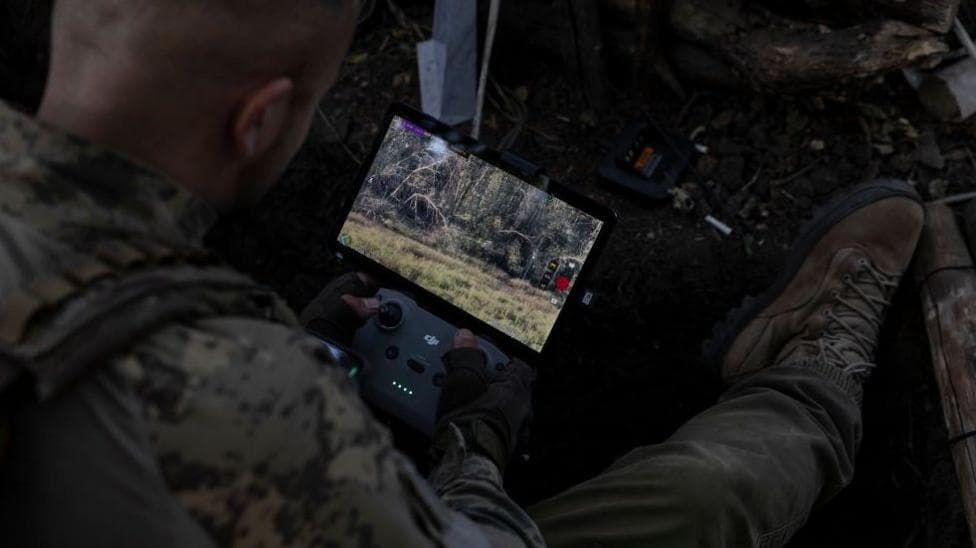
Ukrainian forces adopted Starlink because it offers advantages that conventional military communications systems cannot match. Drones connected to the network maintain stronger connections with their operators over significantly longer distances than traditional radio systems allow, and the satellite-based link is far more resistant to electronic jamming—a tactic Russian forces employ extensively.
The system enables what military analysts call a sensor-to-shooter network, where drones, artillery units, and command posts function as integrated nodes sharing real-time information. This architecture minimizes the delay between detection of a target and engagement, a critical factor in fast-moving combat scenarios. George Barros, Director of Innovation and Open Source Tradecraft at the Institute for the Study of War, described Starlink as
the backbone of military communications in Ukraine, emphasizing that the technology allows
drones, artillery and command posts to function as a single real-time network where the time between sensor-to-shooter is minimized.
The network operates across Ukrainian-controlled and contested airspace but does not function inside Russia itself, limiting its utility for Russian forces. Ukrainian drones can use Starlink satellites to relay targeting data and video feeds back to operators during strikes on Russian territory, providing a communications pathway that has no readily available alternative.
What restrictions did SpaceX impose and why do they matter?
SpaceX implemented a 100 miles per hour (160 kilometers per hour) speed limit on devices connected to Starlink, effective immediately on Tuesday. Serhiy Beskrestnov, an advisor to President Volodymyr Zelensky, stated that Ukrainian officials received no advance warning of the restrictions and were not consulted before they took effect.
The speed cap severely degrades Ukraine's ability to intercept Russian jet-powered Shahed drones, which cruise at speeds exceeding 198 miles per hour. When Starlink-connected Ukrainian interceptor drones are throttled to 100 mph, they cannot match the velocity needed to catch and destroy incoming Russian unmanned aircraft. According to the Institute for the Study of War, the restrictions render Ukrainian efforts to intercept these threats
all but useless.
Tom Whittington, an electronic warfare expert and associate fellow at the Royal United Services Institute, explained that Starlink allows Ukraine to transmit large volumes of data—video feeds, text communications, and voice calls—without requiring the ground infrastructure that conventional mobile networks depend on. The speed restrictions
effectively precludesanything connected to the network from exceeding 100 mph, making drone navigation and control difficult across Ukrainian and Russian-occupied territory.
According to Ukraine's Defense Ministry, connection quality had improved at speeds up to 160 kilometers per hour by 15 October, though the 161 kilometers per hour cap remained in place and restrictions had been tighter earlier in the day. The disruptions also extended beyond drone interception: Ukraine's Defense Ministry reported that the service interruptions affected front-line logistics, reconnaissance operations, and signal relaying in addition to interceptor and mid-range strike drones.
Representatives from Ukraine's 7th Rapid Reaction Corps reported that drones remained airborne during connectivity interruptions, but the dropouts made them significantly harder to control. The unit documented interruptions lasting 10 to 20 seconds when operating at speeds between 110 and 120 kilometers per hour, creating dangerous gaps in operator control during critical missions.
Why does Ukraine believe the restrictions are intentional?
Beskrestnov suggested the timing and nature of the restrictions are not coincidental, linking them to recent tensions between Kyiv and Washington. President Donald Trump has publicly criticized Ukraine's long-range strikes on Russian oil refineries and called for a change in Ukrainian leadership—positions that Elon Musk has echoed in public statements.
The restrictions have drawn attention to the relationship between Starlink, the commercial satellite service, and Starshield, a military-grade variant of the network developed for the Pentagon by SpaceX. While Musk maintains that the two systems are separate entities, they share underlying satellite technology in many operational respects.
In a post on the social media platform X, Musk suggested the U.S. government may bear responsibility for the slowdown affecting Ukrainian Starlink usage.
Starshield systems are owned and controlled by the US government,he wrote.
Any limits on speed or usage are decided by the US military and ultimately POTUS.He continued:
Starlink is a commercial service owned and controlled by SpaceX. Usage of Starlink is limited to civilian or defensive activities and cannot be used for offensive military action, as doing so would be inappropriate for a commercial company.
According to Musk's statements, Starshield speed and usage limits are determined by the U.S. military and ultimately the president, while Starlink is intended for civilian or defensive use rather than offensive military operations.
What is the history of Starlink in the Ukraine-Russia conflict?
Russia launched its full-scale invasion of Ukraine in 2022, and Moscow currently controls approximately 20 percent of Ukrainian territory. SpaceX's satellite communications have proven vital to both Ukrainian and Russian military operations throughout the four-year conflict, including during a Russian attack on a moving passenger train.
Earlier this year, Musk made the decision to restrict Starlink terminal access for Russian forces, a move that significantly blunted Moscow's military advance in Ukraine and created confusion among Russian commanders. Ukraine's former defence minister Mykhailo Fedorov had previously negotiated with Musk to cut off Russian forces' access to Starlink, according to reporting on the latest restrictions.
What happens next?
Ukraine's Defense Ministry stated it is continuing discussions with international partners and SpaceX to secure stable service conditions and prevent sudden restrictions in the future. No timeline for a resolution or decision has been announced. The outcome of these negotiations will likely determine whether Ukrainian forces can restore the operational capabilities that Starlink restrictions have degraded.
Key Facts
- Starlink provides the primary real-time communications network linking Ukrainian drones, artillery, and command posts across all military branches.
- SpaceX imposed a 100 mph speed limit on Starlink-connected devices without advance notice to Ukrainian officials, severely hampering the ability to intercept Russian Shahed drones that travel at 198+ mph.
- The restrictions affect not only drone interception but also front-line logistics, reconnaissance, and signal relaying operations.
- Elon Musk attributed speed limits to U.S. military control of Starshield while claiming Starlink is a commercial service limited to civilian and defensive use.
- Ukraine's Defense Ministry is negotiating with SpaceX and international partners to restore stable service conditions.