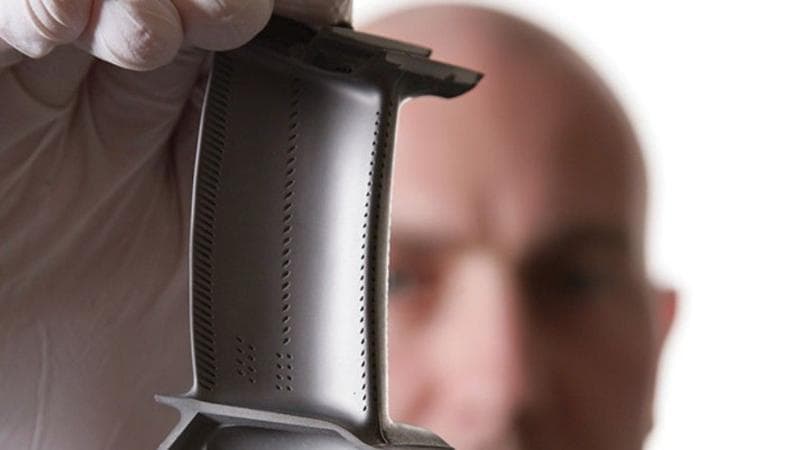
Every commercial flight depends on an extraordinary engineering achievement hidden deep within the aircraft's engines: hundreds of turbine blades that withstand temperatures exceeding 1,500 degrees Celsius and enormous mechanical stresses. These components are not manufactured through conventional cutting or sculpting. Instead, they are grown from molten metal alloy in a process so complex that only a handful of companies worldwide have mastered it.
According to BBC News, this single-crystal casting technology has become so strategically important that major engine manufacturers are restructuring their supply chains to secure access to it. In September, GE Aerospace announced it would acquire its turbine blade supplier for $11.75 billion, a move widely interpreted as an effort to guarantee supply of these critical components.
The process of creating a single-crystal turbine blade began in the 1960s when engineers discovered how to cast molten metal alloy into blade shapes and then cool it with extreme precision over several hours. During this gradual solidification, a single grain of metal alloy forms—comparable to transforming a cup of water into one enormous snowflake of your own design rather than a scattered collection of smaller snowflakes.
It's about as complicated as manufacturing gets,says Ben Fifoot, manufacturing engineer at Rolls-Royce, which produces turbine blades in the UK.
It's a real motivator to get out of bed in the morning.
Only five countries have perfected the complete technology chain for single-crystal blade production: the United States, the United Kingdom, France, Russia, and Japan. Rolls-Royce, GE, and France's Safran rank among the few firms that have achieved this capability. The strategic importance of this technology became evident when GE announced plans to acquire Consolidated Precision Products, with the transaction expected to close in the second half of 2027.
Separately, in March, Rolls-Royce committed to investing more than £19 million in its Rotherham blade casting facility. According to South Yorkshire Combined Authority, the facility is set to double its output by 2030, supported by £19.3 million from the company and a £2 million regional grant. The Rotherham site, which opened in 2015 and employs more than 300 people, manufactures and inspects blades for the Trent XWB-84 engine used on the Airbus A350-900 and the Trent 1000 XE engine used on the Boeing 787.
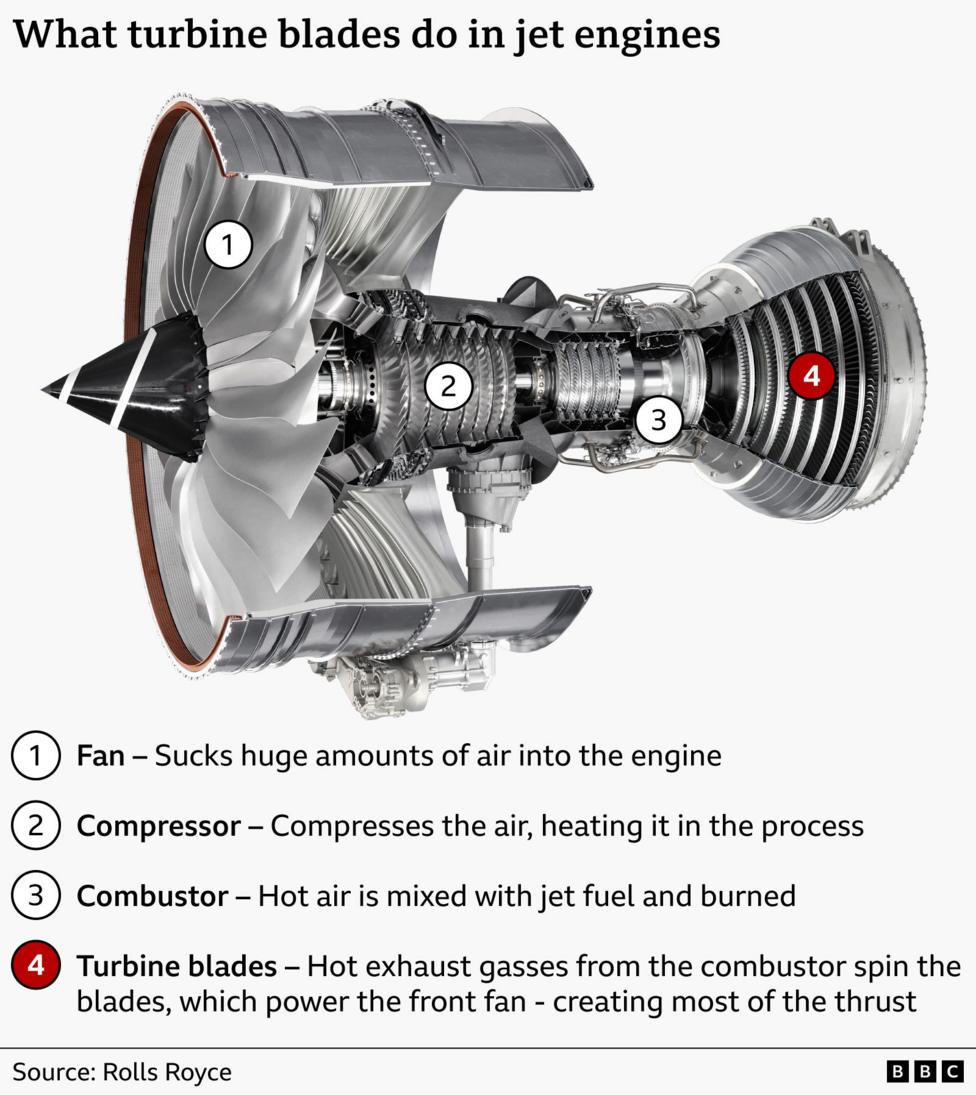
Demand for [turbine blades] is huge. So few companies have managed to do it, which does give it this kind of magical aura,says Bill Sweetman, an aviation industry writer and consultant. He believes GE's acquisition is fundamentally about securing reliability and predictability within the notoriously volatile aircraft manufacturing supply chain.
Why does this ancient process remain so difficult?
The single-crystal casting method, despite existing for decades, remains extraordinarily specialist because achieving a single crystal formation requires fighting against natural physical processes. Each molten blade would naturally cool into a solid object consisting of many small grains of metal alloy, all jumbled together—like a crumbly sugar cube rather than a perfect diamond.
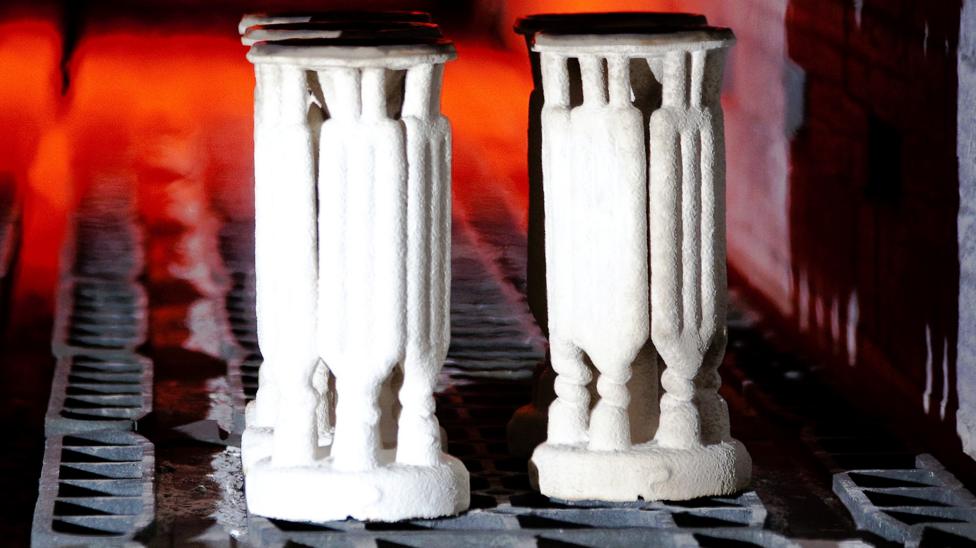
To grow a single crystal into the precise shape of a blade, manufacturers employ a counterintuitive technique called a pigtail: a small spiral at one end of the blade. According to Fifoot, at the beginning of the cooling process, this spiral
chokes the flow of solidifying crystals so that just one takes over.The effect resembles a hairpin corner in a Formula 1 race right before the finish line—one driver can seize the lead and go on to win.
Sometimes we need to play around with the number of turns or the angles on [the pigtail] to try and get more favourable grain,Fifoot explains. Once the blade is formed, this crucial but sacrificial spiral is cut away.
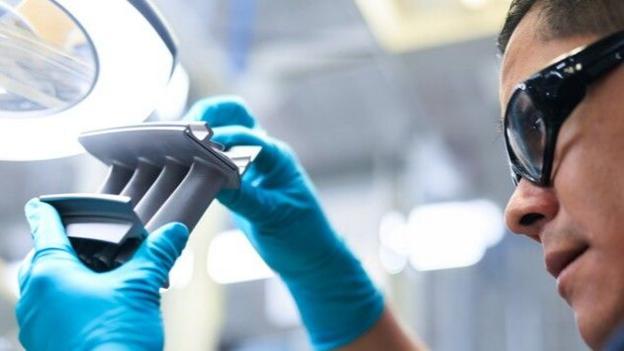
The single-crystal structure is essential to ensure each blade's performance. When a blade does not cool as planned and two crystals form within it instead of one, the metal alloy must be reprocessed so manufacturers can reuse the material.
How do manufacturers protect blades from extreme heat?
Special ceramic coatings shield blades from the extreme temperatures inside engines. Another critical feature is that blades are cast with tiny channels allowing a flow of cooler air to coat them in a protective film while the aircraft engine operates.
The drive at the moment [across the industry] is currently to make those cooling passages really intricate,says Paul Withey, at the University of Birmingham, who formerly worked for Rolls-Royce. The more turbulent those small flows of cool air are, he explains, the more effectively they extract heat from the surrounding, much hotter air.
Blade-makers also pursue reducing the mass of these components as much as possible.
If we can take any weight out of it, you can run that engine more efficiently using less fuel – you can spin it faster and hotter,says Fifoot.
Is China catching up in turbine blade technology?
China aspires to become only the sixth country to master the complete technology chain for single-crystal blade casting. A report in May quoted one engineer at the AECC Beijing Institute of Aeronautical Materials claiming that China had developed a single-crystal alloy
superior to or equivalent to the second-generation single-crystal superalloys widely used in Europe and the USand that it costs less to produce.
However, the West maintains a
huge advantageover China because the majority of commercial airliner production occurs in Western countries, according to Sweetman. Supply chains and the latest innovations are generally concentrated in the West. Additionally, Western manufacturers possess lengthy safety records that inspire confidence in their products.
China must compete across practically every aspect of aircraft manufacturing—not solely on turbine blades—to make serious progress.
You can definitely see that happening but it's a long, uphill struggle,Sweetman adds.
What does rising demand mean for the industry?
Aircraft demand is currently high, already straining various supply chains throughout the industry. According to GE's projections, demand for airfoils—turbine blades and vanes—is expected to rise by more than 30 percent by 2030.
Demand could grow even higher in the coming years, suggests Withey. During the next few years, one of the two main aircraft manufacturers, Airbus or Boeing, could launch a new short-haul plane. The other would then need to follow suit to remain competitive.
There'll be a bun fight,says Withey, over who gets to supply the engines and, by extension, those all-important single-crystal turbine blades.
GE CFO Rahul Ghai characterized the CPP acquisition as a
unique situationand stated it was not a blueprint for integrating every part of the company's supply chain, according to Reuters reporting on the deal.