

The upper stage of a SpaceX Falcon 9 rocket is expected to strike the Moon on 5 August, according to Nasa's Centre for Near-Earth Object Studies (CNEOS). Scientists say the drifting rocket section has been travelling at around 2.43 kilometres per second, or about 5,400mph, and there is no danger to Earth.
The Moon has endured countless blows over millions of years from asteroids, meteors and, more recently, probes and landers sent from Earth. This impact will add another crater to the satellite's already pockmarked surface, while also giving scientists a rare chance to study an accidental collision in detail.
NASA reached its conclusion after independent astronomers, using public data, identified that a portion of the rocket from a January 2025 launch was on an accidental collision course with the Moon. Spokesperson Jimi Russell said NASA would continue to track the booster for training purposes and later observe the impact site for scientific purposes.
The rocket involved was launched by SpaceX as part of a US and Japanese mission to carry a pair of lunar landers and scientific equipment to the Moon last year. While part of the Falcon 9 is reusable and designed to return to Earth for its next mission, other parts are shed in space and can remain there in orbit unless they eventually collide with another celestial body.
What exactly will hit the Moon?
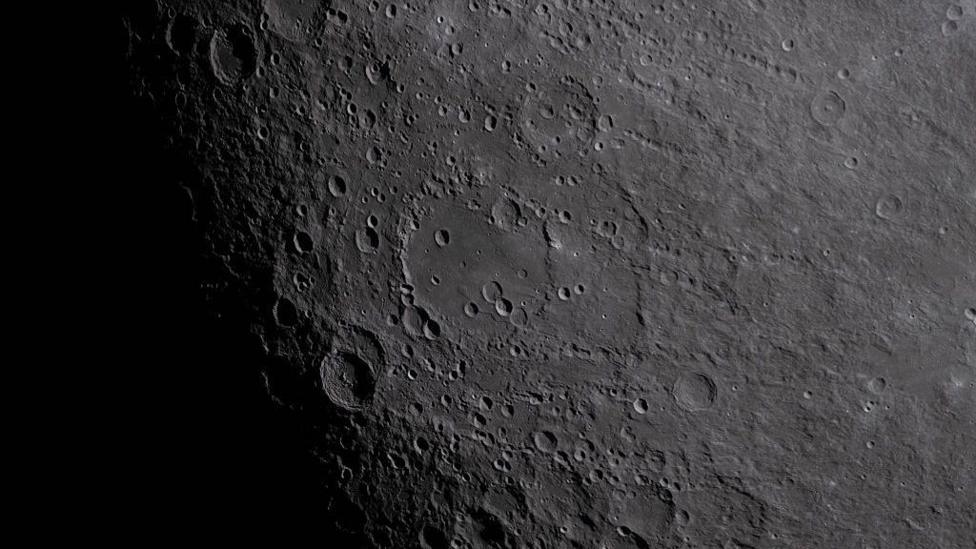
The piece expected to strike the Moon is the upper stage of the rocket, which is about the size of a five-storey building and has a weight on Earth of at least 4,000kg (8,800 lbs). Astronomer Bill Gray, who first discovered the trajectory, says the object will land near the Einstein Crater, on the part of the Moon that receives daylight and is visible from Earth.
Gray predicts the impact will create a crater more than 17m (56ft) in diameter.
When is the collision expected?
The impending collision is predicted to happen at about 02:35 EDT (06:35 GMT) on Wednesday. It is expected to attract the attention of both amateur and professional astronomers, who are eager to observe how the Moon reacts to an impact of this kind.

"It's something really huge smashing into the Moon. It's not remotely dangerous, we can just watch the show," says Dr Matt Bothwell, public astronomer at the University of Cambridge.
"It's going to impact and its going to send up a huge plume of dust, maybe 50km into the air or more, and that's going to spread sideways over time," Bothwell said.
Because the Moon has no atmosphere and far weaker gravity than Earth, Bothwell said the impact will be "more impressive than any [similar] explosion on Earth". Nothing will slow the object down, as the atmosphere would on Earth, and nothing will prevent the estimated million kilograms in debris from rocketing up into space.
The impact will not be visible from Earth with the naked eye, but people with access to a sophisticated telescope may be able to see a flash radiating off the Moon's surface, Bothwell said.
Why are scientists interested in this impact?
Scientists say the collision offers a unique opportunity to study what happens when an object hits the Moon. By observing how much material is thrown up, how high it rises and how it falls back, researchers hope to improve models of lunar impacts and learn more about what lies just beneath the surface at the impact site, where fresh subsurface material will be exposed for the first time.
Big telescopes in the Americas, plus Nasa's Lunar Reconnaissance Orbiter and South Korea's Danuri probe, will track the flash, plume and new crater, while a citizen-science project is signing up keen amateurs to film the impact too. By catching the dust plume in action, astronomers hope to turn this accidental crash into a useful experiment.
Bothwell also said the event should serve as a cautionary tale about the growing amount of human-made space clutter.
"I think more people should be more worried about space debris," Bothwell said. "Every single year we put more stuff in orbit. Sometimes the satellites just collide, and they shatter into more pieces. I think there's a worry about a runaway cascade, if we put so much stuff in orbit."
According to the European Space Agency (ESA), there are around 54,000 objects floating in space that measure larger than 10cm. In total, humans have launched about 17,000 tonnes of objects into space since the Space Age began in 1957.
The last dead rocket to impact the Moon was in 2022, when the Chinese Long March 3C upper stage from the 2014 Chang'e 5‑T1 mission hit the far side of the Moon, which faces away from Earth. Decades earlier, Nasa launched objects into the Moon on purpose in order to collect data for the Apollo missions.
Additional reporting by Pallab Ghosh


