
An international team of physicists has identified a possible dark matter candidate in data from one of the world's most sensitive detection experiments, marking a potential breakthrough in the decades-long hunt for the invisible substance that comprises over 85% of the universe. The finding remains unconfirmed and carries low statistical significance, requiring further investigation before scientists can claim a genuine discovery.
Researchers from the University of Bristol participated in a two-year analysis of data collected by the LUX-ZEPLIN (LZ) detector, housed at the Sanford Underground Research Facility in Lead, South Dakota. The facility, situated approximately one mile beneath the ground in a former gold mine, provides an ideal environment shielded from cosmic radiation that could interfere with measurements. The collaboration involved 250 scientists and engineers from 39 institutions across six countries, including two UK universities.
During the analysis of 2.84 tonne-years of exposure data collected over 220 days from March 2023 to April 2024, the team identified a single high-energy nuclear recoil event measuring 248 ± 23 (stat) ± 23 (sys) keV that could potentially indicate a weakly interacting massive particle (WIMP)—a leading theoretical candidate for dark matter. The researchers tested 616 different models to evaluate the significance of this event.

What makes this finding significant?
The detection represents the kind of rare event that particle physicists have sought for years. Lead researcher Dr Sam Eriksen from the University of Bristol emphasized the cautious nature of the finding, stating
"What we observe is just one high-energy event. We're not claiming this is dark matter at all."He added that the result could represent
"the first step in understanding dark matter as a particle,"though additional research might reveal the particle has no connection to dark matter whatsoever.
The collaboration presented the result at the TeV Particle Astrophysics conference in Tendo, Japan, on 1 September 2026. According to the LZ collaboration's official announcement, the analysis yielded a 2.6 sigma global excess with a 3.4 sigma local maximum across the models tested. For context, the scientific community typically requires a threshold of five sigma—representing a one-in-3.5-million probability of occurring by chance—before declaring a discovery.


Why is the statistical confidence so low?
With only a single candidate event detected, the statistical evidence remains preliminary. Professor Rick Gaitskell from Brown University, a member of the collaboration, cautioned against premature conclusions:
"With only one event, we don't want to get ahead of ourselves. We are not claiming to have seen dark matter. But we have seen something interesting that we want to share with the scientific community for their input."
Professor Henning Flaecher, an experimental particle physicist at the University of Bristol, explained that the team had conducted exhaustive investigations to rule out conventional explanations.
"A huge amount of work had been carried out over countless hours to investigate any previously known reasons researchers might have observed the unusual reaction. To date none provide a convincing explanation."He expressed optimism about future prospects:
"It's an incredibly exciting time, the kind of event every astro-particle physicist dreams of, and we can't wait to analyse more data to see if additional candidate events appear."
How does the LZ detector work?
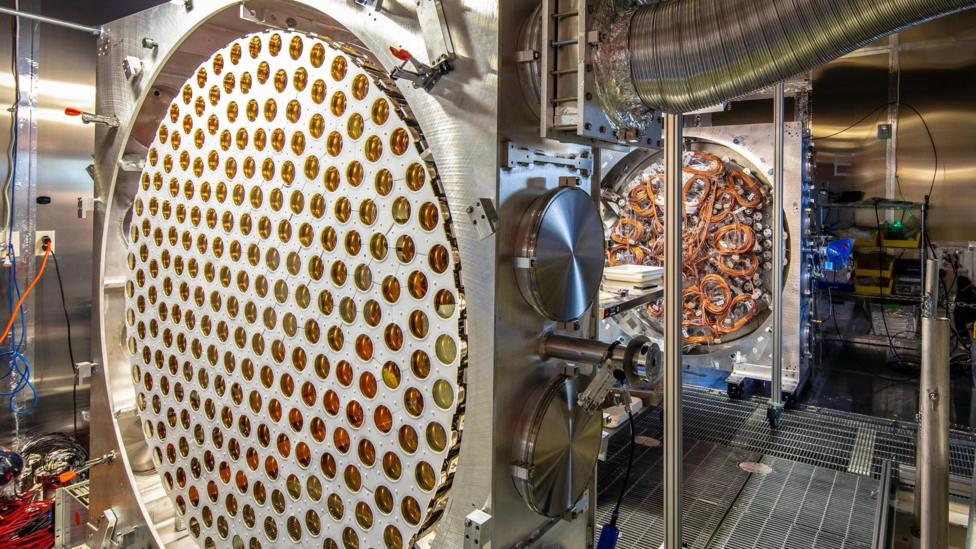
The LUX-ZEPLIN experiment employs extremely sensitive light detectors to capture signals from particle interactions. When a WIMP collides with an atomic nucleus, it produces a faint flash of light that the detector's photomultiplier tubes can register. The underground location is critical: the mile-deep position shields the apparatus from cosmic rays that would otherwise generate false signals and obscure genuine dark matter events. According to reporting on the collaboration's work, WIMPs represent one of the leading proposed dark matter candidates, and the LZ experiment has previously set world-leading limits on such particles above 5 GeV/c².
What happens next?
According to the LZ collaboration, the paper describing these findings will be posted on arXiv and subsequently submitted to Physical Review Letters for peer review. The experiment is expected to continue collecting data until at least 2028, providing opportunities to identify additional candidate events that could either strengthen or refute the significance of the current observation. Only through accumulation of more events can researchers determine whether this signal represents genuine dark matter detection or a statistical fluctuation.
Why does dark matter matter?
Although scientists have long been confident in dark matter's existence—inferred from its gravitational effects on visible matter, radiation, and the large-scale structure of the universe—the substance has never been directly detected because it emits no light and interacts only through gravity. Understanding dark matter's fundamental nature would represent a major advance in physics, potentially revealing new particles and forces beyond the current Standard Model. The invisible substance's dominance in the universe's mass composition makes its detection one of the most important unsolved problems in modern science.