

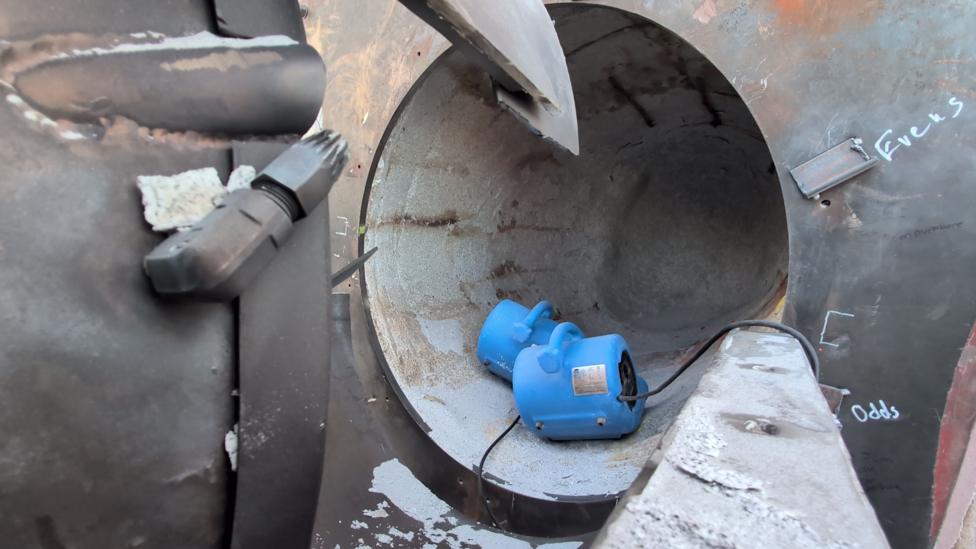
A California quarry became the testing ground in January 2026 for a machine that its creators hope will transform how the world buries power lines, data centres and other critical infrastructure. EarthGrid's tunnel-boring machine used three plasma torches reaching 27,000C to melt through a wall of granite, and founder Troy Helming says the January trial cut through three metres of rock. The demonstration is part of a wider push by engineering firms to move sensitive infrastructure underground, driven partly by lessons from Russia's war in Ukraine about the vulnerability of above-ground facilities to drone strikes.
Helming compared the start-up sequence of the machine to a rocket launch.
"It's kind of like igniting a rocket"
He said the torches, mounted on a spinning head, quieten once they begin producing the superheated plasma stream, which is significantly hotter than the surface of the Sun.
How does the machine actually cut through rock?
The plasma torches generate a spinning vortex inside the tunnel that both melts the granite and clears away the resulting debris, which Helming says at times takes the form of lava.
"We create, basically, a tornado – a violent vortex inside the tunnel"
He described an emotional reaction to watching the test succeed after a decade of development.
"I actually got a little bit emotional watching it. I've been waiting for this moment for 10 years."
The January test was not flawless: Helming said the machine "over-bored" slightly toward the top and left of the tunnel. His team now plans to have the vortex alternate spin direction roughly every five minutes to correct the drift, with commercial deployment hoped for as early as 2026.
What is EarthGrid planning next?
According to a portfolio update published in August 2026, field testing of the tunnel-boring robot was set to begin that autumn near Fresno, California, with commercialisation still expected within the year. EarthGrid's own site, updated as recently as 13 August 2026, indicates the company continues to actively promote its plasma-tunnelling technology, according to EarthGrid's website. Separately, the company's news page states that its Plasma Excavation System was successfully deployed in Raymond, California, in late June, according to EarthGrid's announcement.
EarthGrid's tunnelling page claims the system runs on only air and power, can advance up to 100 metres per day, and could be up to ten times cheaper and 100 times faster than conventional hard-rock boring, according to the company's technical page. The firm has already moved beyond prototypes commercially: in March 2025 it announced a joint venture with EnerTech, a KIA entity, to deploy $18 billion in underground utility projects across the United States, according to EarthGrid's press release. In 2026 it also announced a collaboration with CyberTran aimed at supporting next-generation underground "SuperGrid" systems spanning energy, data, communications, water and freight, according to a joint statement from the two companies.
Helming says he has already fielded interest in using the machine to lay power and fibre-optic cables, as well as pipelines for water, natural gas or ammonia. One proposal under consideration would use the tunnels for an underground freight-distribution network serving airports and warehouses.
"To take more trucks off the road"
Why is underground infrastructure suddenly in demand?
Engineering firms report growing interest in undergrounding partly because of the war in Ukraine, which exposed how exposed surface-level infrastructure can be to drone attacks. Alexander RE Taylor, senior lecturer in communications at the University of Exeter, has tracked what he calls a "data bunker boom" in which data centres are increasingly built below ground.
"What we're seeing is that brutal materiality is still important"
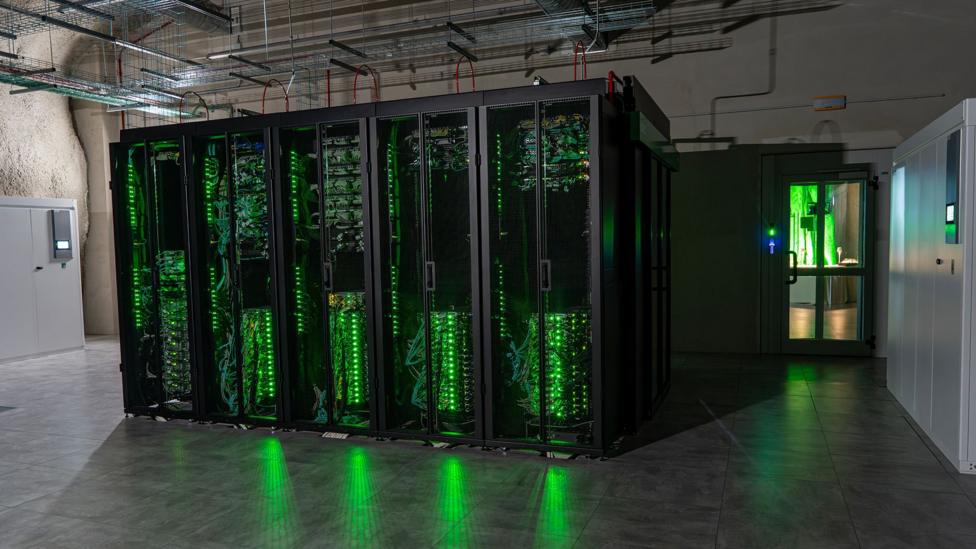
One example is a data centre completed earlier this year inside Italy's Dolomite Mountains. Freshly excavated caverns 100 metres underground now sit alongside spaces once used to store sparkling wine, apples and cheese. The naturally cool environment at Trentino DataMine reduces the energy needed to keep servers cool. Chief executive Dennis Bonn said the surrounding rock offers protection well beyond what surface facilities can match.

"Ninety million cubic metres of dolomite rock provide natural protection against physical intrusion, electromagnetic interference, seismic events and hydrogeological risks - levels of protection that simply cannot be replicated above ground."
The rising demand for data centre capacity has already created friction elsewhere in the energy system. According to our earlier reporting, government plans to prioritise AI data centres for electricity grid connections have prompted builders to warn that new housing projects could face delays as demand for power surges. Undergrounding facilities such as Trentino DataMine, insulated from many surface pressures, may offer one route around some of those competing demands.
Are undersea cables also moving underground?
Subsea internet cables, which can stretch thousands of kilometres across ocean floors, are occasionally damaged by ship anchors. Lane Burdette, senior analyst at telecoms market research firm TeleGeography, says burying more of these cables appears to be reducing the rate of faults per kilometre of deployed cable.
"Submarine cables are increasingly being buried up to three meters deep. In some fault-prone areas, they are buried along their entire lengths."
Taylor argues that a range of examples, from wartime tunnel networks to hardened nuclear sites, show that placing infrastructure underground or inside caves remains an effective defensive strategy.
"The tunnels that Al-Qaeda were using were a major strategic problem for the US [during the war in Afghanistan]"
He also pointed to the attention drawn by Iran's underground nuclear facilities, which have proven difficult to destroy from the surface.
Is this shift visible everywhere?
Robbie McGoran, head of work winning and business development at civil engineering and tunnelling firm Joseph Gallagher, says the war in Ukraine has clearly affected demand in some regions.
"They're very cautious about who they'll even let do their work – and also burying [infrastructure] and making sure it's well protected. We are noticing that"
McGoran says countries bordering Russia are increasingly asking about undergrounding options. He also credits newer laser-guidance systems and gyroscopes, which help machines track their position underground, with improving tunnelling accuracy in recent years. Even so, progress remains slow by conventional standards.
"We usually measure [progress] in millimetres per minute"
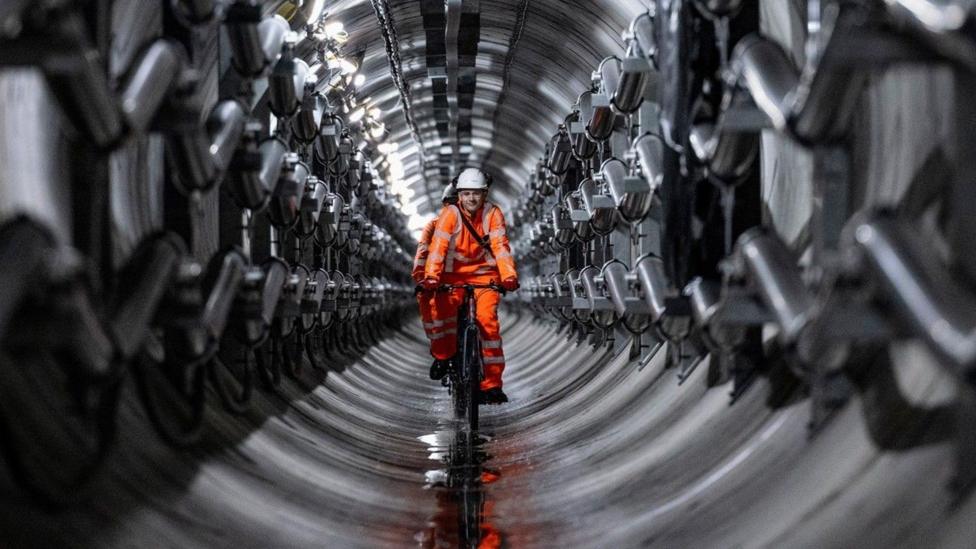
In the United Kingdom, Mark Neller, energy leader for Europe, India, the Middle East and Africa at engineering consultants Arup, says there is not yet a clear trend toward burying critical infrastructure. He and colleagues worked on the £1 billion London Power Tunnels project, which built 18 miles (29km) of tunnels beneath London to house large electricity cables. Neller says tunnelling suited that dense urban setting but is often several times more expensive than above-ground alternatives, meaning that in many locations, simply adding extra circuits provides adequate resilience instead.
"That's actually a much more cost-effective way. The electricity system [in Great Britain] is designed with quite a lot of redundancy built into it."
This tension between cost and resilience echoes a broader debate over Britain's electricity network. Our earlier coverage detailed how a £60 billion overhaul of the UK electricity grid is under way to carry renewable power from northern Scotland to the south using new high-voltage lines and subsea cables, a programme that has faced community opposition and complex planning hurdles. Whether undergrounding becomes a bigger part of that overhaul may depend on how far costs like those Neller describes can fall.
Could this connect to other underground energy technology?
Separately, other companies are exploring what lies beneath the surface for a different purpose: extracting heat rather than burying equipment. As detailed in our earlier reporting, geothermal energy projects are testing technologies such as millimetre wave drilling to reach hotter resources deeper underground, though costs remain high despite bipartisan political support. The same appetite for underground engineering solutions appears to be driving interest in both geothermal drilling and plasma-based tunnelling, even though the two technologies serve very different purposes.
What lessons come from Cold War-era bunker planning?
Richard Little, infrastructure policy consultant and editor of the Journal of Critical Infrastructure Policy, recalls that fears of nuclear war during the Cold War made underground bunkers a recurring topic in Western policy circles. Switzerland still requires that every citizen have access to a nuclear bunker, and many apartment buildings there include such facilities in their basements.
"A lot of it was real Dr Strangelove stuff. The world's going to end but I guess we'll maybe harbour a few hundred critical people down here and they'll survive."
Little, who helped author policy documents on underground critical infrastructure during the 1990s, says planners eventually recognised the limits of the approach.
"It became obvious rather quickly that you can't put everything underground."
He suggests today's focus should be on identifying specific facilities that would be especially hard to rebuild or replace if attacked, citing computer chip manufacturing as one possible candidate for undergrounding.
"Underground facilities, I'm sure in certain instances, would make a great deal of sense – but it's all about what's critical."
Key Facts
- EarthGrid's plasma-based tunnel-boring machine reached 27,000C during a January 2026 test in a California quarry, cutting through three metres of granite.
- The company's tunnelling technology reportedly runs on air and power alone and could advance up to 100 metres per day, according to EarthGrid's own materials.
- EarthGrid announced an $18 billion joint venture with EnerTech, a KIA entity, in March 2025 to deploy underground utility projects across the United States.
- Field testing of the tunnel-boring robot was expected to begin in autumn 2026 near Fresno, California, with commercial deployment targeted for the same year.
- London's £1 billion Power Tunnels project built 18 miles of tunnels beneath the city to house high-capacity electricity cables.


