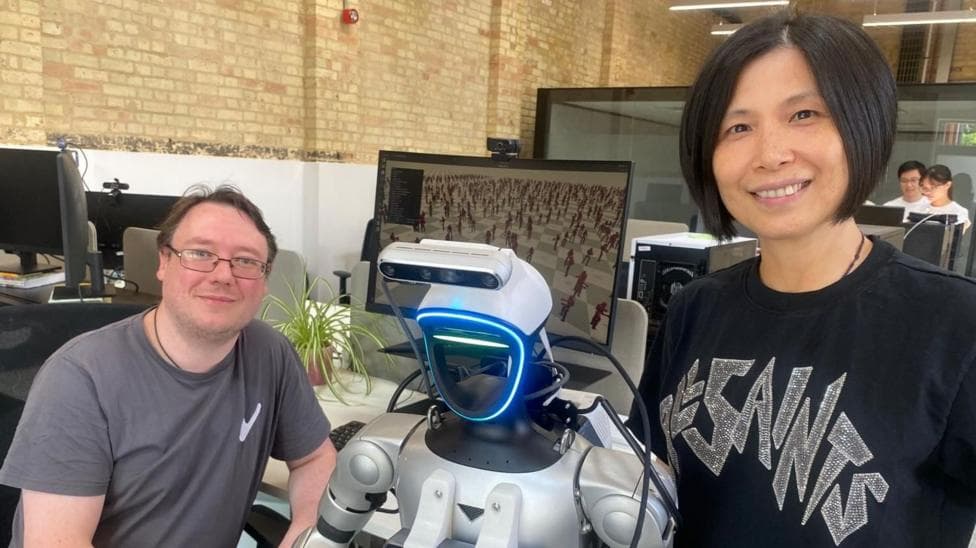
Freddo the robot strides across an office floor and accepts a plastic bottle handed to it by a staff member. While a robot recently surpassed Usain Bolt's 100-metre sprint time, this particular feat may seem unremarkable. Yet the velocity at which Freddo acquired the ability to walk, identify the bottle and grip it represents a significant breakthrough. Training took only minutes, and the developers claim competing systems require days to reach equivalent proficiency.
The technology behind Freddo originates from Vsim, a Cambridge-based start-up founded by Michelle Lu and Kier Storey. Their ambition is to develop software capable of enabling robots to navigate and perform practical functions in homes and offices. The pair previously contributed to early iterations of Nvidia's Isaac Sim platform before launching their own venture in 2022.
Kier Storey highlights a paradox in robotics development:
It's a weird situation with robotics because actually the stuff that we find as humans to be incredibly difficult, like gymnastics, you can get robots to do reasonably well. The stuff that humans are really good at, like fine dexterity, is really hard in robots.
How do robots learn new skills so quickly?
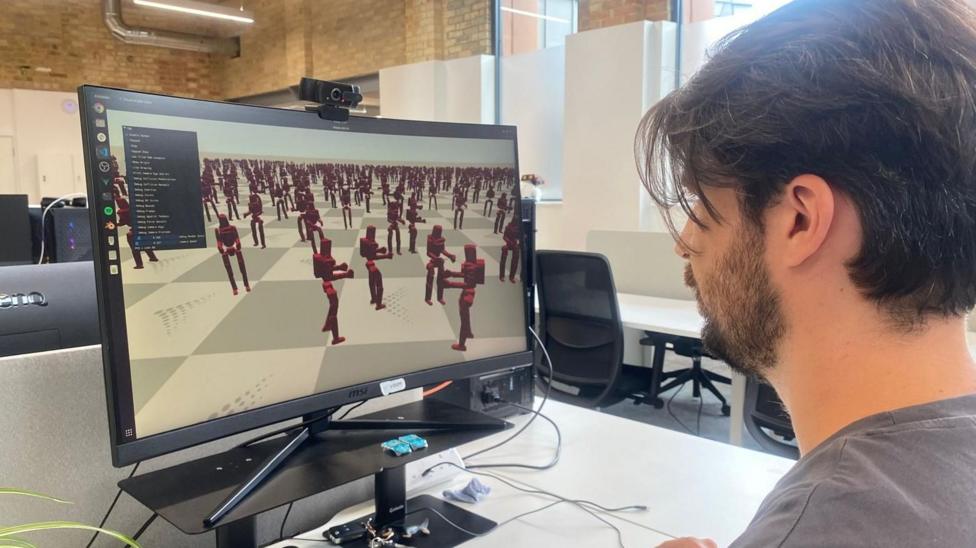
Freddo's capabilities were developed within a virtual environment where tasks execute millions of times in computer simulations. Once the system identifies the optimal approach (termed a policy), it transfers to the physical hardware. This simulation-based training method has become standard across the robotics industry.
Nvidia's Isaac Sim represents the dominant platform in this space, and Lu and Storey recognised an opportunity to build their own system from the ground up. This approach allowed them to optimise their software specifically for graphics processing units (GPUs)—the specialised computer chips powering artificial intelligence systems.
Storey explains the technical advantage:
The underlying algorithms that we were using for most of these robotic simulations they hark back to the 1970s and 1980s, but those algorithms are not really brilliant fits for GPUs.By redesigning these foundational algorithms, Vsim achieved performance levels that exceeded anything the founders had previously encountered. Within eighteen months, Lu reports that
we actually have a completely functional, super high-performance simulator.
The efficiency of Vsim's software enables it to run on Freddo's onboard hardware. This means the robot can execute tens of thousands of simulations while moving through its environment. Storey elaborates:
It can look about a second, or so, ahead into the future for 20,000 different kind of combinations of things that might happen.Such capability proves essential for robots operating in unstructured spaces like typical homes, where unpredictable events demand rapid adaptation.
Lu emphasises the safety implications:
Things outside of the robot's control, like humans, animals or even other robots, could do things that require a change of strategy. These unexpected events could happen very quickly and the robot needs to be able to quickly adapt to ensure its actions remain safe and on-mission.
How does Vsim compare to larger competitors?
Vsim operates as a lean operation with ten engineers, contrasting sharply with Nvidia's dominance in AI chip manufacturing and its extensive robotics software division employing hundreds of engineers. Rather than manufacturing robots directly, Nvidia provides a comprehensive software suite enabling organisations to train and deploy robotic systems.
Nvidia's offerings include virtual simulation training systems and a world model called Cosmos, which furnishes robots with an understanding of real-world physics and environmental dynamics. However, even with Nvidia's substantial computational resources, the software provides only elementary comprehension of the physical world.

Spencer Huang, director of product for robotics at Nvidia, acknowledges this limitation:
Manipulation, - where I just grab a bottle, that's not too hard. The problem is when you start doing long-horizon tasks, where I say: 'I want you to take the bottle and I want you to fill it up and I want you to go pour'.
Huang remains optimistic about progress. During 2026, Nvidia has deployed artificial intelligence agents to construct virtual environments for robot training and validate whether training solutions function in practice.
When we talk about creating the [virtual] world and actually scanning it in - a lot of that is actually manual labour. We're just throwing agents at it... it's basically given us a huge workforce.
According to Nvidia's robotics platform documentation, the company has established a workflow combining synthetic data generation, model training, post-training validation, and deployment across Isaac Sim, Isaac Lab, and Jetson hardware. Isaac Lab 3.0 entered early access in March 2026, designed to accelerate large-scale robot learning on high-performance computing infrastructure.
What alternative training methods exist?
Virtual simulation represents one approach among several. Robots can also learn by observing human demonstrations or analysing video footage. Rika Antonova, an associate professor at the Department of Computer Science and Technology at the University of Cambridge, has devoted more than a decade to robotics research. Her work concentrates on developing software and hardware enabling robots to acquire complex behaviours.

Antonova employs MuJoCo, a training system owned by Google's DeepMind since 2021. As open-source software, it permits researchers to use and modify the code without cost. She notes that
It is very, very user-friendly. So for research groups or for small start-ups, that's useful.
Regarding Vsim's methodology, Antonova observes:
If you have a very, very fast simulator, then you can simulate hundreds of millions of samples in that few seconds that your robot is thinking about how to adjust its motion, and then you can change the motion almost in real time.
However, simulated environments remain imperfect approximations of reality, constraining what training can accomplish. Antonova identifies specific challenges:
There are certain things that are hard to model in simulation, like highly deformable objects and cutting.Both Nvidia and the Vsim team are actively addressing this constraint.
What developments lie ahead?
Lu describes their current focus as having
reduced approximation, using accurate simulations to train models that genuinely work in reality as well as they do in simulations.A second robot, designated Nacho, will soon join Freddo in advancing this technology. Lu anticipates this addition will accelerate development and demonstrate that their software functions across different hardware platforms.
The broader robotics sector continues expanding. AWS documented in January 2026 that its VAMS workflow integrates with Isaac Lab for GPU-accelerated robotic reinforcement learning, illustrating how simulation-based training has become central to industry practice. Meanwhile, Chinese start-ups are advancing robotic hands to transform humanoid robots into practical tools, and Chinese robots have begun reshaping UK retail warehouses, with companies like Geek+ deploying thousands of units across British distribution centres.
The convergence of faster simulation, improved algorithms, and expanding hardware deployment suggests that robots capable of performing useful domestic and workplace tasks may transition from laboratory demonstrations to widespread practical use within the coming years.