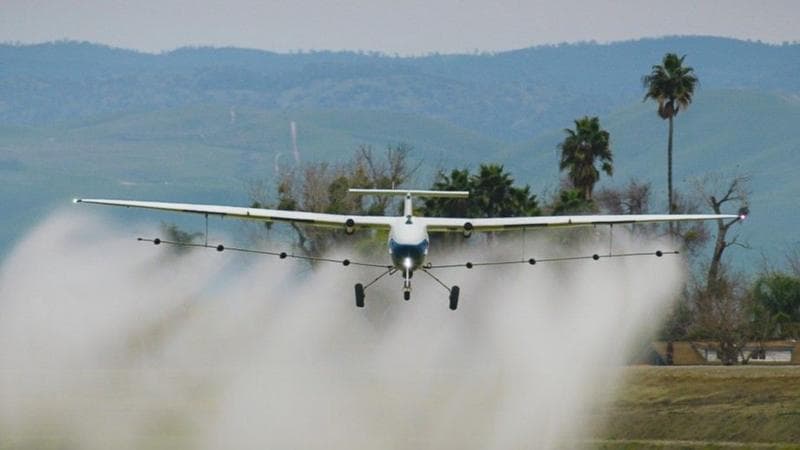
Over an alfalfa field in California's San Joaquin Valley, a small crop-spraying plane descends to a height that would alarm most observers. Yet there is minimal danger to people on the ground—the aircraft has no pilot aboard.
"We can actually go lower than a human pilot can,"explains Russ Marotzke, a flight test engineer at Pyka, as the unmanned aircraft skims across the vegetation below.
Operating at lower altitudes reduces spray drift and cuts the volume of chemicals required compared with traditional manned crop-dusting operations, Marotzke notes. The pilotless aircraft belongs to Pyka, a startup based in a converted Second World War hangar overlooking San Francisco Bay that manufactures self-flying aircraft without cockpits. The company designs these machines either to spray crops or transport cargo.
Pyka is part of a small cohort of firms competing to bring autonomous fixed-wing aircraft into commercial operation. While electric vertical take-off and landing (eVTOL) aircraft—often called urban air taxis—have dominated public conversation around autonomous aviation, a parallel effort is underway to deploy self-flying planes for tasks including crop spraying and cargo delivery, with many manufacturers eventually aiming to carry passengers.
"A fully scaled, ubiquitous passenger operation is the holy grail,"says Michael Norcia, Pyka's co-founder and CEO, who envisions a substantial fleet of minibus-capacity Pyka aircraft transporting passengers along the US east and west coasts.
"There's a decent chance we'll get to that point before the eVTOL industry."
How do these aircraft operate?
A test site roughly 80 kilometres (50 miles) east of Pyka's factory, accessible by a rough dirt road, demonstrates the technology in action. On this day, Marotzke and an associate are evaluating a software update on a demonstration aircraft.
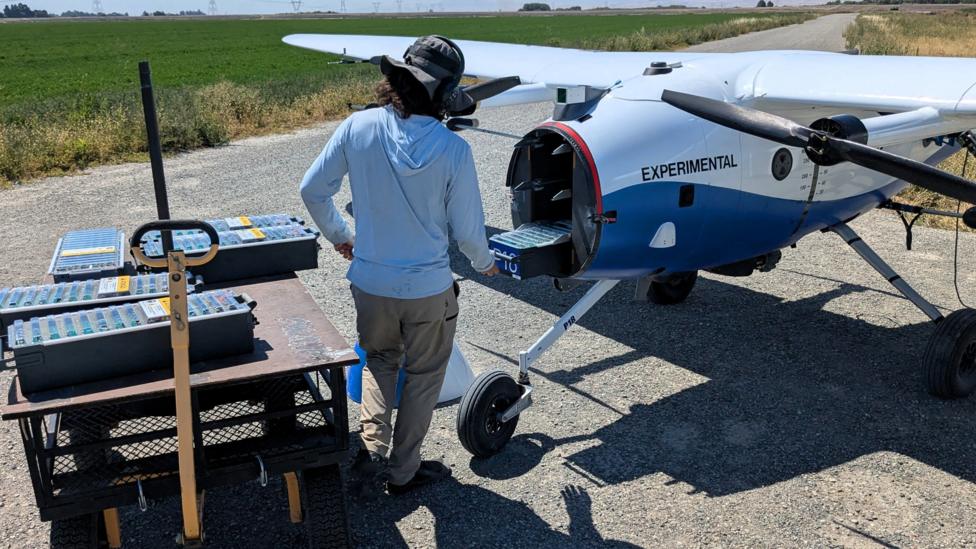
The crop-spraying plane runs entirely on electric power, with its battery housed in the nose section. It can remain airborne for approximately 35 minutes and carries up to 300 litres of spray in a central tank. Though sometimes referred to as large drones, the description undersells them: all Pyka aircraft have wingspans of 11.5 metres.
Inside a shipping container positioned beside the field, engineers use a computer to designate the area requiring treatment. The software calculates the flight path, accounting for obstacles such as nearby power lines that have already been catalogued in the system. The aircraft takes off smoothly along a runway beside the field. After roughly 15 minutes, once it detects that its spray supply is depleted—water is used for this demonstration—the plane lands itself for manual refilling and a battery swap demonstration. It then launches again to resume spraying at precisely the point where it stopped.
What is the difference between autonomous flight and autopilot?
Autonomous flight differs fundamentally from autopilot. Autopilot functions as an assistance system, comparable to cruise control and lane-keeping technology in automobiles. Autonomous systems, by contrast, manage the entire flight cycle—including take-off and landing—with minimal or no human involvement, employing algorithms to interpret sensor information and direct the aircraft.
Self-flying planes have taken longer to develop than self-driving cars, despite operating in what is typically viewed as a more orderly and foreseeable setting. This delay stems partly from the fact that major technology firms
"doubled down"on cars, channelling enormous resources into that sector, according to Mykel Kochenderfer, a specialist in safe aviation autonomy at Stanford University. Additionally, aircraft face stricter safety requirements than cars, establishing a substantially higher threshold for approval.
"The consequences for air accidents can just be so severe,"Kochenderfer observes. Military backing has been instrumental in advancing the technology. Numerous companies maintain defence contracts to demonstrate and evaluate their systems, often encountering fewer regulatory obstacles than in civilian applications, and some are already serving military clients.
What regulatory approvals exist today?
In the United States, Pyka's crop sprayer represents the largest autonomous fixed-wing aircraft authorised for commercial civilian use to date, having secured approval in the previous year. However, operations remain confined to a narrowly defined agricultural context and mandate a ground operator and visual observer. Pyka obtained comparable authorisation in Brazil earlier, where regulatory frameworks are less stringent.
Pyka is targeting a production increase from roughly two dozen aircraft annually at present to 1,000 by 2030. Each aircraft carries a price tag of $550,000, and customers receive training to operate them. According to recent reports on Pyka's expansion, the company had delivered seven Pelican 2 aircraft by the end of 2025 and aimed to deliver 30 more by the end of 2026, with orders extending into 2027 and 2028. The Pelican 2 now features a 300-litre payload capacity and can operate at up to 100 hectares per hour, making it the largest autonomous agricultural aircraft in the world according to the manufacturer.
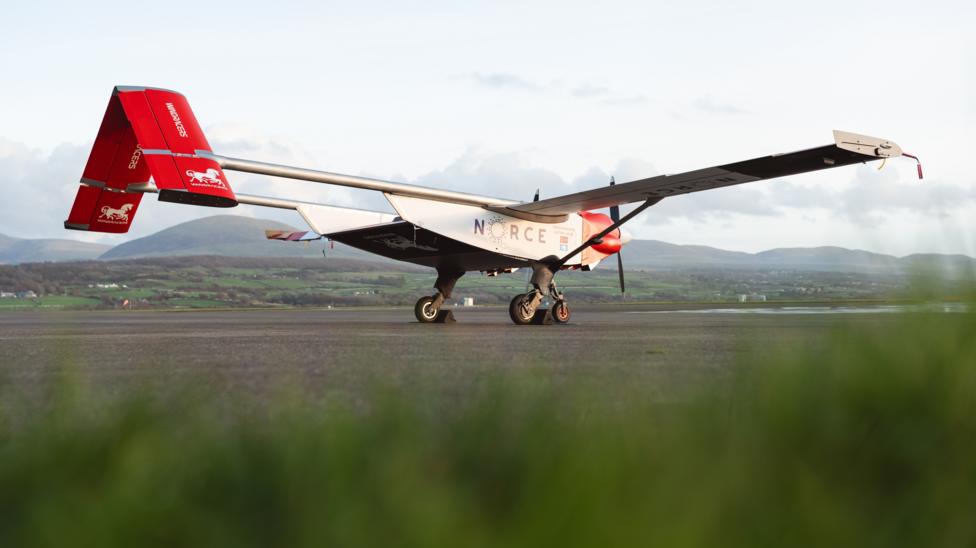
The UK has not yet approved any such extended operations, though the British firm Windracers is pursuing permission to establish an autonomous cargo service in Shetland and Orkney. Its aircraft, engineered to deliver goods to isolated regions, are also conducting missions in Ukraine.
"It would be the first heavy-lift air cargo service by drone certainly in the UK and probably anywhere,"states Stephen Wright, Windracers founder and chairman.

What are the potential benefits?
Advocates contend that autonomous aircraft could mitigate pilot scarcity, eliminate people from hazardous activities such as crop spraying, boost operational efficiency—for instance, by enabling aircraft to transport greater cargo loads—and reduce expenses if a single operator can oversee numerous planes. They further argue that automation could enhance flight safety, citing historical reductions in accidents as more automated systems have been incorporated into aviation.
The US Air Line Pilots Association (ALPA) characterises the removal of pilots as
"a serious gamble with safety and a step too far".The US National Agricultural Aviation Association, representing crop dusting pilots, raises concerns that small uncrewed aircraft are difficult for its aviators to detect. Piloted aircraft, the association contends, can treat a substantially larger area more rapidly.
How do manufacturers approach autonomous system design?
Pyka and Windracers construct aircraft from the ground up, arguing that this method permits autonomy to be integrated from inception and allows the aircraft to be tailored to its specific function. Other companies are retrofitting existing larger aircraft with autonomous technology.
Backed by Boeing's investment division, the US-based firm Reliable Robotics is currently trialling its system on the Cessna 208B Grand Caravan, a single-pilot cargo aircraft capable of transporting roughly 1,360 kilograms of payload across hundreds of kilometres.
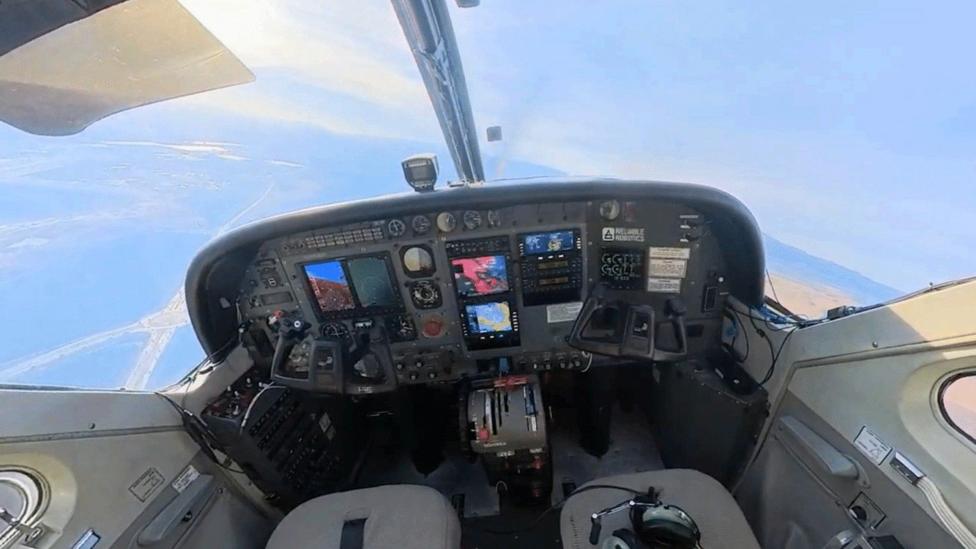
Retrofitting onto certified aircraft permits the company to concentrate exclusively on validating the autonomous system's safety rather than also pursuing approval for a novel aircraft design, explains Robert Rose, Reliable Robotics' co-founder and CEO. Merlin Labs, also US-based, has been progressing through progressively larger military aircraft and is now deploying its system to the two-pilot Lockheed Martin C-130J military transport plane, with commercial multi-crew cargo aircraft to follow.
"It is a common autonomy brain that can transition between different aircraft,"explains Matt George, Merlin's founder and CEO.
How do companies differ on artificial intelligence?
The firms diverge significantly in their approach to artificial intelligence. Reliable is eschewing it entirely, contending that it would complicate the certification process. Merlin, conversely, is adopting a substantially more AI-focused strategy. This division is evident in so-called detect and avoid systems.
One of autonomous aviation's most formidable obstacles is replicating a pilot's capacity to identify and manoeuvre safely around other aircraft and obstacles, with virtually no tolerance for failure. With no universally accepted solution yet available, companies are deploying varied sensor configurations and duplicating existing standard systems to furnish additional redundancy.
Reliable has incorporated forward-looking air-to-air radar capable of detecting other aircraft more than eight kilometres away, paired with software that adheres to predetermined rules to establish the aircraft's response. Rose asserts it is
"better than a pilot's eyeballs"."Merlin, meanwhile, employs AI-powered cameras to identify and categorise objects. Pyka has relied on lidar from the outset to sense trees, vehicles, large birds and terrain. Given lidar's restricted range, the company intends to incorporate AI-powered cameras, marking its initial substantial use of AI onboard.
"For a lot of things there's no need to use AI…but for figuring out that six pixels in the distance are an airplane versus some other smudge, it is perfect territory,"says Norcia.
How will aircraft communicate with air traffic control?
The AI question also applies to interactions with air traffic control. In shared airspace, aircraft must be capable of receiving, comprehending and reacting to radio instructions, ordinarily issued by air traffic control. Reliable's approach involves stationing a remote pilot on the ground, initially fully qualified, to manage communications and make safety-critical determinations. Merlin intends to employ generative AI, trained on thousands of hours of documented exchanges, to comprehend instructions and respond independently.
"Our problem is harder… but we want to move beyond remote piloting,"says George. Merlin plans to progressively decrease pilot involvement, moving from two pilots to one and ultimately to none. Pyka, according to Norcia, prefers to allow others to
"blaze the trail"in determining the optimal approach to functioning in shared airspace.
What recent developments has Pyka announced?
Beyond its agricultural operations, Pyka has expanded into military logistics and defence applications. The company completed the first flight of its DropShip heavy-lift autonomous aircraft on 27 April 2026, a platform designed for cargo transport in contested environments. The DropShip carries a payload of up to 550 pounds and has a ferry range of 3,500 miles. Subsequently, Pyka executed autonomous airdrop resupply and casualty-evacuation missions during the U.S. Army Reserve CSTX exercise on 30 June 2026. On 11 June 2026, Pyka unveiled a fully autonomous low-altitude parachute airdrop capability for its DropShip platform, broadening the aircraft's operational scope beyond traditional cargo delivery.
In April 2026, Pyka's Pelican 2 was selected as the lead technology partner for California's Zero-Emission Aviation Demonstration project, a multi-year state-backed initiative to assess large-scale commercial autonomous agricultural aviation. This selection underscores the growing confidence in autonomous crop-spraying technology among government and environmental stakeholders.
What comes next?
Pyka has committed to delivering an additional 30 Pelican 2 aircraft by the end of 2026, with orders already secured extending into 2027 and 2028. The California Zero-Emission Aviation Demonstration project is structured as a multi-year undertaking, indicating sustained testing and deployment activity beyond 2026. Merlin and Reliable Robotics continue to advance their respective systems toward certification for larger commercial operations, while Windracers pursues UK regulatory approval for its cargo service in northern Scotland.
Even if fully autonomous passenger flight remains distant, many industry observers anticipate that the technology being developed will gradually integrate into commercial aviation, potentially rendering piloted flying safer. That prospect, the US pilots' association acknowledges, would represent a constructive development for the aviation sector.