

Indian astrophysicists say new observations from Aditya-L1, the country's first solar observatory in space, have shed fresh light on one of astronomy's oldest puzzles: why the Sun's outer atmosphere, the corona, burns millions of degrees hotter than its surface, and how it stays that hot despite repeatedly losing enormous amounts of energy in eruptions. The findings, led by Prof R Ramesh of the Indian Institute of Astrophysics (IIA), were published in a recent paper in the Astrophysical Journal Letters.
Prof Ramesh describes the temperature pattern across the Sun's layers as something that appears to contradict ordinary physical expectations.
The temperature variations in different regions of the Sun defy the laws of physics.
Beneath the Sun's visible surface lies a structure of dramatically shifting temperatures. At the core, conditions reach roughly 15 million degrees Celsius. Moving outward to the photosphere - the layer visible from Earth - temperatures drop sharply to around 5,500C. Yet further out still, in the corona, temperatures climb again to about 2 million C, occasionally spiking as high as 40 million C. Separately, the Indian space agency ISRO has described the corona as exceeding a million degrees Kelvin while the visible solar disc sits at roughly 6,000 K, according to a report citing the agency's mission overview.

Why does the corona not simply cool down?
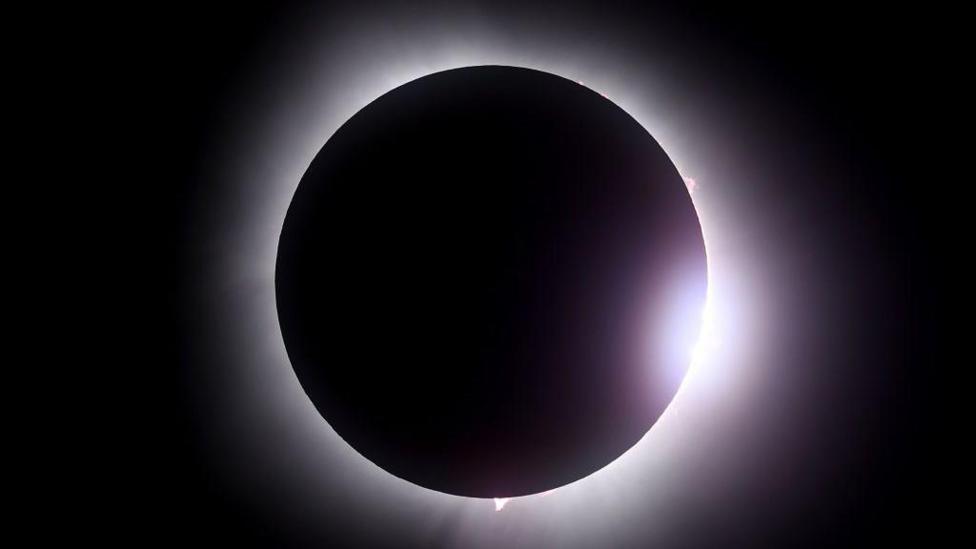
The corona is the site of violent solar weather events, including solar flares and coronal mass ejections (CMEs), during which the Sun hurls vast quantities of energy and charged particles into space. These eruptions produce auroras on Earth but can also disrupt power grids, satellite communications and weather systems through geomagnetic storms, Prof Ramesh explains. During quieter periods the Sun releases two to three CMEs daily, but that number can climb past ten a day during the peak of its roughly 11-year activity cycle.
Now if the Sun is losing such huge amounts of energy with each CME and it's not replenished, the star at the centre of our solar system would lose all its energy and Earth would plunge into an irreversible deep freeze.
Because that catastrophic cooling does not occur, Prof Ramesh argues there must be some mechanism continually restoring the corona's extreme heat.
What mechanisms are keeping the corona so hot?
Scientists attribute the corona's persistent heat to two competing processes. The first involves turbulent, boiling motions on the Sun's surface that generate waves capable of carrying energy outward into the corona, much as ocean waves push foam onto a shoreline. The second involves tangled magnetic field lines in the Sun's atmosphere that continuously snap apart and reconnect.
Prof Ramesh explains that CMEs occur when these twisted, braid-like magnetic structures rupture, ejecting massive clouds of magnetised plasma and gas into space. Such eruptions tend to originate near sunspots - cooler, darker regions where magnetic fields are unusually concentrated.

But then these lines reconnect and the Sun replenishes the lost energy back within hours.
Which of the two mechanisms matters more?
The new paper quantifies, for the first time according to the researchers, exactly how much energy each of these two systems contributes to heating the corona - addressing both why it becomes so extraordinarily hot and how it recovers that heat after major energy losses. The team concludes that magnetic reconnection, not surface wave motion, does the bulk of the work.
Though the waves generated as a result of the bubbling, boiling motions on the Sun's surface generate and transport energy, their contribution is very little - they supply only 7% of the energy requirement.
The remaining 93% comes because the Sun reconfigures itself and replenishes the lost energy.
This breakdown aligns with a separate account of the same research, in which a science outlet reported that localized interactions between tangled magnetic fields, rather than surface waves, are being identified as the dominant source of energy replenishment in the corona.
How was the calculation made?
To reach these figures, the researchers examined an especially powerful CME that erupted on 5 August 2024, with emissions captured by Aditya-L1's Visible Emission Line Coronagraph (Velc) instrument.
We saw that in 10 hours after the CME, the tangled field lines were able to go back to their original place, they reconnected and corona's energy was reconfigured.
Aditya-L1's instruments have captured other notable solar events as well. According to a separate report, the VELC instrument observed a CME on 16 July 2024 accompanied by a strong solar flare, recording coronal dimming, a roughly 30% rise in temperature, and turbulence speeds near 25 km/s. A national broadcaster's earlier coverage noted that this same July 2024 observation pinpointed the precise moment the CME began, underscoring the value of Aditya-L1's data for studying solar eruptions, as detailed in that report. A further spectroscopic study using Aditya-L1 data reported that a CME reached a temperature of 1.8 million Kelvin with an initial velocity of 264 km/s, according to one account of that later analysis.
What groundwork led to this discovery?
Earlier heliophysics research from an ISRO instrument aboard a previous mission had already linked coronal heating to microflares and Alfvén waves during quieter solar conditions, laying some of the scientific groundwork for Aditya-L1's more detailed corona studies, according to an earlier report. In 2023, researchers at IIT Kanpur said Aditya-L1's mission would specifically investigate why solar temperatures rise from about 6,000C near the surface to roughly 1 million C in the corona, as noted in coverage from that period. Separately, ground-based solar astronomy has also advanced in recent years; the most detailed images yet of the Sun's surface, captured using the Inouye Solar Telescope, have revealed swirling surface activity linked to space weather.
What comes next for solar research?
Prof Ramesh says the new data establish an important reference point for future investigations into how energy is generated and transferred within the Sun's atmosphere.
I think they would help answer the fundamental questions of physics that defy logic.
Aditya-L1's ongoing observations are expected to continue focusing on how CMEs and solar flares initiate and evolve, according to a report on the mission's broader science programme. Researchers are also expected to publish further analysis of the July 2024 VELC observation as they refine models of flare and CME physics, per that earlier report. Separately, a new mission led by UK scientists is preparing to image Earth's magnetic bubble from above the North Pole, aiming to improve space weather forecasting that could complement solar studies like those from Aditya-L1.
Key Facts
- Aditya-L1 is India's first dedicated solar observation mission in space.
- The Sun's core reaches about 15 million C, its surface about 5,500C, and its corona about 2 million C, sometimes spiking to 40 million C.
- New analysis finds surface wave motion supplies only 7% of the corona's energy needs, with magnetic field reconnection supplying the remaining 93%.
- The key CME studied occurred on 5 August 2024, with magnetic field lines reconnecting within about 10 hours.
- A separate CME on 16 July 2024 showed a roughly 30% temperature rise and turbulence near 25 km/s, per Aditya-L1's VELC instrument.


