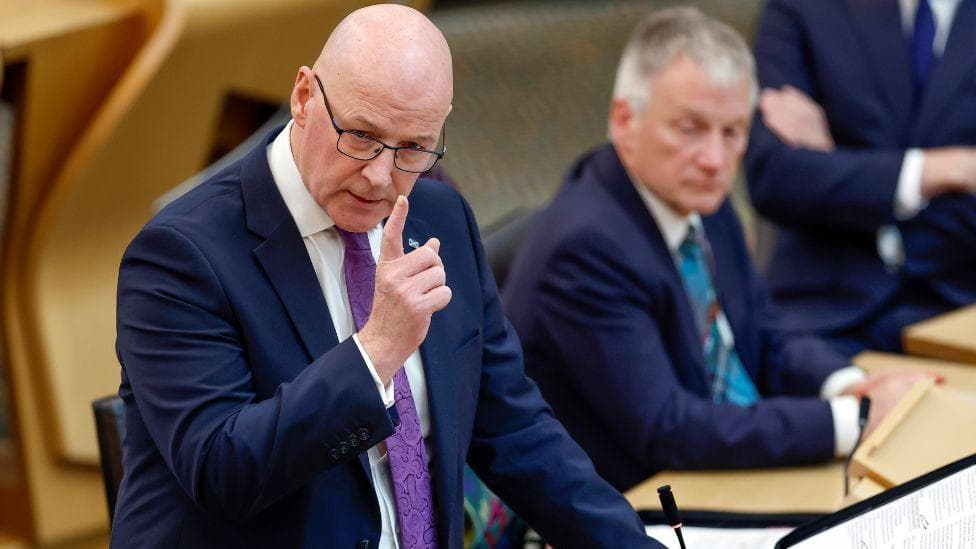
First Minister John Swinney has restated his government's commitment to decriminalising all drugs for personal use following a significant rise in drug-related fatalities across Scotland. The country recorded 1,133 deaths linked to illicit drugs in 2025, representing an increase of 116 cases (11%) compared with 2024, cementing Scotland's position as Europe's deadliest jurisdiction for drug-related mortality.
Swinney characterised the escalation as "unacceptable and intolerable" during parliamentary proceedings, though he faced sharp criticism from opposition party leaders who questioned the government's track record on the issue. The intervention comes as National Records of Scotland data shows male deaths rose 19% to 830 while female deaths fell 5% to 303, with the average age of those who died standing at 46.
Any move towards decriminalisation would require approval from the UK government, which retains control over drugs policy across Britain. Despite this constraint, Swinney indicated that his administration remains committed to exploring the approach as part of a broader strategy to support those affected by substance use.
Why is Scotland's death toll so high?
The surge in fatalities reflects multiple interconnected factors, including what Swinney described as "intergenerational poverty and trauma" alongside an "upsurge in grossly harmful synthetics". The emergence of powerful synthetic opioids being mixed with heroin, cocaine and other substances by criminal networks has substantially worsened the crisis.
According to recent analysis, cocaine was implicated in 589 deaths in 2025, up 23% from the previous year, while nitazenes—particularly etonitazene—were involved in 247 deaths, with etonitazene alone accounting for 215 fatalities. The scale of polysubstance involvement underscores the complexity of the challenge: more than one drug was implicated in 78% of all drug use deaths in 2025.
Comparative data illustrates the severity of Scotland's position. The age-adjusted death rate stood at 216 per million in 2025, substantially exceeding rates in England (91 per million), Wales (140 per million) and Northern Ireland (135 per million). Deprivation remains a critical factor, with drug-related deaths in the most deprived areas running 15 times higher than in the least deprived areas. The 2025 figure represents the sixth highest annual toll on record, and the death rate is now four times as high as when current records began in 2000.
What is the Scottish government's current approach?
Swinney stated that his administration was "testing to the limits what we can do in Scotland" within existing legal frameworks. The government has implemented several initiatives designed to reduce harm and provide support to drug users.
The centrepiece of this strategy is the Thistle safer consumption facility in Glasgow, established as the UK's first such venue. The facility permits individuals to inject heroin or cocaine under medical supervision, a model designed to prevent overdose deaths and connect users with treatment services. When challenged by Scottish Conservative leader Russell Findlay, who highlighted that deaths in Glasgow had increased since the facility opened, Swinney rejected the criticism, stating that
more people would have died without the Glasgow facility.

Ministers have also announced that Scotland's first drugs-checking facility will open shortly in Glasgow, allowing users to test substances for purity and harmful adulterants before consumption. Over the past decade, more than 11,000 drug-related deaths have been recorded across Scotland, underscoring the scale of the public health emergency.
Why does the government support decriminalisation?
The Scottish government, under the previous leadership of Humza Yousaf, declared its support for decriminalising personal drug use in 2023. The UK government rejected the proposal as dangerous at that time. The SNP included the policy in its 2024 election manifesto, citing Portugal as a potential model after that country relaxed its drugs laws in 2001.
Swinney indicated that decriminalisation could form part of a suite of measures offering
more control and ability to provide greater support to those affected by drugs use. He emphasised that addressing the crisis required tackling underlying social factors, stating that
we have to interrupt the circumstances that are feeding and refeeding this crisis in our society.
What did opposition parties say?
Scottish Labour leader Michael Marra described the government's record as "indefensible", though he signalled his party's willingness to collaborate with ministers on developing solutions. He told the Scottish Parliament:
If this was a middle-class epidemic, we would have locked down, legislated, found the money, educated widely and reformed indiscriminately. Nothing near that scale has happened.
Scottish Liberal Democrat leader Alex Cole-Hamilton highlighted that he had raised concerns about a "spike in synthetics" three years earlier, when such drugs were connected to just nine deaths.
Back then, these drugs were connected to just nine deaths in Scotland. Last year, they took the lives of 247 people.He questioned whether the SNP's stated commitment to tackling drugs as a "national mission" had failed.
Russell Findlay of the Scottish Conservatives called for closure of the Glasgow safer consumption facility, arguing that the government's approach was sending thousands of drug users
to an early grave by pedalling the lie that inherently dangerous drugs can be taken safely. Swinney rejected this characterisation, describing Findlay as "plain wrong".
Reform UK Scotland has submitted a motion of no confidence in Alcohol and Drugs Minister Maree Todd, asserting that "bereaved families want someone in government to finally be held accountable".
What happens next?
The Scottish government remains committed to opening the country's first drugs-checking facility in Glasgow in the coming months. The Thistle safer consumption room will continue operating as the policy debate around decriminalisation and harm reduction unfolds. However, any formal shift towards decriminalisation of personal drug use would require the UK government to agree to the change, a significant political hurdle given Westminster's previous rejection of the proposal.
Key Facts
- Scotland recorded 1,133 drug-related deaths in 2025, an 11% increase from 2024, maintaining Europe's highest fatality rate
- Male deaths rose 19% to 830 while female deaths fell 5% to 303, with an average age of 46 among those who died
- Cocaine was implicated in 589 deaths (up 23% from 2024) and synthetic opioids in 247 deaths, with 78% of fatalities involving multiple substances
- Scotland's death rate of 216 per million substantially exceeds England (91), Wales (140) and Northern Ireland (135)
- The UK government would need to approve any decriminalisation policy before it could be implemented in Scotland