

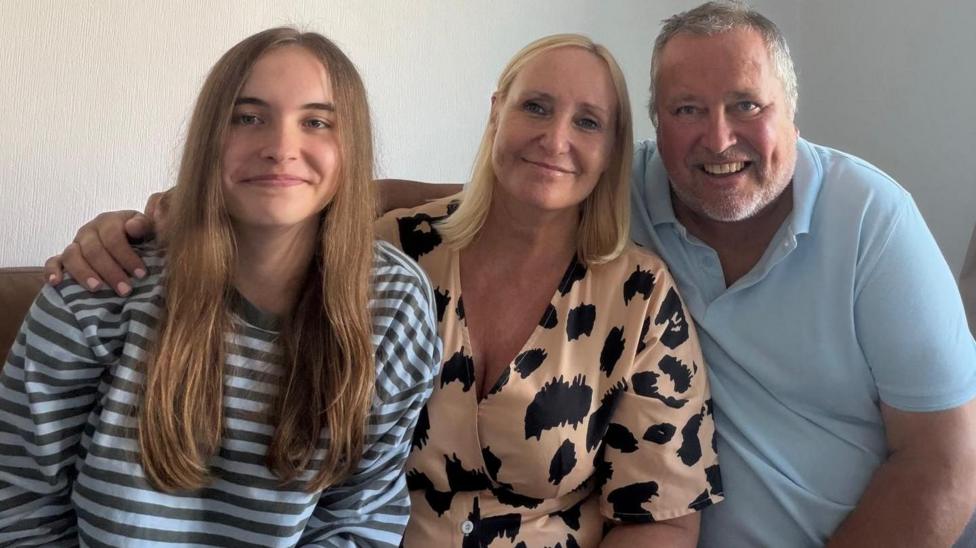
Ava-Grace Britton, 17, splits her time between studying acting at a college in north London and caring for her father, Paul, who has significant mobility and memory problems following a series of strokes eight years ago. Alongside her mother, Karen, she monitors his blood glucose levels, administers medication and helps with household tasks, saying she worries about him constantly.
I worry about him all the time. Before I go to college I help him and most days I have to return home quickly to look after him.
Paul's strokes were triggered by a sepsis infection he contracted after cutting his thumb at work, and his health is further complicated by diabetes that requires close monitoring. The condition forced him to leave his job as a borehole engineer, and he now relies on full-time care from Ava-Grace and Karen, who separately runs a charity organising lunch clubs for elderly and vulnerable people.
It turned our life upside down. Paul spent three months in hospital and in rehab. I don't know how I would cope without Ava-Grace.
How many young carers are there across the UK?
Census figures put the number of carers under 18 in England and Wales at roughly 130,000, though campaigners believe the real total is far higher because so many go unrecognised. The Carers Trust estimates as many as 1 million people under 18 may be providing care, alongside a further 500,000 aged 18 to 25, with some shouldering more than 50 hours of responsibility a week.
Separately, England's school census identified 89,800 pupils as young carers in the 2025/26 academic year, a rise of 25,300 on the previous year, according to the Department for Education's statistics service, which cautions that the figures should be treated carefully as data collection for this relatively new series continues to develop. That climbing count sits well above the 84,256 young carers a 2025 broadcast investigation found were formally known to local authorities in England and Wales, a gap the report suggested meant roughly nine in ten young carers could be going unsupported, according to a national broadcaster's investigation.
What sacrifices do young carers make?
More than half of young carers support a parent, as Ava-Grace does, while the remainder mostly look after siblings or grandparents. The Carers Trust reports a sharp increase in young people caring for relatives other than parents in recent years, attributing this to the cost of living crisis pushing parents to prioritise paid work, leaving children to fill caring gaps.
You have to make sacrifices. I can't do all the things my friends do.
At one point I was really enjoying dance and could have started competing, but it would have been a huge time commitment which wasn't possible.
Ava-Grace has changed schools several times after facing bullying and struggling with attendance, a difficulty compounded by epilepsy she also has to manage. Carers Trust says its chief executive noted in a March 2026 message for Young Carers Action Day that young carers can miss more than a month of school in a single year, according to Carers Trust.
I worry about the future. I really want to go to university, but can't imagine going anywhere too far from home. I know my dad needs me.
Department for Education figures show young carers are 25% less likely than their peers to achieve five GCSE passes including English and maths, and are twice as likely to spend two years or more out of education, employment or training as a result.
What support exists for young carers, and is it enough?
Local councils are required to offer young carers assessments examining the impact of caring on their health, education and wellbeing. Andy McGowan, who leads on young carers at the Carers Trust and was himself a young carer for both his parents, says these assessments can be transformative when they happen.

When young carers get these it can make a real difference. But it takes many years of caring before they are actually identified. And then the support in place to help is patchy, it really depends on where you live.
McGowan argues that even where respite breaks, peer support and counselling are offered, the underlying caring burden itself is frequently left unaddressed.
The threshold to get adult social care from councils to relieve the caring burden is so high, many don't get help. Until that is addressed, the inequalities young carers face will not be tackled.
He believes the NHS could offer more preventative and early support, particularly around substance misuse and mental health, which he says can themselves drive up the caring demands placed on children.
Often young carers are left to fight their own battles for too long – and so school and their own health come second.
Some newer initiatives are aimed specifically at older young carers. In June 2026, a bursary fund backed by the City & Guilds Foundation launched to support young adult carers aged 16 to 25 across England, Scotland and Wales, according to the City & Guilds Foundation. Broader debate over how to fund and organise care in England continues, with families affected by funding delays and high costs calling for reform as Andy Burnham pursues a cross-party settlement on social care.
How has policy on young carers evolved?
Government commitments to young carers are not new. Ministers first legislated for young carers to receive assessments of their support needs and coordinated family help through a 2013 amendment to the Children and Families Bill, according to government guidance. Yet the gap between official recognition and lived reality has persisted: the 2021 Census recorded about 120,000 young carers aged 5 to 17 in England and a further 8,200 in Wales, figures the Carers Trust cites as evidence that official counts routinely fall far short of the true scale of caring among children, according to Carers Trust.
In July 2026 the government published an action plan for unpaid carers that includes measures aimed at young carers specifically, such as improved support in schools and better coordination between the NHS, social care and education services. Scotland has its own dedicated young carers' grant. A government spokesman told the broadcaster the administration was committed to change.
Through our new national care service, this government is determined to build a system that recognises the extraordinary contribution of unpaid carers, supports them better and, in particular, helps young carers.
For Karen, the pace of that change matters urgently.
I worry about the impact caring has on Ava-Grace. She has had to grow up very quickly – that has had benefits, she is calmer and more mature than many girls her age and she has a real strength about her. But Ava-Grace and others like her need more help and understanding.
What happens next?
Carers Trust holds its annual Young Carers Action Day each March, with the 2026 edition held on Wednesday 11 March under the theme "Fair Futures for Young Carers," according to Carers Trust, and the charity's next public awareness push is expected to build around the same annual event. The Department for Education has also indicated that its school census data on young carers will continue to be published annually, meaning a further update covering the next academic year is expected, according to the department's statistics service.
Elsewhere in the care system, families continue to describe strain from funding and staffing pressures, including an 84-year-old father facing new stress after a care package for his adult sons was withdrawn and staffing shortages leaving an 89-year-old woman confined to bed for up to 19 hours a day, underlining how caring responsibilities are being felt across generations.
Key Facts
- Census data suggests around 130,000 carers under 18 in England and Wales, but Carers Trust estimates the true figure could be as high as 1 million, with another 500,000 aged 18 to 25.
- England's school census recorded 89,800 pupils as young carers in 2025/26, up 25,300 on the prior year, according to the Department for Education.
- Young carers are 25% less likely to achieve five GCSE passes including English and maths, and twice as likely to spend two years or more out of education, employment or training.
- A City & Guilds Foundation-backed bursary fund for young adult carers aged 16-25 launched in June 2026.
- The government's July 2026 action plan for unpaid carers includes measures for schools and joined-up NHS, social care and education support.


