

The world's oceans reached their warmest recorded temperatures for the month of July in 2026, with scientists linking the surge partly to developing El Niño conditions in the Pacific. The European Union's Copernicus Climate Change Service reported that average sea surface temperature across non-polar waters climbed to 20.96C, edging past the previous July record of 20.89C set in 2023. The finding adds to a growing body of evidence that the world's seas are warming at an accelerating pace.
Copernicus measured sea surface temperature across the band stretching from 60 degrees north to 60 degrees south, deliberately excluding the poles from its calculation. Globally, July 2026 tied for the second-warmest July on record, running 1.47C above the estimated average temperature of the pre-industrial era.
What is driving the record ocean heat?
El Niño, a naturally occurring warming pattern in the Pacific Ocean, is combining with human-caused climate change to push temperatures higher than either factor would produce alone. According to the World Meteorological Organization, El Niño conditions were formally declared on 2 June 2026, a development Copernicus says made a new seasonal ocean temperature record largely expected. Separate analysis has pushed the figures even higher: according to Mercator Ocean International, the global mean sea surface temperature for July 2026 reached 21.00C, plus or minus 0.11C, slightly above the Copernicus figure, and the Mediterranean recorded its warmest July on record.
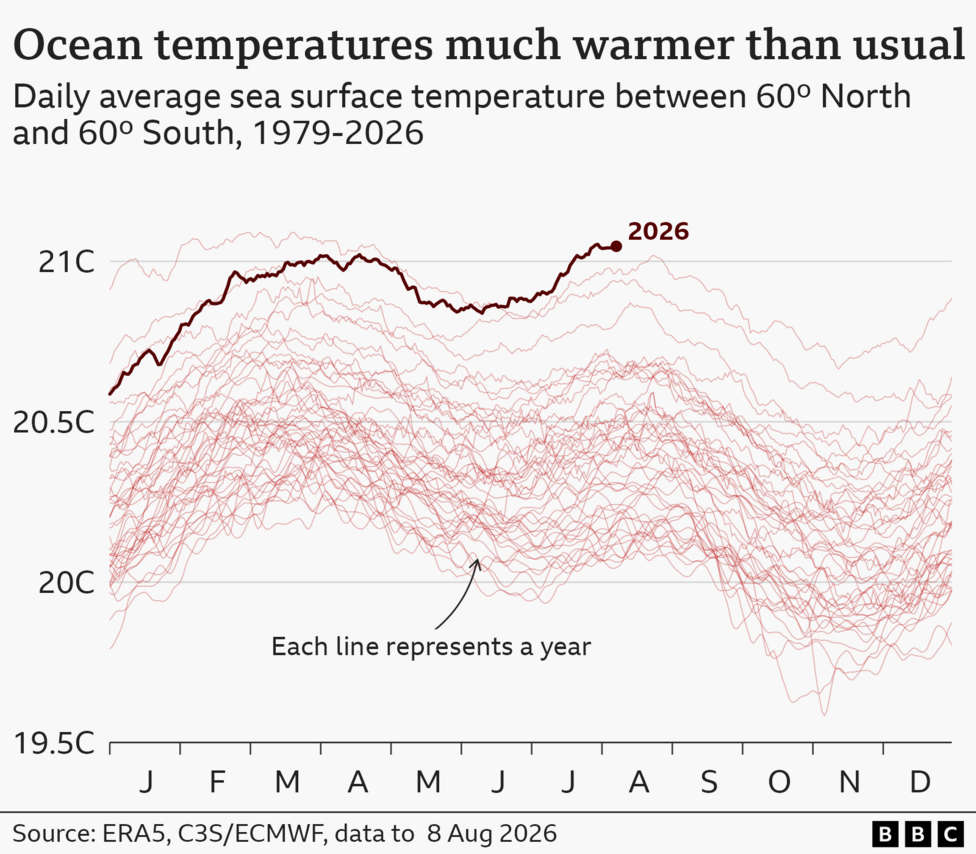
Mercator's bulletin also found that intense marine heatwaves covered 27% of the ocean's surface for at least one day during July, the widest extent recorded in the past 34 years, surpassing the previous high set in 2024. The North Atlantic logged its third-warmest July on record, with a mean temperature of 24.15C, plus or minus 0.25C, while the Mediterranean Sea itself reached a mean of 27.07C, warmer than its previous July record set only a year earlier, in 2025.
Sea temperatures stayed exceptionally elevated across much of the tropical Pacific, where forecasters expect El Niño to strengthen further in coming months. This built on an earlier surge: our previous reporting on the UK's marine heatwave found that waters around Britain were already running at extreme levels amid record global sea temperatures in early July, well before the month's final tally was in.
How is Europe being affected?
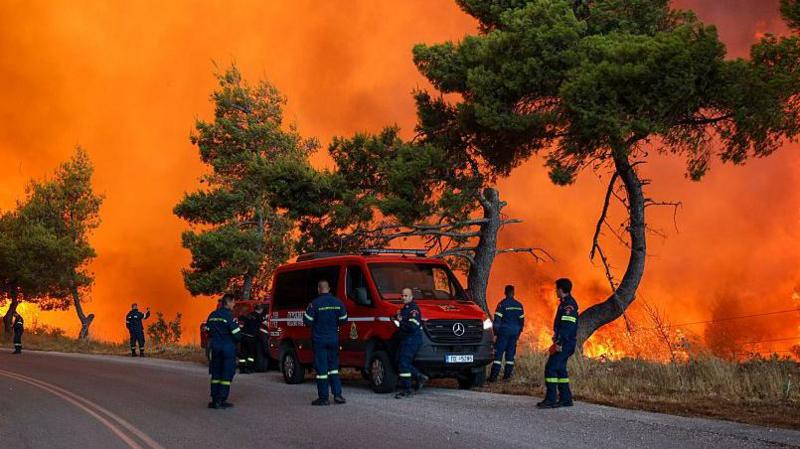
Along Europe's Atlantic coast and in the western Mediterranean, sea surface temperatures set new July records, feeding widespread strong and severe marine heatwaves. On land, western Europe endured its hottest June and July on record as a combination, with extended hot, dry weather fuelling extreme wildfires across the region.
Samantha Burgess, strategic lead for climate at the European Centre for Medium-Range Weather Forecasts, said the pattern reflected a deepening trend.
"July 2026 was the third consecutive month of exceptional heat in western Europe."
She attributed the persistence of the heat partly to atmospheric conditions holding it in place, along with a lack of natural cooling from the ground.
"This is a clear example of how climate change is intensifying heat extremes, with heat and drought increasingly reinforcing one another."
The average temperature across western Europe for June and July combined reached 21.62C, some 2.79C above the norm and the highest ever recorded for that two-month stretch. This extends a trend documented in our earlier coverage of Europe's record-breaking heatwaves in May and June 2026, when numerous temperature records were already falling, and of the heatwave that struck northern and central Europe in late June, when temperatures topped 40C in several countries and contributed to a health crisis.

Why does ocean heat matter for the wider climate system?
Oceans play a central role in regulating the planet's climate, absorbing the bulk of the excess heat produced by greenhouse gas emissions and generating roughly half of the Earth's oxygen. Warmer waters, however, are less able to absorb carbon dioxide, leaving more of the gas in the atmosphere to drive further warming.
Rising ocean temperatures also threaten marine ecosystems directly, as species relocate in search of cooler water, disrupting established food chains. That risk was flagged in our earlier coverage of the marine heatwave around UK waters, which raised concerns over the survival of marine species and broader ecosystem disruption.
What is happening with rivers, drought and wildfires?
France, Spain, parts of Germany and the UK all recorded exceptionally low rainfall and soil moisture during the period, with soil moisture across much of western Europe running significantly below levels seen even during the severe 2022 drought. River levels have fallen well below average in many places, with the Seine, Rhine and Danube among the waterways most affected, according to both Copernicus data and additional reporting from CGTN. Reduced river flow adds pressure to water supplies, irrigation, river-based transport, aquatic ecosystems and energy production.

The hot, dry conditions have also created favourable ground for wildfires, with what officials describe as exceptional activity across western Europe last month in terms of area burned and the volume of smoke and emissions produced. Laurence Rouil, director of the Copernicus Atmosphere Monitoring Service, said the pattern was reshaping fire risk across the continent.
"Climate change is increasingly bringing the kinds of hot and dry conditions that favour large, high-intensity wildfires in southern Europe while extending the fire season northwards."
He added that larger fires generate more smoke and push it higher into the atmosphere, allowing it to travel much further, meaning countries far from the original blaze can still be affected by drifting smoke.
What is happening in the UK?
In the UK, the extended dry spell is straining already stretched water supplies. England and Wales recorded their driest July since records began 190 years ago, according to the Met Office, and large parts of England, along with the whole of Wales, have already been formally declared in drought. The Environment Agency has warned further areas of England could be added to the list if dry weather continues, as the country braces for its fifth heatwave of the year.
Mike Kendon, a Met Office climate information scientist, said the shift is now structural rather than exceptional.
"We are right now living in a time of historic and unprecedented change."
The Met Office's latest assessment found that the hottest day of the year in southern England is now 4.5C warmer than it was between 1961 and 1990, prompting Kendon to conclude that evidence shows the climate of the 20th century has now gone. That assessment builds on findings noted in our earlier report on England's warmest June on record, when temperatures reached 37.76C and heat-related deaths were reported in France and Spain.
What happens next?
Forecasters expect El Niño to keep strengthening in the coming months, and according to phys.org, some climate scientists were warning as early as July 2026 that the developing pattern could become one of the strongest in decades. Its effects are layered on top of long-term warming driven largely by fossil fuel emissions, with the world now roughly 1.4C warmer on average than in the late 19th century. Monitoring agencies are expected to continue tracking both ocean temperatures and drought conditions across Europe as the strengthening El Niño interacts with an already warmed climate system.
Key Facts
- Global average sea surface temperature for July 2026 reached 20.96C per Copernicus, or 21.00C per Mercator Ocean International, both surpassing the prior July record of 20.89C set in 2023.
- Intense marine heatwaves covered 27% of the ocean surface for at least one day in July 2026, the widest extent in 34 years of records.
- Western Europe's June-July average temperature of 21.62C was 2.79C above normal, the highest ever for that period.
- England and Wales recorded their driest July since records began 190 years ago.
- El Niño conditions were formally declared on 2 June 2026 and are forecast to strengthen further.


