

Romania has taken its only nuclear power station fully offline after severe heat and drought pushed the Danube river to levels too low to cool its reactors. The second of the plant's two 706-megawatt units at Cernavodă was disconnected from the national grid on the morning of 13 August 2026, according to the World Nuclear Association, following the shutdown of the plant's first reactor in July. Plant director Romeo Urjan told the AFP news agency that engineers do not expect either unit to return to service for at least ten days.
The closure leaves Romania without a source that normally supplies roughly a fifth of the country's electricity. It marks only the second time Cernavodă has been forced offline by drought, after a similar shutdown in 2003, and comes as Romania's Danube inflow slipped to about 1,350 cubic metres per second on 12–13 August, down from around 1,370 on 11 August and roughly 1,400 in early August, according to the World Nuclear Association. Those figures put the river close to the historical minimum recorded in 1985.
The problem is not confined to Romania. Neighbouring Hungary's Paks plant, which also draws on the Danube, has so far stayed connected to the grid, though our earlier coverage of the Danube crisis reported that Hungary faced its own imminent shutdown risk, and a follow-up report on how Hungary narrowly avoided halting Paks described the same drought threatening cooling supplies there. Water levels along Europe's second-longest river have fallen to their lowest point in three decades in several countries.
What did Romania do to try to avoid the shutdown?
Authorities attempted to force more water toward the plant's intake by sinking barges loaded with rock into the Danube earlier in the week. Our earlier report on how Romania blasted a rocky outcrop in the Danube detailed the military's decision to detonate a rock formation to boost flow toward Cernavodă. According to , officials later delayed sinking four additional barges meant to redirect water toward the reactor as they weighed conditions on the river. Plant officials said the suction nozzles used to draw in cooling water could no longer reach the shrunken river.
How is Romania managing the resulting energy shortfall?
During hot, windy daylight hours the gap left by Cernavodă is largely being filled by solar and wind generation. In the evenings, however, traditional coal- and gas-fired plants have had to be supplemented by electricity imports. Romania also has substantial hydropower capacity, but that too has been curtailed by the same low river levels responsible for the nuclear shutdown. According to , the government declared a nationwide state of emergency covering the whole of August because the Danube-driven shortfall has reduced overall power production. Nuclearelectrica, the plant's operator, issued force majeure certificates on 10 August covering its electricity supply contracts, the World Nuclear Association reported.

What is driving the extreme heat across Europe?
Scientists say the underlying cause is climate change, which is warming Europe faster than any other continent. According to the Copernicus climate service, Europe is heating up at roughly twice the global average rate, a trend that is intensifying summer heatwaves, straining rivers and water supplies, and fuelling more severe wildfires across the continent.
How is the heatwave affecting other countries?
The Rhine, another of Europe's principal waterways, is also running at unusually low levels, significantly restricting river traffic. Agriculture has been hit hard as well: Italy's largest farming association, Coldiretti, estimated that climate-related damage — including hail, drought and wildfires — could exceed €3bn (£2.6bn; $3.5bn). France's Environment Minister, Monique Barbut, warned that data from the country's national statistics agency suggested the recent heatwaves could cost between €10bn and €15bn in direct and indirect losses. The Dutch bank Triodos said the extreme heat and its knock-on effects could erase much of the European Union's projected economic growth this year, after the European Commission had forecast 1.1% growth and the IMF had projected around 0.9% expansion for the euro area.
In Greece, more than 200 people, most of them tourists, were evacuated on Friday from the resorts of Siviri and Fourka on the Halkidiki peninsula in the country's north as a wildfire threatened residential areas.
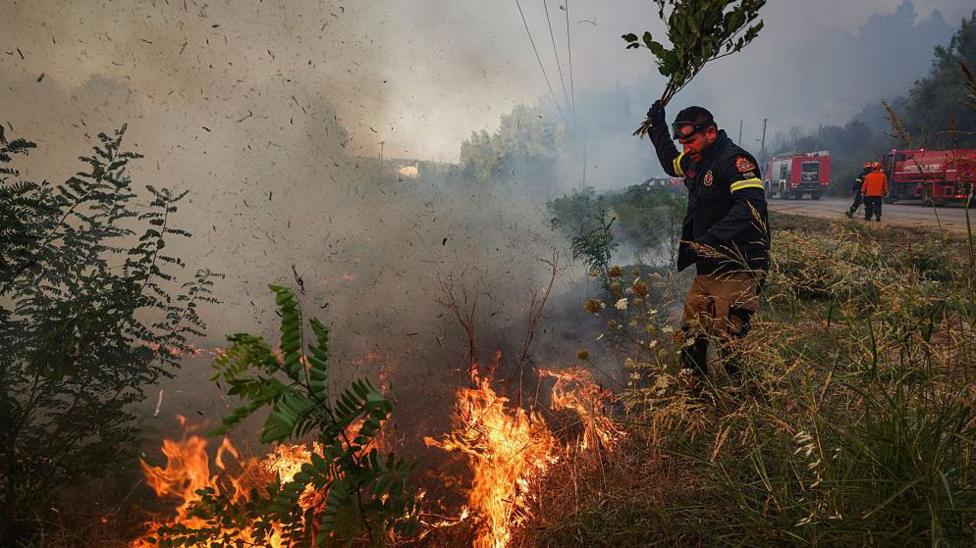
Meanwhile, as many as 80 French administrative departments remained under heatwave alert, with temperatures forecast to top 40C (104F) in some areas on Friday. France has already suffered its worst wildfire damage since the Second World War in recent weeks. Spain, still recovering from deadly wildfires of its own, recorded temperatures as high as 37C in central regions on Thursday.
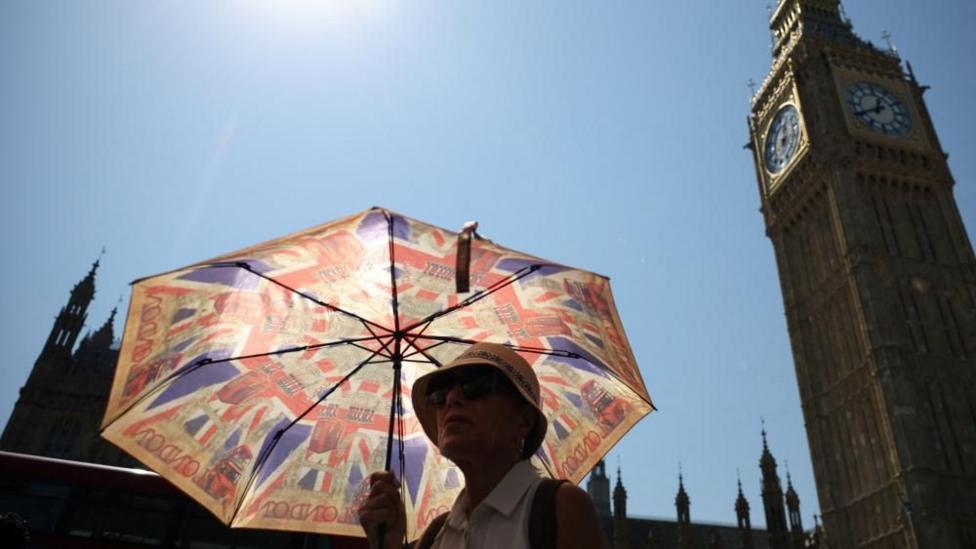
The United Kingdom recorded its hottest day of the year so far on Thursday, with the Met Office provisionally logging 38.1C at Kew Gardens in London. Rain is forecast to spread across more of the country over the weekend, though meteorologists caution that a few showers will not be enough to end the widespread drought gripping the UK.
What happens next?
Nuclearelectrica has not set a fixed date for restarting Cernavodă, saying the timing will depend on forecasts for the Danube's flow, according to the World Nuclear Association. reported on 6 August that Romania still intended to sink four rock-filled barges to redirect river water toward the plant if conditions allowed. Romania's nationwide state of emergency, declared because of the power shortfall, is set to remain in force through the rest of August.
Key Facts
- Both Cernavodă reactors, each rated at 706 megawatts, are now offline; the first shut in July and the second on 13 August 2026.
- The plant normally supplies about 20% of Romania's electricity.
- Danube inflow fell to roughly 1,350 m³/s on 12–13 August, nearing the historical low set in 1985.
- Romania is under a nationwide state of emergency for August because of reduced power output.
- Cernavodă was previously shut for drought only once before, in 2003.


