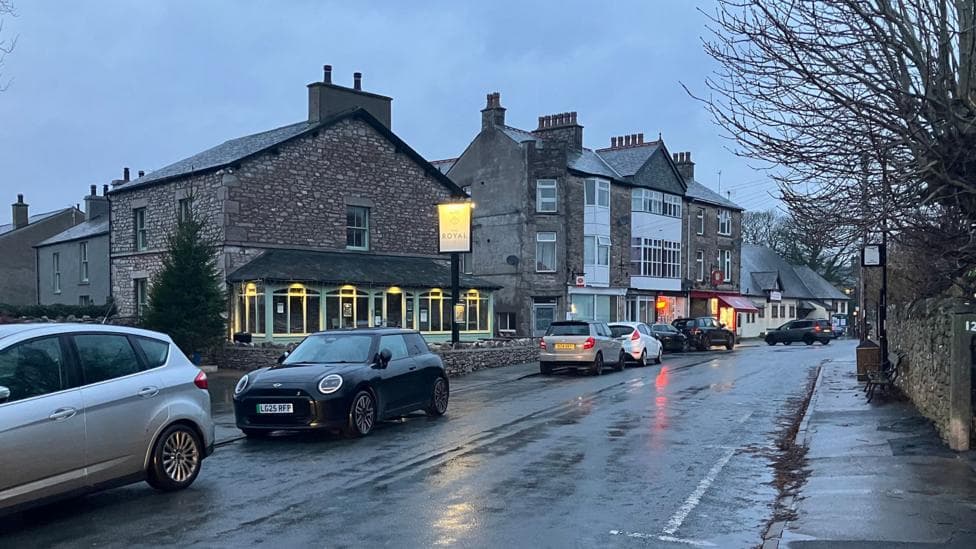
Silverdale, a village in Lancashire, has become the centre of an unusual geological puzzle after recording 25 earthquakes over the past 12 months. The largest tremor struck in December with a magnitude of 3.2, powerful enough to be felt by residents up to 12 miles (20 km) away. The seismic activity has left villagers concerned about what may come next.
CCTV footage from the December earthquake captured the moment the ground shook—cameras trembled, lights flickered, and sleeping dogs jolted awake in their baskets. Andrew Smith, a resident, described the experience vividly.
"I was upstairs, just sorting out some stuff and, all of a sudden, there was this almighty crash,"he said.
"I thought something had hit the house or exploded somewhere."
Smith expressed worry that the tremors might continue.
"It does seem to be a continuing theme,"he explained.
"There is always that concern - will there be worse ones?"
Across the village, Tom Bradfield reported similar experiences.
"The first one, I thought a truck had crashed into our house,"he said.
"The bed was shaking upstairs, the dog woke up."Bradfield had felt multiple tremors throughout the period.
Why is Silverdale experiencing so many earthquakes?
The British Geological Survey (BGS) in Edinburgh has been monitoring Silverdale closely. According to local reporting, scientists attribute the recurring small quakes to ancient fault lines beneath the region. Dr Brian Baptie, who leads the BGS's earthquake seismology team, provided context on seismic activity across the UK.
"We do get earthquakes in the UK. We get around 200-300 every year - and about 20-30 of them are felt by people - so it's actually quite normal."
He noted that western parts of England, north-west Wales and the west of Scotland are all significant earthquake zones. The elevated activity around Silverdale followed the initial December magnitude 3.2 quake's effect on surrounding faults. According to the BGS, approximately 28 tremors have been centred on the Silverdale area since that initial quake, with about five or six felt by residents.
What causes aftershocks and could a larger earthquake occur?
Earthquakes typically occur in clusters, with aftershocks following the initial event. Baptie explained the pattern:
"People are probably familiar with the idea of when there is a big earthquake around the world we get these aftershocks which can, maybe, last for days, or weeks, or even months. Usually those aftershocks are smaller than the first event, but very rarely they can actually be bigger."
When asked about the possibility of a larger earthquake, Baptie was cautious.
"So we can't rule out a bigger earthquake, but it's really quite unlikely."This assessment offers some reassurance to residents, though concerns persist.
How have recent tremors affected the area?
The most significant recent earthquake occurred on 21 September, with a magnitude of 2.7 and a depth of approximately 3 km. According to reporting on the event, this tremor was felt across a wide area including Warton, Carnforth and Crag Bank. It proved stronger than a magnitude 2.3 quake recorded in the Silverdale area in May.
The following day, on 22 September, the BGS recorded a further magnitude 1.5 tremor near Silverdale, which was felt in both Silverdale and Milnthorpe. The December 2025 quake, with a magnitude of 2.4, had been felt across an even broader region including Carnforth, Morecambe, Milnthorpe, Lancaster and Grange-over-Sands.
What are residents' concerns about living in an earthquake zone?
For those who have recently moved to Silverdale, the seismic activity came as an unwelcome surprise. Smith, who relocated to the village relatively recently, expressed his frustration.
"It is obviously a concern - you don't expect that sort of thing. It wasn't on our list when we were looking for a property: 'Avoid an earthquake zone'!"
Despite reassurances from seismologists that larger earthquakes remain unlikely, the frequency of tremors has understandably unsettled residents who are still adjusting to their new surroundings and the geological realities of the area.