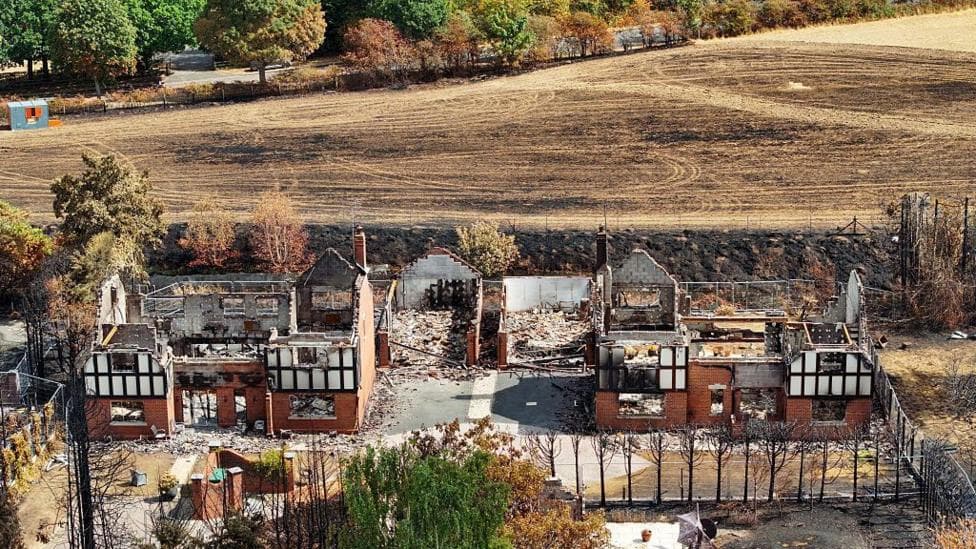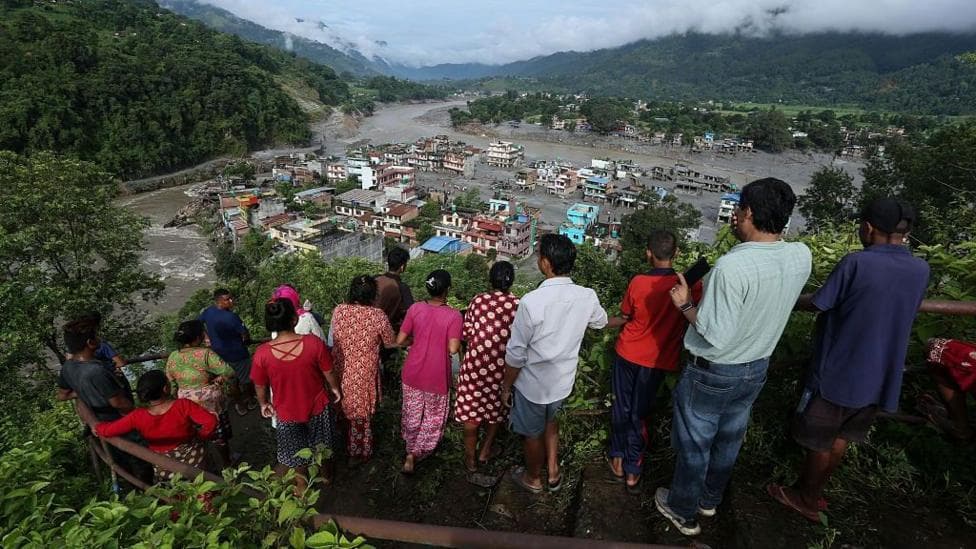
Thousands of people remain dead or missing following catastrophic floods and landslides that devastated the Nepal-Tibet border region last month. According to recent updates from Nepal's disaster authority, the combined cross-border toll now stands at 1,446 dead and at least 6,669 missing, including 43 dead and 519 missing on the Chinese side of the border.
A peer-reviewed study has established that climate change played a significant role in destabilising the glacier that collapsed and triggered the disaster.
"Absolutely no doubt that human-induced climate change played a role here in the preconditioning of the disaster,"said Dr Friederike Otto, a climatologist at Imperial College London and one of the study's authors.
The World Weather Attribution study, released on Thursday, characterised the disaster as a "compound event" resulting from multiple interacting factors: rising temperatures, thinning glaciers, thawing permafrost and pre-existing geological weaknesses in the mountain terrain.
How did the glacier collapse occur?
Scientists determined that a massive section of glacier near the peak of Langtang Lirung, a mountain on Nepal's side of the Himalayas, fractured and fell. The enormous chunk of ice and rock struck the valley floor with such force that it generated a magnitude 5.2 seismic signal, according to United States Geological Survey data. Satellite imagery confirmed a high-altitude landslide coinciding with the collapse, with the affected area located approximately 12 miles northeast of the Nepal-China Rasuwagadhi border crossing.
What role did climate change play?
The World Weather Attribution study identified climate change as a "destabilising factor acting on a pre-existing geological predisposition," though not the sole cause of the disaster. During July and August, temperatures in the region were approximately 1.5 degrees Celsius (34.7 degrees Fahrenheit) warmer than historical averages specifically due to human influence on the climate, according to the study's findings.
Glaciers throughout the region have been thinning at a rate of roughly half a metre (1.6 feet) annually, a process that can weaken existing fractures and increase structural instability. Heavy snowfall in October and November of the previous year also contributed to a substantial volume of meltwater accumulating early in the year. The study suggested this combination of factors "may have interacted to amplify the compound event."
What other factors weakened the glacier?
A magnitude 7.8 earthquake that struck the area in 2015 and triggered a rock-ice avalanche may have also compromised the underlying rock mass, according to the study. However, authorities stated they could not definitively confirm that earlier earthquake's precise impact on the glacier collapse that occurred last month.

Dr Walter Immerzeel, a mountain hydrologist at Utrecht University and co-author of the report, characterised the area as a "geologically vulnerable slope." He explained that the slope was "potentially weakened by the 2015 earthquake" and subsequently "destabilised further" by ongoing glacier and permafrost retreat.
The Langtang Lirung, like the broader Himalayan range, has been gradually rising due to tectonic forces, a process that makes the glacier "steeper and steeper," according to Dr Mike Searle, a professor of earth sciences at Oxford University. He noted that while parts of the glacier inevitably break away under these conditions, the collapse of such a substantial section "in one go" remained "very unusual."
Can single events be attributed to climate change?
Dr Simon Cook, a glacier specialist with the University of Dundee, acknowledged the difficulty in attributing any individual event solely to climate change. Nevertheless, he emphasised that "climate warming ultimately destabilises these high mountain environments," making such catastrophic failures increasingly likely in warming conditions.
The study's conclusions align with expert assessments made immediately after the disaster. Some specialists had previously suggested that the glacier collapse resulted from a combination of climate change and long-term tectonic movement in the region.
What is the current humanitarian situation?
Nepal's disaster authority significantly revised the number of people missing in the disaster from 5,179 to 6,150, reflecting ongoing search and recovery operations. The number of bodies retrieved in Nepal stood at 1,403, with 105 identified at the time of the latest update. Chinese state media reported that the Tibet side had recorded 43 dead and 519 missing.
In the immediate aftermath of the disaster, a newly formed lake at the China-Nepal border had posed an additional flood threat. However, Chinese authorities reported that the lake had decreased in size by Saturday and the flood threat had lessened, though rescue and accounting efforts continue as authorities keep revising figures in both Nepal and Tibet.
What are Nepal's policy responses?
In the wake of the disaster, Nepali authorities have called for coordinated global action to address climate change, emphasising that Nepal ranks among the world's lowest contributors to greenhouse gas emissions yet remains among the most vulnerable regions to the effects of global warming. Prime Minister Balendra Shah is scheduled to make his first foreign trip in that capacity to the United Nations General Assembly in New York next week, where he plans to address the recent disaster and advocate for climate justice on the international stage.
Key facts
- The combined death toll across Nepal and Tibet stands at 1,446, with at least 6,669 missing as of the latest official count
- A World Weather Attribution study confirmed that human-induced climate change destabilised the glacier through rising temperatures, glacier thinning, and permafrost thaw
- July and August temperatures in the region were approximately 1.5°C warmer than normal due to human climate influence
- A 2015 magnitude 7.8 earthquake may have weakened the underlying rock mass, though authorities cannot confirm its exact role in the recent collapse
- Nepal's Prime Minister plans to address the United Nations General Assembly to discuss the disaster and call for global climate action