

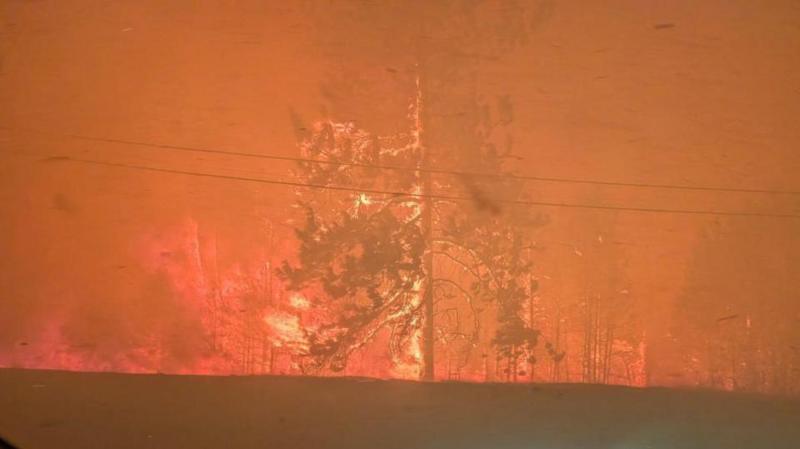
A rapidly advancing wildfire in a remote stretch of western Canada has doubled in size within a single day, forcing thousands of residents from their homes in British Columbia. The Bald Range fire has scorched more than 36 square miles (95 sq km) across the Summerland and Okanagan-Similkameen districts since it was first spotted on 8 August 2026, according to the BC Wildfire Service, and remained classified as out of control as of Saturday morning.
Erick Thompson, an emergency official with the Regional District of Okanagan-Similkameen, described the blaze as among the most aggressive he has encountered in the region, which is no stranger to wildfire activity.
"quickest-moving, largest fires in such a short time"
As flames closed in, authorities ordered the complete evacuation of Summerland, a community of roughly 12,000 people, along with about 8,000 residents in the neighbouring town of Peachland. City officials confirmed that electricity supply across Summerland had also been knocked out early Saturday.
How is the emergency response coping with the fire's speed?
The pace of the fire's growth has stretched even experienced emergency personnel, some of whom have had to abandon their posts to protect their own families. On Friday evening, Thompson had been issuing public updates from the regional emergency operations centre, but by the following morning he had stepped away from that role entirely to get his own household out of danger.

"I had to leave the EOC to come and get my family to leave this area. We're heading south,"
Officials have not yet been able to determine how many buildings have been lost to the fire. The uncertainty reflects the speed at which the Bald Range fire has moved, leaving little opportunity for damage assessments while evacuations remain the priority.
What is happening to livestock in the fire's path?
The Okanagan region is also home to a significant horse population, and many residents have struggled to move their animals out of harm's way in time. Some owners who could not safely evacuate their horses instead opened gate enclosures, hoping the animals would be able to escape the flames on their own, according to residents who spoke to Canadian broadcaster CBC. Others marked their animals with paint so they could be identified later if they became separated during the chaos, CBC reported.
How does this fit into Canada's wider wildfire season?
The Bald Range fire is one of many burning simultaneously across British Columbia. A CBC live tracker recorded 117 active wildfires across the province as of the afternoon of 4 August 2026, with nearly half of them classified as out of control, according to CBC's coverage. The same report said the Pear Lake fire had already burned more than 1,246 square kilometres and that several hundred structures across roughly 120 properties in the Clinton area were believed destroyed, while the Fintry fire had displaced more than 2,200 people.
Nationally, the scale of destruction continues to grow. According to a Moody's RMS event response update, wildfires across Canada had burned 2,307,828 acres (933,945 hectares) as of 7 August 2026, with 49 active uncontained fires nationwide, including 13 uncontained fires within British Columbia alone. The same update noted that the Bradley Creek Fire, which ignited on 31 July, had since expanded to 7,046 acres (2,853 hectares).
The Canadian federal government's most recent wildfire update, issued in July, had already put the season's toll at 3,137 fires and 1.4 million hectares burned nationally, with 796 wildfires active at the time. Ontario has also been severely affected this year; a separate CBC report found the province's fire season had burned more than 7,250 square kilometres, surpassing the previous record set in 2021. Earlier this summer, flames were reported to have surrounded a freight train near Armstrong, Ontario, as more than 100 fires burned in that province and smoke degraded air quality as far away as Toronto.
Cross-border impacts have also been significant this season. In early August, wildfires in Washington state forced roughly 60,000 people to evacuate and destroyed around 600 buildings near Spokane, leaving more than 10,000 customers without power. Researchers have also linked the severity of this year's fires to broader climate trends, with one analysis concluding that human-driven climate change made this season's fire-prone conditions twice as likely as nearly 700 fires burned across the country at the time of that report.
Key Facts
- The Bald Range fire has burned more than 36 square miles (95 sq km) since being detected on 8 August 2026.
- Summerland (population approximately 12,000) and Peachland (approximately 8,000 residents) have both been fully evacuated.
- British Columbia had 13 uncontained fires as of 7 August 2026, part of 49 active uncontained fires nationwide, per Moody's RMS.
- The Bradley Creek Fire, ignited 31 July, has grown to 7,046 acres (2,853 hectares).
- The Pear Lake fire has burned over 1,246 square kilometres, with several hundred structures believed destroyed in the Clinton area.


