

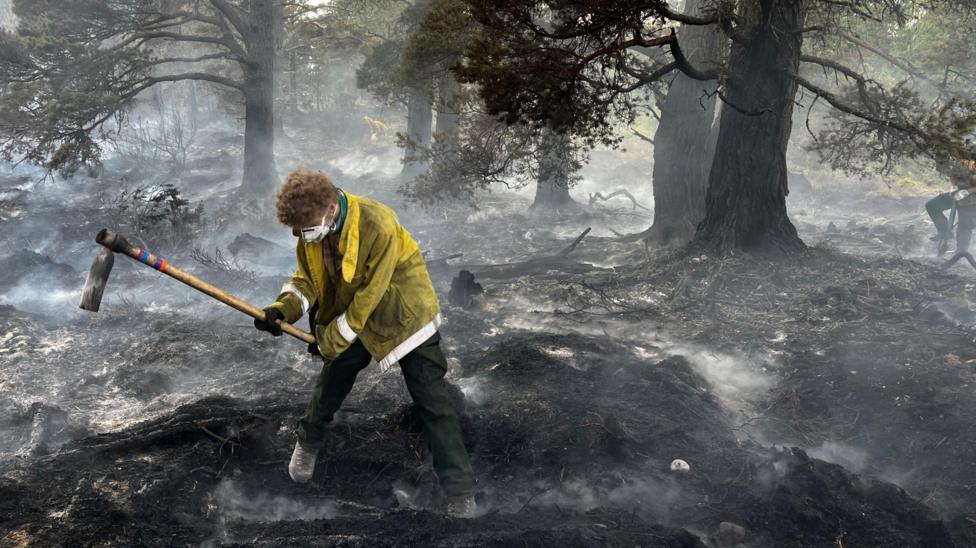
The Scottish Fire and Rescue Service (SFRS) has withdrawn the last of its personnel from the site of a major wildfire in the Cairngorms National Park, almost five weeks after the blaze first broke out. The final 15 firefighters left RSPB Abernethy Nature Reserve on Monday, though reserve staff remain on site to dampen down remaining hotspots.
The fire began on 15 July in the Glenmore area near Aviemore and went on to burn across roughly 10 square miles (25 square kilometres) of moorland and forestry. At its peak, more than 500 firefighters were deployed, and several homes and campsites in the vicinity had to be evacuated as the blaze spread.
How did the wildfire develop over the past five weeks?
The incident grew rapidly in its early stages, and by the following week fire crews were still battling significant hot spots after the blaze had already scorched 10 square kilometres of land, with more than 100 firefighters involved and evacuation orders and access restrictions still in force, according to earlier coverage of the hot spots that remained after the fire burned 10 square kilometres. A subsequent flare-up in Abernethy prompted crews to construct miles-long fire breaks and deploy helicopters and drones to bring the blaze back under control, as detailed in reporting on the fire breaks used to contain the wildfire after a flare-up. Residents who had been evacuated from Nethy Bridge were later permitted to return home once police confirmed the fire was no longer classified as a major incident, even as firefighting operations continued, according to coverage of evacuated residents being allowed back to their homes.

What have officials and conservation groups said about the withdrawal?
RSPB Scotland described the departure of fire crews as a significant step forward and expressed gratitude to everyone who took part in tackling the blaze. A spokesperson for the charity added:
However, it will still be a while until we can safely welcome visitors back to RSPB Abernethy.
SFRS characterised the operation as a complex and protracted incident that brought disruption and anxiety to local communities and businesses over an extended period. Deputy Assistant Chief Officer William Pollard said:
While SFRS has now left the scene, we would remind members of the public that large areas of ground within the Cairngorms National Park have undergone significant disruption due to firefighting operations and the creation of firebreaks.
Businesses across the area are reopening and look forward to welcoming the return of visitors.
However, some locations remain closed due to unsafe ground conditions. We urge people to avoid closed zones and avoid entering restricted areas.
What restrictions remain in place around Glenmore?
Forestry and Land Scotland has kept parts of Glenmore Forest closed to the public while safety and remediation work continues. Specific sites still shut include the Allt Ban and Allt Mor car parks, the Ryvoan Trail, the Lodge Trail and the Green Lochan, according to a multi-agency assessment published by Scottish Fire and Rescue Service. Police Scotland had earlier confirmed that road and walking-route closures remained active around Glenmore, Loch Morlich, Badaguish and parts of Abernethy Forest, according to a police update issued on 3 August 2026. To help locate any remaining trouble spots, SFRS has been using thermal-imaging drones on a daily basis across the Glenmore area, according to a fire service update from 5 August 2026.
What happens next for businesses and visitors?
The Glenmore cordon itself was lifted at 8am on Friday, 7 August 2026, clearing the way for local businesses to reopen even as crews continued damping down hotspots, according to the same multi-agency reopening assessment. Cairngorm Mountain reopened to visitors that same day, although some nearby facilities, including the Ciste motorhome stopover and walkers' car park, were due to remain closed until at least Monday, 10 August 2026, according to a Highlands and Islands Enterprise report on the mountain's reopening. Access management measures overseen by Forestry and Land Scotland and the Cairngorms National Park Authority are expected to remain in force in some areas even as the wider site reopens.
Key Facts
- The wildfire started near Ryvoan Bothy in the Glenmore area on 15 July 2026 and burned about 10 square miles (25 sq km) of moorland and forestry.
- More than 500 firefighters were involved at the height of the response, which also prompted evacuations of homes and campsites.
- The last 15 firefighters were stood down at RSPB Abernethy Nature Reserve on Monday, nearly five weeks after the fire began.
- The Glenmore cordon was lifted on 7 August 2026 and Cairngorm Mountain reopened, though sites such as the Ryvoan Trail, Lodge Trail and Green Lochan remain closed.
- Police Scotland and Forestry and Land Scotland continue to enforce access restrictions in parts of Glenmore, Loch Morlich, Badaguish and Abernethy Forest.


