The area burned in Brazil's Amazon in 2025 was far smaller than in the previous year, according to the deforestation monitoring group MapBiomas. The report says 3.1 million hectares were burned in 2025, compared with a record 15.8 million hectares in 2024, the smallest area since records began in 1985.
These figures come after the Amazon rainforest experienced its worst forest fires in more than two decades in 2024, which the Copernicus Climate Change Service attributed to “climate extremes and human activity”. The lower 2025 numbers are likely to be welcomed by President Luiz Inácio Lula da Silva, who made protecting the Amazon one of the pledges of his campaign four years ago as he seeks re-election in October.
How significant is the drop in burned area?
The decline is significant because it shows a sharp reversal from 2024 and marks the smallest burned area recorded in the Amazon since MapBiomas began tracking the data in 1985. Vera Arruda, a researcher at the Amazon Environmental Research Institute (IPAM) and co-ordinator at MapBiomas, said the 2025 figures demonstrate that it is possible to reduce the burned area in the country.
“The 2025 figures are significant and show that it is possible to reduce the burned area in the country,” Vera Arruda, a researcher at the Amazon Environmental Research Institute (IPAM) and co-ordinator at MapBiomas, told the BBC.
“The 31% drop compared to the historical average - driven primarily by the lowest number of fires recorded in the Amazon in 41 years - is positive news, but it does not yet allow us to conclude that this is an established trend or to scale back prevention efforts,” Arruda added.
The MapBiomas report shows that the drop was not limited to the Amazon. Across Brazil as a whole, around 12.7 million hectares burned in 2025, down from 30 million hectares in 2024.
The highest number of hectares burned in Brazil since records began was in 2007, when 30.7 million hectares were recorded across the country.

What explains the change from 2024 to 2025?
The decline in 2025 partly reflects the easing of the unprecedented fires seen in 2024, and cooler La Niña conditions rather than the warmer El Niño pattern. MapBiomas warned, however, that the natural weather pattern of El Niño, which raises global temperatures, could lengthen this year's dry season and increase the risk of forest fires.
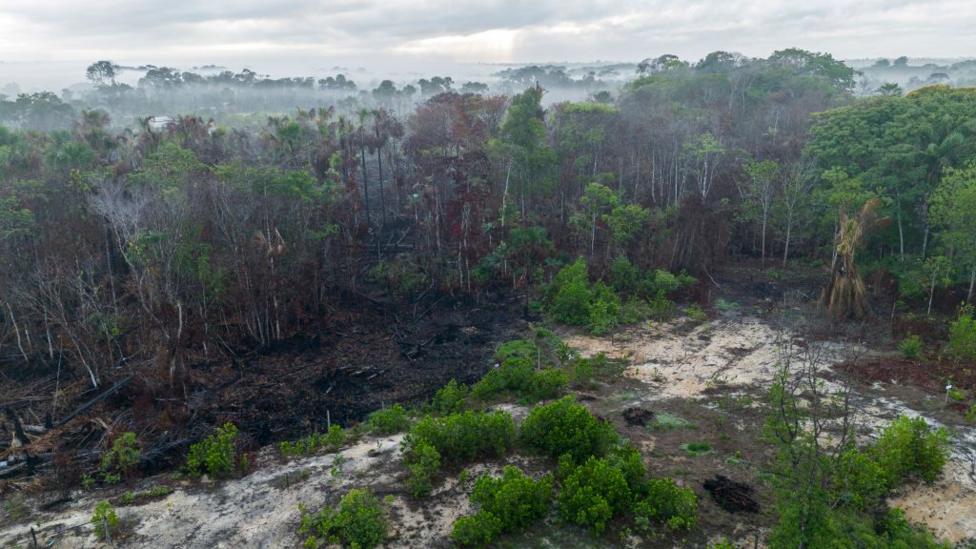
The Amazon rainforest is home to millions of species and, when healthy, absorbs vast quantities of planet-warming carbon dioxide, helping to keep the Earth cool. Tropical rainforests like the Amazon have been under increasing pressure from decades of deliberate land clearance for agriculture and logging, as well as climate change, which scientists say can create the conditions for larger fires to spread.
How does this fit into Lula's Amazon agenda?
When he took office, President Lula promised to reverse the deforestation that took place during the presidency of his predecessor, Jair Bolsonaro. Bolsonaro argued that more farming and mining in the Amazon would reduce poverty in the region, while environmentalists accused him of allowing deforestation to accelerate.
Three years into Bolsonaro's four-year term, the amount of trees cut down in the Amazon rainforest had risen by 75%. On his first day in office, on 1 January 2023, Lula said: “our goal is to achieve zero deforestation in the Amazon”.
“our goal is to achieve zero deforestation in the Amazon”
That pledge was welcomed by environmentalists, but Lula has also faced criticism for approving oil exploration at the mouth of the Amazon river. Activists say this runs against his promise to protect the Amazon region.
Protecting the Amazon was one of the pledges Lula made while campaigning four years ago, and the latest figures will be seen as a boost to his re-election campaign in October. The report adds to a complex picture in which the 2025 decline is welcome, but scientists and environmental monitors continue to warn that prevention efforts still need to be maintained.