
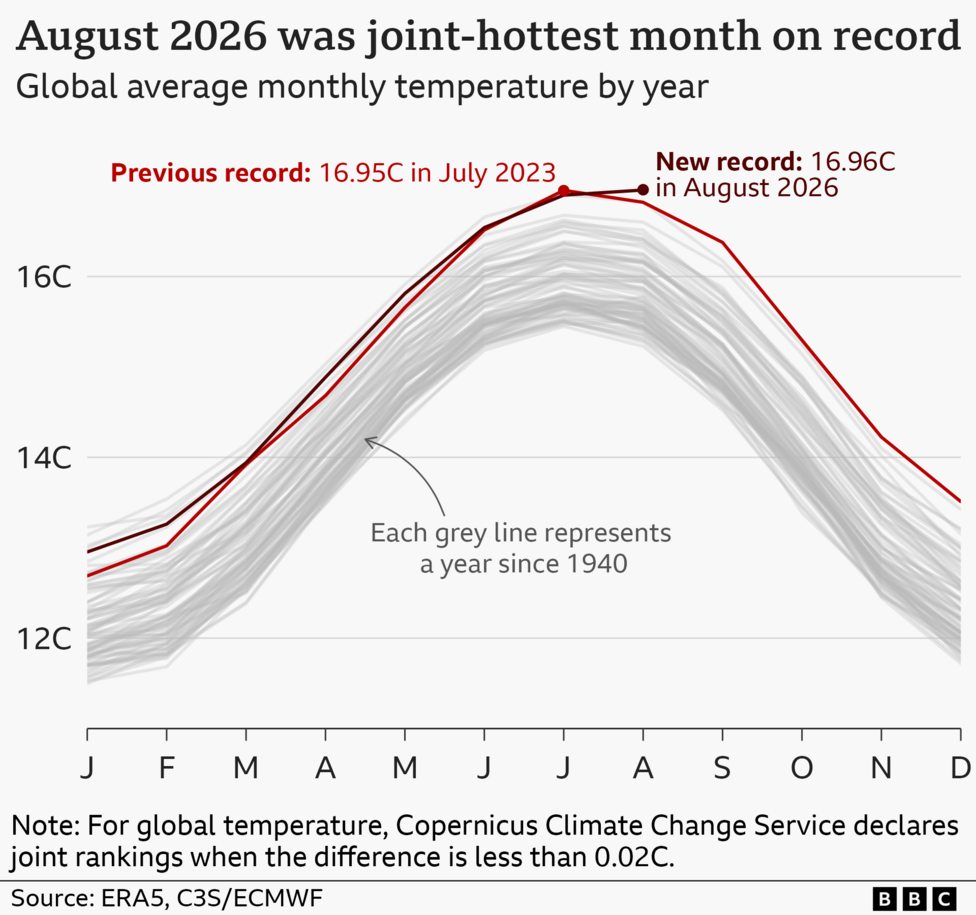
August 2026 has been confirmed as the joint-hottest month ever recorded, matching July 2023's previous record, according to the European Union's climate monitoring service. The exceptional warmth resulted from a combination of human-caused climate change and the strengthening influence of El Niño, a natural Pacific Ocean warming pattern that releases stored heat into the atmosphere.
Global average temperatures for August reached 1.65°C above pre-industrial levels, surpassing the 1.5°C threshold that countries agreed to try to avoid under the Paris Agreement. While a single month above this limit does not indicate the threshold has been permanently breached, the trend demonstrates movement towards crossing it.
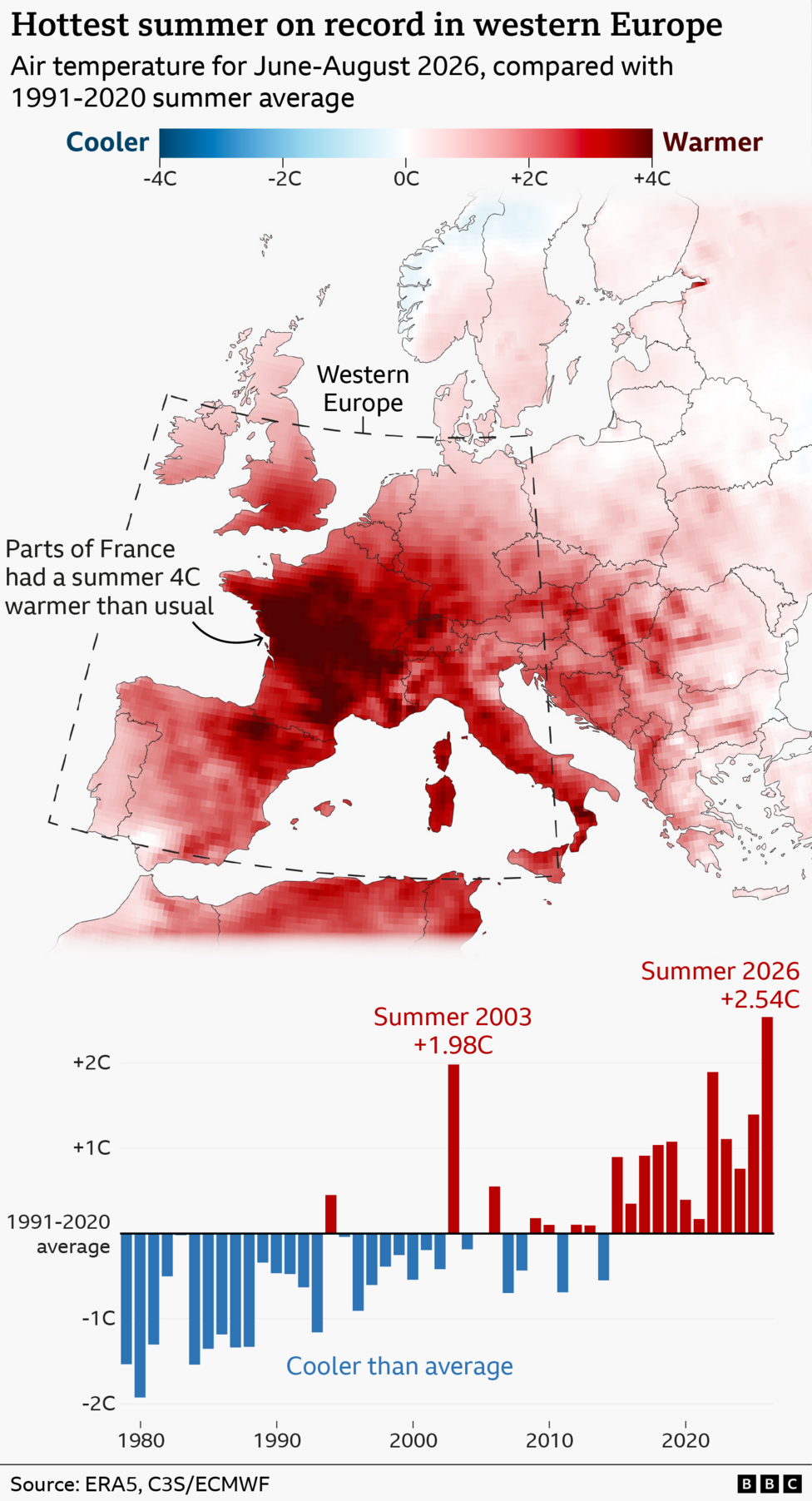
The month also marked the culmination of western Europe's warmest summer on record. Temperatures across the region exceeded those of the devastating 2003 heat wave, with June and July temperatures in Western Europe reaching their highest levels in 2026. The UK experienced its hottest summer since records began in 1884, a phenomenon that researchers found had been made approximately 130 times more likely by human-caused climate change.
What drove the record temperatures?
Two major factors combined to produce August's exceptional heat. The ongoing burning of fossil fuels continues to trap heat in the atmosphere, while a developing El Niño pattern is amplifying this effect. El Niño occurs when a band of the eastern Pacific Ocean becomes unusually warm, releasing vast quantities of stored ocean heat into the atmosphere and raising global temperatures for approximately a year.
The current El Niño is still intensifying and could become one of the most powerful on record. According to NOAA's Climate Prediction Center, El Niño has strengthened over the past month, with eastern equatorial Pacific temperature anomalies exceeding +2.0°C. The most significant impact of this natural phenomenon on global temperatures is expected to occur over the coming year, suggesting that the current sequence of temperature records may continue to be broken.
How are ocean temperatures responding?
Ocean temperatures have reached unprecedented levels. Global sea-surface temperatures reached a new daily record of 21.1°C on 22 August 2026, with the previous August high having been 20.98°C in 2023. This represents a 0.67°C increase above the 1991–2020 daily average for that date. The record ocean warmth reflects the combined influence of climate change and developing El Niño conditions, creating conditions that affect weather patterns far beyond the Pacific.


What are the human consequences?
The extreme heat has produced tangible harm across affected regions. Dr Clair Barnes, an extreme weather researcher at Imperial College London, emphasised that the heat across the UK and Europe has disrupted schools, strained hospital systems, damaged food production, fuelled wildfires and drought conditions, and caused tens of thousands of deaths.
"Until we stop burning fossil fuels these records will continue to tumble, and the extremes will worsen faster than we are able to adapt. Crucially, how much worse we allow it to get remains within our hands,"Dr Barnes said, rejecting the notion that such extreme summers should be accepted as inevitable.
Dr Samantha Burgess, strategic lead for climate at Copernicus, characterised August as
"a remarkable month in the global climate record"and noted that its impacts were
"increasingly being felt by communities, economies and ecosystems across the world."She highlighted how the combination of record air temperatures, record ocean heat, and Europe's exceptional summer demonstrated that climate change was now driving extremes across both the atmosphere and the oceans.
What do climate leaders say?
UN climate chief Simon Stiell characterised the record as clear evidence of humanity's impact on the climate system.
"The evidence is irrefutable: this is the spiralling price of humanity's fossil fuel addiction, and the global climate crisis it is fuelling,"he said.
The World Meteorological Organization had warned on 5 August that the developing 2026–2027 El Niño, combined with positive Indian Ocean Dipole conditions and record-warm sea-surface temperatures, was likely to drive above-normal temperatures through the August–October season. This forecast has proven accurate, with conditions continuing to intensify.
What happens next?
The August–October period is expected to see the strongest temperature impact from the developing El Niño. Monthly climate bulletins from Copernicus will continue to track global conditions, with the next update expected in September 2026. The El Niño pattern is anticipated to influence monsoon rains and storm activity across Asia, with potential consequences for vulnerable populations in the region.
Key Facts
- August 2026 tied with July 2023 as the joint-hottest month on record, with global temperatures 1.65°C above pre-industrial levels
- Global sea-surface temperatures reached 21.1°C on 22 August 2026, breaking the previous record of 21.09°C set in March 2024
- Western Europe experienced its warmest summer on record, with temperatures 2.54°C above the 1991–2020 average, surpassing the deadly 2003 heat wave
- The developing El Niño is strengthening and could become one of the most powerful on record, with its strongest temperature impact expected over the coming months
- The extreme heat has caused widespread disruption to schools, hospitals, food production and has resulted in tens of thousands of deaths across affected regions