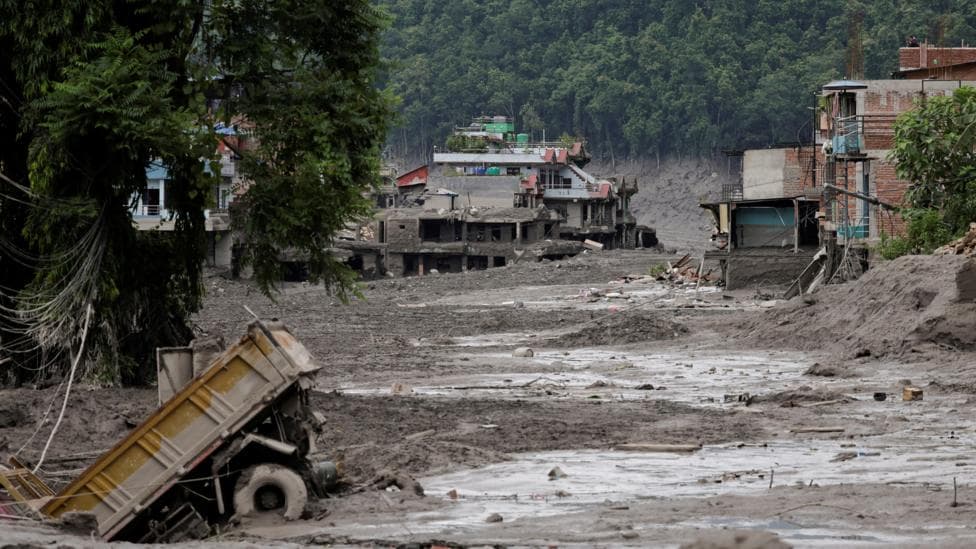
Rescue teams are searching for nearly 1,400 missing people after a devastating flash flood and mudslide struck the Rasuwa region near the Nepal-Tibet border on Wednesday morning, killing at least 475 people across Nepal and Tibet. The disaster has affected nationals from 28 countries, including 33 British citizens, 54 Americans, 24 Canadians, and more than 100 Indian nationals, according to Nepal's Tourism Board and police. Families of missing UK nationals have begun flying to Nepal to search for their relatives as rescue operations continue.
Nepal police reported 579 tourists missing, comprising 466 foreign nationals and 113 Nepali nationals. According to later reporting, at least 341 foreign nationals were unaccounted for, with 537 tourists missing across both countries. The UK Foreign Office stated it is coordinating with Nepalese authorities and has advised British nationals in the country to adhere to local guidance and remain alert to the changing situation. The US State Department said it was aware that Americans were impacted but did not provide specific numbers, citing privacy reasons. Canada's foreign office said it was monitoring developments and ready to provide assistance if needed.
UK Prime Minister Andy Burnham pledged an initial £5 million and offered to send emergency responders to support Nepal's disaster response efforts.
It's a devastating picture that is emerging from what has happened in Nepal. Scenes that we've never seen the like before, I don't think, certainly the scale of the devastation, he said during a visit to south Wales. The government is deploying consular support staff to the region so that British nationals can access support 24/7. Speaking on Thursday, King Charles said he and the Queen were
heartbrokenand sent their
most profound sympathyto those affected.
Which nationals are unaccounted for?
Alpine Eco Trek, an expedition company operating guided tours throughout Nepal, reported that 12 British nationals and two Irish nationals participating in one of its excursions across the Nepal-Tibet border are believed to be missing. Travel records maintained by the company indicate the missing British participants range in age from 13 to 65 years old, including a 13-year-old girl, three men aged 65, 64 and 52, and seven women aged 44, 47, 51, 60, 63, 63 and 65. Manager Kumar Adhikari stated there was
not much info to share at the moment, but yes we have 12 British citizens (supposed) to make entry this morning. Four of the firm's Nepali tour guides are also missing.
Tour company Kailash Journeys confirmed it had not been able to account for seven UK nationals—five women and two men aged between 18 and 55—travelling with the company. They were on a nine-day tour to Mount Kailash and crossing into Tibet from Nepal when they became trapped at the border as the flash floods struck. The Trekkers' Society, another tour operator, said nine British nationals on one of its tours to Mount Kailash were among those unaccounted for, including four males aged 14, 50, 50 and 54, and five females aged 40, 46, 50, 50 and 53. Several of those missing had been making a pilgrimage to the sacred Hindu site.
Named individuals among the missing include Leena Bector from Slough, confirmed by Fishtail Tours and Travels to be among 27 travellers linked to the tour company who remain unaccounted for. Her husband, Bhupesh Bector, told The Times:
I know that she's in Nepal for sure, so even if they find her today or tomorrow, I need to be there.Sarada Simkhada, a senior nurse at Darent Valley Hospital in Kent, is also among the missing. Tatajana Phillips from Folkestone in Kent told media that her sister Julija Jakovicka, a mother-of-two living in Germany, was in the country for a yoga and meditation retreat and was near the Nepal-Tibet border when the floods struck.
Then there is no more news, Phillips said. University of Kent graduate Nabhi Das from Streatham in South London has also been widely reported as missing.
Pramod Poudel, who lives in Uckfield in East Sussex, told the BBC he has not heard from his family since the flood hit on Wednesday.
It's a very, very difficult time for me and for my family and my country at this moment, but obviously I have to go and see what's happening there, he said, adding that he is travelling home to Nepal because
my family needs me. Poudel's wife, mother, brother and uncle are among the missing. Essex nurse Rajendra Pudasaini said his relatives were
swept awayby the floods.
My wife's auntie and uncle, and their granddaughter and her husband are missing, and my godson as well. They're gone. The speed the water came, they couldn't be saved, they were just swept away.
The US embassy in Nepal said it remained in close contact with Nepali authorities and was working closely with local tour agencies to assist affected Americans. In a joint statement, the UK embassy in Nepal, alongside representatives from Australia, the European Union, Finland, France, Norway and Switzerland, called on British nationals in Nepal to exercise caution in affected areas.
What triggered the flood?
Initial assessments suggest the deluge originated from the Tibet side, but the precise trigger remains under investigation. The US Geological Survey has said that further analysis indicates
that the seismic energy was instead generated by a landslideby itself, contradicting earlier reports that an earthquake had triggered an avalanche. According to the US Geological Survey, a magnitude 5.2 seismic event caused by a
glacial collapse and debris flowoccurred near the border at 08:37 local time on Wednesday.
According to later reporting, officials were examining the possibility of a glacial lake outburst flood in Tibet as the trigger. Nepal's Flood Forecasting Division also suggested that a landslide may have blocked a river in Tibet before the swollen river burst through. Notably, Nepal's Department of Hydrology and Meteorology stated that local rainfall was light and unlikely to explain the flood surge, pointing to sources originating upstream in Tibet. Landslides or avalanches can have various triggers, with water from rainfall or melting ice potentially destabilising the ground or ice. Climate change is known to be driving faster glacier melt in the Hindu Kush Himalaya region, but scientists say it is too soon to pinpoint its role in this specific event.
Bishal Nath Upreti, president of the Nepal Centre for Disaster Management, described the flash floods as like a
tsunami from the sky, adding that
it was such a huge amount of water. You can imagine it is 20 million cubic meters excess water on the river… Villages and villages along the almost 40 to 50 kilometres were completely wiped out. He noted that after the 2015 earthquake, this is one of the largest disasters Nepal has experienced.
How did the flood spread?
The surge entered from the Tibetan side and had progressed to the Galchhi area of Dhading by Wednesday afternoon. Dramatic security camera footage captured a wall of water and mud striking buildings near a border crossing, while video recorded from inside a bus in Trishuli showed dozens of people attempting to escape a flood wave advancing through the valley. The deluge caused significant damage to infrastructure, with roads, bridges and power projects destroyed in the Himalayan border areas. Authorities reported that markets and hydropower installations in the Timure and Syabrubesi areas sustained substantial damage. According to a government official, roads and bridges worth more than 15 billion Nepalese rupees (£72.18 million, $98.33 million) were damaged by the floods, based on initial estimates.
What is the current rescue status?
Nepal's armed forces had rescued at least 25 people by Wednesday afternoon, with rescue operations expected to continue through the night. Nine Armed Police Force personnel stationed at Timure near the Nepal-China border were reported missing. The Gyirong–Rasuwagadhi land border crossing has been closed until further notice following the disaster. Chinese state media outlet CCTV reported that a mudslide in Tibet's Gyirong killed three people and left 265 missing, with rescue efforts underway on the Chinese side of the border.
UK government minister Pat McFadden told Times Radio the picture was
not completely clear yet, with
many, many morepeople understood to be missing than those reported by the Nepalese authorities, and no clear figures from China yet. He added that the government is working as closely as possible with Nepalese authorities and that consular assistance is available to families of those missing.
What comes next?
Nepal's President Ram Chandra Paudel has called upon the government, political parties, social organisations, all agencies including security forces, and the general public to intensify rescue and relief efforts.
I urge everyone to remain vigilant and actively engage in necessary coordination and cooperation in the lower coastal areas, he said. Authorities are continuing to work to establish the full scale of casualties and damage as rescue operations proceed. According to Nepalese officials, downstream districts are being kept on alert for possible secondary flooding, with a continuing warning focused on the Bhote Koshi river.
The Foreign, Commonwealth and Development Office said British nationals in Nepal should follow local authority advice and exercise caution while travelling, with consular assistance available by calling (+44) (0)207 008 5000 or (+977) (0)14237100.
Key Facts
- Nearly 1,400 people are missing across 28 countries following the Wednesday morning flash flood in Rasuwa, with at least 475 deaths confirmed in Nepal and Tibet
- 33 UK nationals, 54 Americans, 24 Canadians and more than 100 Indian nationals are among those unaccounted for; tour companies including Alpine Eco Trek, Kailash Journeys and The Trekkers' Society have reported missing British nationals, with ages ranging from 13 to 65
- The US Geological Survey indicates a magnitude 5.2 seismic event caused by a glacial collapse and debris flow triggered the flood; officials are investigating a possible glacial lake outburst flood in Tibet as the trigger
- Infrastructure damage includes roads and bridges worth more than 15 billion Nepalese rupees; Nepal's border crossing with Tibet has been closed and rescue operations are continuing with warnings of possible secondary flooding downstream
- UK Prime Minister Andy Burnham pledged £5 million in initial support and offered to send emergency responders; King Charles expressed his heartbreak at the disaster