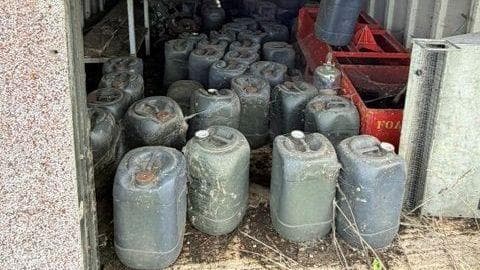
Barrels of firefighting foam containing hazardous chemicals have been removed from a former military fuel storage site in Oxfordshire that is earmarked for residential development, according to the site's developer. The removal follows concerns raised by local campaigners about the presence of approximately 40 containers of foam liquid, which had been stored at the Islip Fuel Depot since the 1988s.
The Islip Fuel Depot is a former RAF and Esso facility that has received outline planning permission to build residential and affordable homes. The site covers just over 14 hectares, and the Environment Agency has classified it as high risk for contamination, though the agency indicated that risks could be managed through an approved remediation strategy.
The firefighting foam contains PFAS—a group of synthetic chemicals commonly referred to as forever chemicals because they do not break down naturally in the environment. The barrels were manufactured by Angus Fire Armour, a company that previously settled a legal dispute out of court with residents in Yorkshire over claims of PFAS exposure near its foam manufacturing plant.
What prompted the removal?
Local campaigners from the Gallos Brook community group discovered the barrels and raised alarm about potential contamination. The group has been conducting regular testing for PFAS in the area and obtained a soil sample from near the storage area, which they sent to a UKAS-certified laboratory. Their analysis indicated 3.74325 micrograms of PFAS per kilogram of soil, with PFOS—a specific type of forever chemical—measured at levels 205 times higher than the safe limit for residential land use.
The depot previously supplied fuel to RAF Upper Heyford, approximately five miles to the north, which is suspected to be a source of PFAS contamination from firefighting foam. According to historic Ministry of Defence assessments reported in June 2026, firefighting chemicals at RAF Upper Heyford were drained into stormwater systems. A 1997 MOD risk assessment had warned that if soil or groundwater contamination occurred at the site, human health could be affected through skin contact, inhalation or ingestion.
What does the developer say?
Hugo Llewelyn, CEO of Newcore, which took over the site in 2012, stated that the company had already identified the potential for contamination and was made aware of the barrels "in recent weeks." He said the containers were removed in a "responsible and professional manner."
Whilst firefighting foam containers were present on site from the MOD's operation back in the 20th Century, we do not believe it was ever deployed; the containers were sealed; and successive surveys have confirmed that there is no "pathway" for it to cause pollution.
Llewelyn disputed the testing methodology used by the campaigners, characterising their sample collection as an unlawful trespass and questioning the validity of their results. He produced alternative test results from what he claimed was the same area, obtained as part of the developer's Phase 2 investigations, showing a total PFAS level of 0.0641 micrograms per kilogram—roughly 98% lower than the campaigners' findings.
A 'pressure group' has trespassed unlawfully to obtain a questionable sample from this site to demonstrate that in the secured area of the site that was purposefully designed to accommodate foam for firefighting purposes, which is likely to contain PFAS, does, according to their findings, contain PFAS. I'm not sure there is anything to be surprised about here.
Llewelyn noted that a Phase 1 assessment conducted the previous year had already flagged the potential for contamination, and that the Phase 2 investigation specification was designed to address this risk. He stated that any contamination identified would be cleaned up immediately.

What is the wider contamination picture?
The Environment Agency's Chemical Compliance team has been in contact with site owners to ensure proper management of the drums. In August 2026, the Environment Agency reported that Gallos Brook failed chemical targets for PFOS and other PFAS as part of its England-wide monitoring programme. The Gallos Brook Community Group has conducted more than 14 tests near RAF Upper Heyford, with results showing elevated PFAS levels; one independent result was reported as 43,000 times the environmental quality standard.
Cherwell District Council has confirmed that PFAS have been detected in local watercourses, though the source has not been definitively established and there is currently no evidence of an immediate risk to residents' health.
What happens during development?
The planned development includes 50% affordable housing. The council's planning condition requires work to stop if previously unidentified contamination is discovered during construction, until a remediation strategy is submitted and approved by the local authority.
Key Facts
- Approximately 40 barrels of firefighting foam containing PFAS have been removed from the Islip Fuel Depot in Oxfordshire
- The site is planned for residential development with 50% affordable housing
- Campaigners' soil testing showed PFAS levels 205 times higher than the safe limit for residential use, while the developer's testing showed much lower levels
- The Environment Agency has classified the site as high risk for contamination but indicated risks could be managed through an approved remediation strategy
- Development must halt if new contamination is discovered until a remediation plan is approved