

A £5m trial beginning in the United Kingdom will use artificial intelligence to predict where aircraft are likely to create warming contrails, so that flights can be steered around them. The 30-month programme, called Operation Blue Skies, is a partnership between Google, the UK government, the Met Office, air traffic control provider National Air Traffic Services (NATS) and academic researchers. It will focus on the Shanwick Oceanic airspace over the eastern North Atlantic, a corridor estimated to be responsible for roughly 5% of global contrail warming.
Contrails form when hot exhaust gases from jet engines mix with cold air at cruising altitude, producing ice crystals. Most vanish within minutes, but under sufficiently cold and humid conditions they can linger and spread into thin, high clouds that trap heat which would otherwise radiate away from the planet.
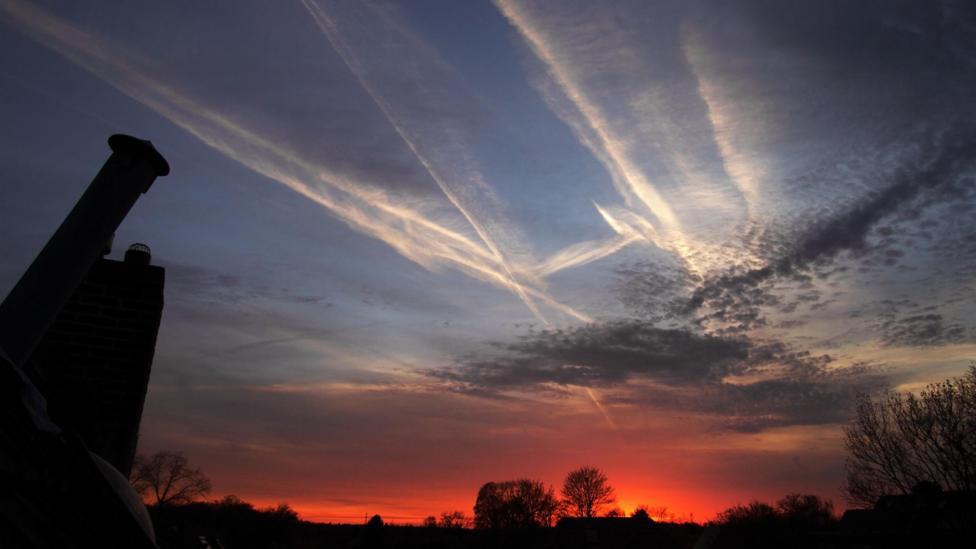
Why are scientists so concerned about contrails?
Researchers believe contrails may account for a substantial share of aviation's overall contribution to climate change, even though the exact figure remains uncertain. Dr Paul Hodgson, Google's technical lead for Operation Blue Skies, told a technology programme that his young child has taken to calling the white streaks "sky graffiti."
"We think that contrail warming is responsible for something like a third of all aviation climate warming,"
Hodgson said the precise scale of the effect is still debated among scientists, but the consensus is that it represents a serious issue either way.
"either quite a large problem or a very large problem"
How would the AI system actually work?
The approach relies on combining satellite imagery with historical flight data to map where aircraft have previously generated contrails. Google will layer that information with weather forecasts to predict where atmospheric conditions are likely to favour new contrail formation. Those predictions will then be shared with NATS, whose air traffic controllers can instruct pilots to adjust course.
In practice, most adjustments are expected to involve shifting an aircraft's altitude by around 2,000ft rather than altering its overall flight path. Because similar altitude changes are already routinely made to dodge turbulence or poor weather, passengers are unlikely to notice any difference during the trial.
Ian Jopson, NATS' director of sustainability, said the changes should integrate smoothly into existing operations.
"pretty much business as usual using existing procedures for the operators on the North Atlantic"
When and how extensively will the trial run?
According to Google's project announcement, the 30-month programme will include two operational trial windows lasting roughly four months each, rather than a single continuous test as originally suggested. The company also states that around 10,000 flights from hundreds of departure cities are expected to pass through Shanwick airspace during trial hours each year, with only a small proportion of those actually rerouted. Separate reporting from New Scientist indicates the two winter test windows, spanning 2026-2027 and 2027-2028, will each involve somewhere between roughly 20 and 40 individual test days, while trade publication Aviation Week reports the trial is provisionally pencilled in for the quieter months between November and February.

Google describes Operation Blue Skies as the first state-backed trial anywhere to attempt contrail avoidance across an entire oceanic airspace, according to the company's own announcement.
The Department for Transport is contributing £2.65m to the project, while Google is providing £1.4m in the form of AI research, engineering work and computing infrastructure. Aviation Minister Keir Mather said the programme would test modest adjustments to transatlantic flight paths that could help make air travel less environmentally damaging.
"small tweaks to flight paths over the Atlantic"
"This is a world-first, and it's British ingenuity leading the way,"
Does avoiding contrails create a net climate benefit?
Changing an aircraft's altitude typically increases fuel burn, prompting the question of whether avoiding contrails might simply shift emissions elsewhere rather than reduce them overall. Hodgson said earlier trials suggest the additional fuel use is minor compared with the climate benefit of preventing a contrail from forming in the first place.
"The CO2 penalty is in the order of less than 1%, compared to the contrail cost, which is of a similar order magnitude to all of the CO2 of aviation,"
Modelling carried out for Operation Blue Skies estimates that a full deviation through Shanwick airspace would require around 100kg of extra fuel per affected aircraft. Hodgson said previous airline-level trials achieved reductions of roughly 60-70% in contrail formation or warming.
What does past research show?
Google reported in March 2026 that an earlier AI-driven contrail-avoidance trial conducted with American Airlines cut contrail formation by 62% on flights that followed the AI's suggested routing, according to the company's research findings. Separately, the Associated Press reported that the American Airlines trial covered 2,400 transatlantic flights and ran from January to May 2025, according to an AP report. The University of Cambridge's Aviation Impact Accelerator has separately estimated that contrail avoidance could cut aviation's total climate impact by as much as 40%, at an average ticket price increase of around 1%, according to the initiative's own figures.
NATS has said it is also involved in related contrail-reduction research, including the CICONIA project alongside Airbus, Air France, Swiss and easyJet, according to the air traffic provider's research page.

What happens next?
The first operational trial window for Operation Blue Skies is expected to run during the winter of 2026-2027, with a second window following in winter 2027-2028, according to New Scientist's reporting. Google has said the two phases will be used to test contrail avoidance at full operational scale before any decision is made on wider rollout, according to the company's project page. The trial's findings are expected to be published in academic literature and made available for independent scientific scrutiny.
The programme arrives as the UK government continues to back expansion of the country's airports, a policy that raises broader questions about whether technological fixes like this one can meaningfully offset the environmental cost of growing flight demand.
Key Facts
- Operation Blue Skies is a £5m, 30-month trial involving Google, the UK government, the Met Office, NATS and academic researchers.
- The trial targets Shanwick Oceanic airspace, responsible for about 5% of global contrail warming.
- Testing will occur across two winter windows, 2026-2027 and 2027-2028, with roughly 20 to 40 test days each, according to New Scientist.
- Around 10,000 flights are expected to pass through the airspace annually during trial hours, per Google, with only a small share rerouted.
- A prior American Airlines trial covering 2,400 flights cut contrail formation by 62%, according to Google and AP reporting.


