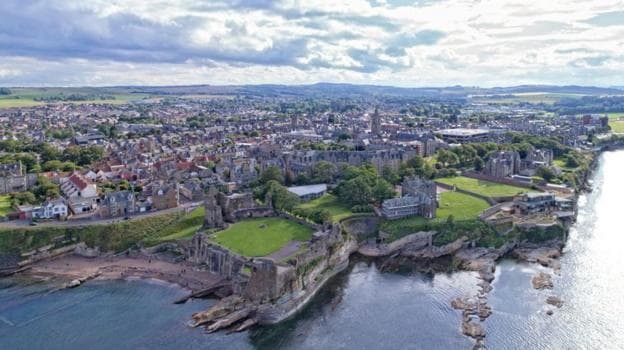
St Andrews faces an acute shortage of affordable housing, with international property investment and wealthy buyers from outside Scotland driving prices beyond the reach of local residents, students and workers. New data reveals that nearly one in five properties sold in the town were registered to addresses outside Scotland, including 164 purchases from the United States alone. The Fife coastal town, home to a world-renowned university and the historic golf courses that define the sport globally, has become a magnet for investment that is reshaping its character and pricing out those who live and work there year-round.
The appeal of St Andrews extends far beyond its academic reputation and sporting heritage. Its picturesque setting, international profile and status as a prime Scottish property market have attracted downsizers, wealthy parents purchasing homes for university-age children, golf enthusiasts and overseas investors seeking a foothold in a desirable location. Yet this very appeal has created a paradox: the town that draws visitors and investment from across the world is becoming increasingly unaffordable for the people who sustain its community.
How significant is overseas investment in St Andrews property?
Registers of Scotland data obtained by a national broadcaster reveals the scale of international property ownership in the town. Across the KY16 8 and KY16 9 postcodes covering St Andrews, 5,494 titles were registered to Scottish addresses at the time of purchase, representing 81% of all transactions. A further 845 properties (12%) went to addresses elsewhere in the United Kingdom, while 444 titles (7%) were registered outside the UK entirely.
The overseas registrations span 51 different countries and crown dependences, ranging from Russia to the Cayman Islands. The United States dominates this overseas investment, accounting for 164 St Andrews titles—37% of all properties purchased by non-UK buyers. Switzerland follows with 30 purchases, and Hong Kong with 28. Nationally, St Andrews ranks fourth among Scottish postcode sectors with the highest proportion of overseas buyers, behind three Edinburgh postcodes including the Quartermile development, where more than a third of properties were purchased by overseas-based owners.

What impact has this had on housing costs?
Property prices in St Andrews have surged dramatically, far outpacing the Scottish average. Data from property firm Rettie shows the average sale price over the last 12 months reached £482,879—more than twice the Scottish average—and has nearly doubled from £312,464 a decade ago. Rental costs tell a similarly stark story: average advertised rents in St Andrews over the past year have been £1,702 per month, compared with the Scottish average of £1,245 per month, according to property firm Rightmove.
Francesca Bisi, a fourth-year PhD student in the School of Art History at the University of St Andrews, has felt these pressures acutely. Unable to secure affordable accommodation in the town, she commutes from a nearby village to pursue her studies.
It has been really stressful to try to navigate the housing market here, and even in my fourth year it's something that is still causing a huge challenge,she explained.
It distracts from my work, distracts from my studies and really takes a huge toll on my mental health as well. I know that any savings that I've been able to put aside that year always end up being drained in whatever down payment because in this market you know you can't really afford to be picky with what you find and you just feel lucky that you found any place at all.

Amy Elvins, of the St Andrews University Students' Association, described how the rental crisis has shifted power entirely to landlords.
The high rents in St Andrews have ultimately meant that all power lies with landlords, which means that students are potentially having to work full time.She added that
it has created a market in which the understanding is that all houses in town will be filled so it doesn't really matter the standard and the price that they are. It means that members of the community are also being priced out and what we ultimately need is more affordable rentable housing.
Why is St Andrews such a hot property market?
Dr John Boyle, director of research and strategy at Rettie, characterised St Andrews as a
hot market in a Scottish context.He identified multiple overlapping sources of demand:
When the tourists come here they think this might not be a bad place to retire to. So you've got a lot of downsizer demand within the community and you've got the university setting so both a lot of students and a lot of staff. St Andrews along with Edinburgh's New Town, Morningside and west end Glasgow, it's the handful of real prime areas across the country. It's very sought after by a whole range of different buyers including buyers that have got significant amounts of money to go and spend on finding a place to live there.
The University of St Andrews itself is a major draw. With a population of just over 16,000 according to the last census, the town can feel overwhelmed on busy days, resembling the centre of a busy European city. The university has capped its student numbers at around 10,000 for nearly a decade specifically because of pressure on housing and other local amenities. Yet the institution remains a global magnet: it contributes an annual £480 million to Scotland's economy and supports 9,000 jobs across the Fife and Tayside area.


What do local leaders say about the crisis?
Ben Stuart, director of residential and business services at the University of St Andrews, acknowledged the complexity of the situation.
St Andrews obviously borders with the ocean and green belts. There's not a lot of space left to provide that type of housing. All entities have to get together here and understand how they can relieve the pressures.He stressed that
students are often unfairly blamed for the housing situation, when evidence shows it is a much more complex picture.
Stuart highlighted a troubling dynamic:
Quite often, those with the deepest pockets are simply outbidding—by a substantial margin—locals who try to acquire property in town. And often those with the deepest pockets are from overseas.This observation reflects the data showing overseas buyers competing for limited stock and driving prices beyond what local incomes can sustain.
Debbie MacCallum, a local entrepreneur and chairwoman of St Andrews Business Improvement District, acknowledged the town's international value while calling for balance.
However, a globally recognised town also has to work for the people who live here all year-round and St Andrews is, first and foremost, a community. As demand for property grows, we need to continue having sensible conversations about how we balance the benefits of international investment with the need for homes, businesses and services that support a thriving local community.
Fife Council has formally recognised the challenge. John Mills, head of housing for Fife Council, stated:
We know that finding affordable housing in St Andrews is a major challenge and there is no single solution. That's why we're taking a range of steps to help improve housing options for local people.
What measures are being taken to address the shortage?
Fife Council has implemented several policy tools to increase affordable housing supply. All new developments are required to include a 30% affordable housing contribution, a policy that has begun to yield results. The council has also introduced control areas for short-term lets to prevent further erosion of the long-term rental stock, and is conducting an ongoing review of how key workers are allocated council housing.
More substantial relief is expected from major new developments on the town's outskirts. These projects will deliver more than 1,000 new homes, significantly increasing overall supply. According to Kingdom Housing Alliance's development plans, the Craigtoun St Andrews Phase 2 project was scheduled for completion in September 2026, delivering 41 homes including 12 social rent and 29 mid-market rent properties. This represents the type of mixed-tenure approach that local authorities are pursuing to ensure new supply serves multiple income levels.
Beyond individual projects, Fife Council's affordable housing programme is funded through 2029, with plans for 336 new council homes and 350 new Fife Housing Association Alliance homes across the 2026-29 period. This multi-year commitment signals a sustained effort to expand the affordable stock, though the scale of the challenge means these additions will take time to meaningfully shift the market.
The housing crisis in St Andrews must also be understood within Scotland's broader property market dynamics. Scotland's house sales value reached a record £24.3 billion in 2025, with median property prices rising 4% to £198,000, reflecting a national housing emergency that extends well beyond the Fife coast. St Andrews, however, remains an acute flashpoint where international investment, tourism, university demand and limited land combine to create prices that local wages cannot support.
What happens next for St Andrews housing?
The immediate outlook depends on whether new supply can outpace continued investment demand. According to reporting from late summer 2026, students were still scrambling for accommodation ahead of term, suggesting that housing pressure remained acute even as new projects came online. The completion of Craigtoun Phase 2 in September 2026 and the broader pipeline of 1,000-plus homes should begin to ease supply constraints, but whether these additions will be affordable enough to serve local workers and students remains uncertain.
The town's stakeholders—the university, the council, local businesses and residents—have committed to ongoing dialogue about balancing St Andrews' international appeal with its function as a living community. The 2027 Open Championship, to be held at the Old Course, will further elevate the town's global profile and likely intensify both tourism and investment interest. How effectively the new housing supply is deployed, and whether policy tools such as affordable housing quotas and short-term let controls prove sufficient, will determine whether St Andrews can sustain itself as a place where not only visitors and investors, but also students, workers and families can afford to live.