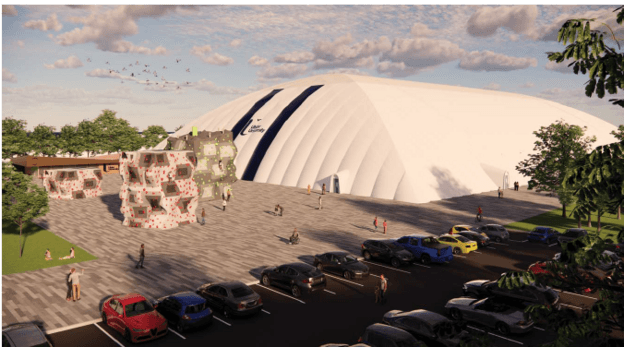
Ulster University has disclosed spending £800,000 on a proposed indoor sports dome in Londonderry before abandoning the project in August due to financial pressures. The facility, which was announced in 2024 as a landmark development for Northern Ireland, had ballooned in estimated construction costs from £16.8 million to £20.1 million by the time the university decided to halt it. According to BBC News, the university revealed the expenditure through a Freedom of Information request, breaking down the costs as approximately £700,000 spent on project-related activities and a further £100,000 for project management and governance arrangements.
The 15,000 square metre facility was originally promoted as a transformative asset for Derry, designed to accommodate rugby, football, Gaelic games, and community and musical events. The project came at a time when Ulster University announced it needed to reduce spending by approximately £25 million and would eliminate up to 450 staff positions. The decision to scrap the dome reflected what the university described as "an inevitable consequence" of the "lack of a sustainable funding model for higher education" in Northern Ireland.
The dome project had been part-funded through the PeacePlus programme, a cross-border initiative jointly supported by the European Union, the UK government, the Irish government and Stormont. The international funding contribution was set at €10.86 million (approximately £9.16 million), with Ulster University expected to provide £8.3 million in match funding. The Special EU Programmes Body confirmed that no PeacePlus funding had been disbursed before the project was cancelled.
Why did the project become unviable?
Beyond the escalating construction costs, the university identified annual running expenses as a critical barrier to the project's sustainability. Operating the dome as a commercial entity would have required more than £1 million annually, a burden the university determined it could not support given its broader financial constraints. SDLP assembly member Sinéad McLaughlin expressed concern about the timeline and decision-making process, stating that the dome had been announced to "much fanfare" but had proven to be an "unaffordable project."

McLaughlin told BBC Radio Foyle that the higher education sector in Northern Ireland faced a financial crisis that made it impossible for Ulster University to sustain the dome's upkeep. She questioned how the institution had reached the decision to abandon the project only after spending £800,000, describing it as regrettable that "it took so long to get to that point."
What happens to the PeacePlus funding?
The cancellation of the dome project has created uncertainty about the reallocation of substantial European funding. In September 2026, Derry City and Strabane councillors were informed that there was no guarantee the more than £9 million in PeacePlus funding earmarked for the cancelled dome would be reinvested in the district. A council director indicated that released funds would likely be directed into a broader allocation pool rather than reserved for local projects.
The Special EU Programmes Body stated it was exploring options for how the funding would be reallocated and remained "committed to delivering impactful projects for communities across the area and throughout Northern Ireland and the border counties of Ireland." However, the body could not provide assurance that any reallocation would benefit the north-west region.
In response to these concerns, Derry City and Strabane District Council agreed to write to Ulster University seeking clarity on its plans for the proposed site and alternative investment opportunities. The council also committed to contacting the Economy Minister and the Executive to seek reaffirmation of the university's commitment to expand its Magee campus to 10,000 students by 2032.
What was the original vision for the dome?
When first announced, the facility was described as "game-changing" for Derry and positioned as a first-of-its-scale facility for Northern Ireland. The dome was intended to serve multiple functions beyond sports, including hosting community gatherings and musical performances. The PeacePlus programme had identified the dome as one of six projects sharing €77 million in funding to develop cross-community facilities as part of a broader €1.14 billion initiative.
Key Facts
- Ulster University spent £800,000 on the dome project before cancelling it in August, comprising £700,000 in project-related activities and £100,000 in management and governance costs
- Estimated construction costs had risen from £16.8 million to £20.1 million, with projected annual operating expenses exceeding £1 million
- The PeacePlus programme had committed €10.86 million (approximately £9.16 million) toward the project, with no funding disbursed before cancellation
- The cancellation reflects broader financial pressures at Ulster University, which announced plans to reduce spending by £25 million and eliminate up to 450 staff positions
- Uncertainty remains about the reallocation of PeacePlus funding, with no guarantee it will be reinvested in the Derry district