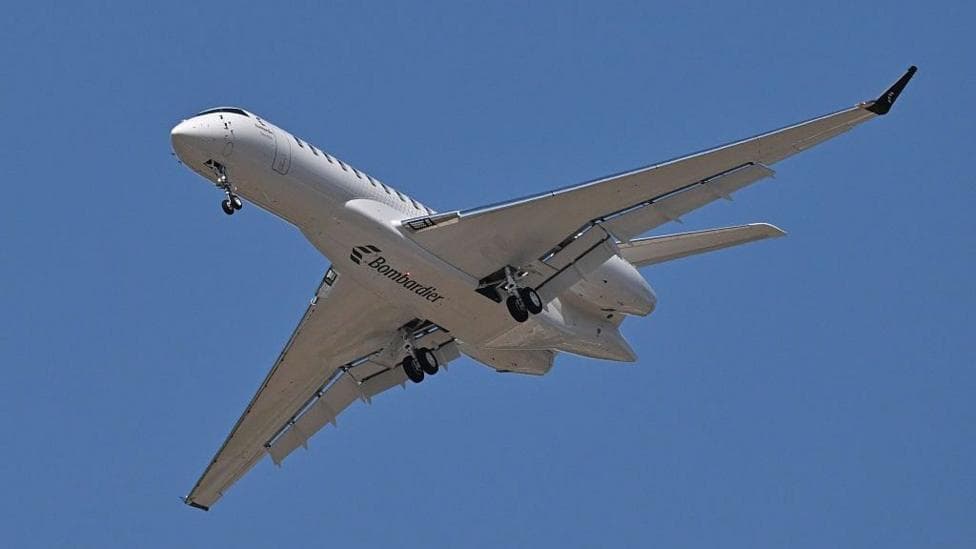
President Donald Trump has issued a stark ultimatum to Montreal-based aircraft manufacturer Bombardier, declaring on Monday that the company cannot continue selling its jets in the United States unless it relocates production to American soil.
"NO MORE SELLING BOMBARDIER IN THE UNITED STATES!"Trump wrote in a Truth Social post.
"If they want our Market, they must build here, and stop treating America like a 'piggybank'."
The threat represents an escalation in the deteriorating trade relationship between the two countries. According to Bloomberg, Trump's post also accused Bombardier's products of being substandard and claimed that over 50 percent of the company's revenue originates from the United States market.
The timing is significant: Trump's threat arrived just hours before Canada was set to impose retaliatory tariffs on American goods. According to reporting on the tariff package, Canadian countertariffs covering C$27.6 billion worth of US imports were scheduled to take effect at 12:01 a.m. on Tuesday, encompassing steel, aluminium, household appliances, agricultural equipment, pulp and paper, and electronics.
This is not Trump's first confrontation with Bombardier. According to , the company faced a separate Trump threat in January tied to aircraft certification and potential 50 percent tariffs on aircraft manufactured in Canada, centring on pressure for Canada to certify Bombardier's Global Express aircraft produced by Gulfstream's rival.
What is Bombardier's current US presence?
Bombardier already maintains substantial operations across the United States. The company operates a manufacturing facility in Kansas that produces special mission military aircraft and employs 3,500 American workers. Beyond Kansas, Bombardier maintains sites in Texas, Arizona, Florida, Connecticut, Illinois, Delaware, California, Washington DC and New Jersey. Approximately half of its global fleet—5,100 aircraft—is operated by customers based in the United States.

In a statement released on Monday, Bombardier acknowledged its deep American footprint without directly addressing Trump's threat.
"Bombardier values its great partnership with American companies and its US employees. Our plan is to continue to invest in our people, our customers and the communities in which we operate across the country."The company added that its operations
"create tens of thousands of US jobs through the company's growing American footprint".
How significant is Bombardier to Canada's economy?
Bombardier ranks among Canada's largest corporations and holds particular importance to Quebec's manufacturing sector. According to a report commissioned by the company, Bombardier contributed C$7.4 billion ($5.4 billion; £4 billion) to Canada's gross domestic product in 2024. The company is also one of the largest employers in Quebec's manufacturing industry.
Quebec Premier Christine Fréchette responded to Trump's threat on Monday, calling Bombardier
"a source of pride"for her province and
"a flagship of our economy"."She stated that she had contacted Bombardier CEO Éric Martel and offered her government's complete support. On Trump's threat, Fréchette wrote:
"I will not respond to provocation with provocation. Quebec will not allow anyone to dictate where our companies must produce in order to access a market."
Where are Bombardier's jets manufactured?
Bombardier's aircraft are produced at facilities located in Canada, the United States and Mexico, according to the company's website. These operations comply with the North American free trade agreement that Trump signed during his first term, known as CUSMA in Canada and the USMCA in the United States.
What is the broader context of US-Canada trade tensions?
Trump's threat against Bombardier arrives amid a severe deterioration in trade relations between Washington and Ottawa. Trade negotiations between the two countries collapsed late last month after Canada withdrew from talks. Following that breakdown, the United States imposed new 50 percent tariffs on a range of Canadian goods.
Prime Minister Mark Carney accused the Trump administration of presenting last-minute negotiating terms that were both
"unfair"and
"uneconomic"."US officials countered by accusing Carney of refusing to sign a deal for political reasons, citing Trump's unpopularity in Canada—an allegation Carney denied.
What happens next?
Canada's retaliatory tariffs are set to begin at 12:01 a.m. on Tuesday. The mechanism by which Trump intends to enforce his ban on Bombardier sales in the United States remains unclear, as the company already operates multiple American facilities and complies with existing trade agreements.