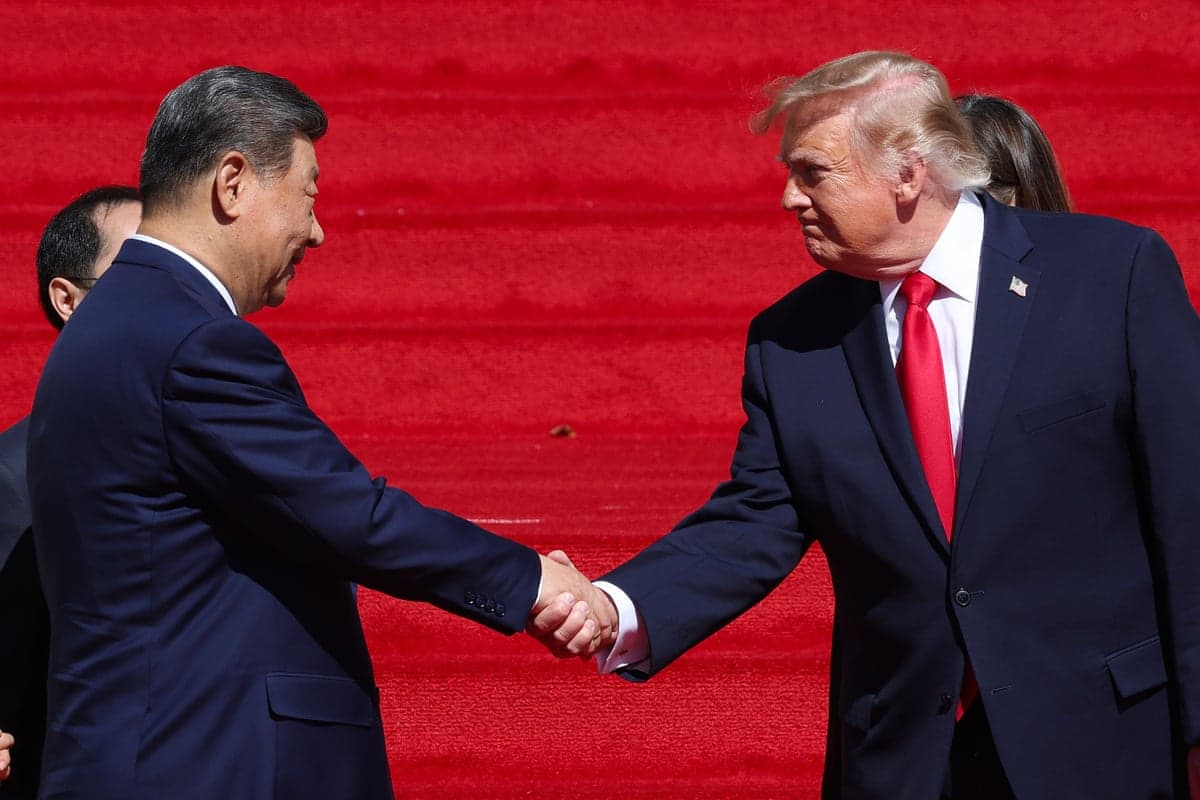
Donald Trump and Chinese President Xi Jinping concluded a three-day state visit on Friday without securing a major breakthrough on artificial intelligence, drawing criticism from lawmakers and analysts who saw the gathering as a missed opportunity to establish guardrails on the technology.
The summit prioritized ceremonial pageantry and personal rapport over substantive policy commitments. While the two leaders discussed conflicts in Iran and Ukraine, Taiwan's status, and trade relations, their most concrete achievement was extending an existing trade truce by two months. According to , the trade agreement now expires on January 10, 2027, providing a new deadline for broader negotiations between the two economic powers.
Despite the presence of leading technology executives at a White House state dinner on Thursday evening, neither Trump nor Xi announced measures to slow their nations' competing artificial intelligence development programs. The dinner brought together prominent figures including executives from major tech firms, yet produced no visible commitments to coordinate on AI safety or establish joint oversight mechanisms.
Ro Khanna, the senior Democrat on the House select committee focused on China, expressed frustration with the outcome.
It was such a layup,he said, describing what he viewed as an easily achievable diplomatic win.
If [Trump] had just said, look, we have established technical working groups and we've agreed to a framework that has called for DeepSeek and Moonshot and Alibaba to sit down with Anthropic and OpenAI and Gemini and with technical experts and they're going to commit to at least a pause on any self-improving AI, he could have looked like he was a statesman taking the lead.Khanna added that he believed China would have accepted at least some technical working groups, but that Trump showed no interest in pursuing such arrangements.
What agreements did emerge from the summit?
The two-month trade truce extension represents the most tangible outcome, though analysts characterized it as a holding measure rather than a comprehensive resolution. According to reporting, the extension was designed to buy time for negotiators to work toward a larger agreement addressing deeper trade disputes. The arrangement follows a previous truce established at a meeting in South Korea in October 2025, which had helped stabilize relations after a period of escalating tensions.
On the artificial intelligence front, both sides acknowledged the need for responsible development. Xi stated that the United States and China bear a
responsibility to develop and manage AI for goodand to
ensure that the development of AI is always under human control.China has set a target to deploy next-generation smart terminals and AI agents by 2030. However, according to reporting from a major US newspaper, the two nations did discuss establishing an AI safety dialogue and a possible national-security hotline for reporting incidents related to artificial intelligence, though neither country signaled willingness to reduce the pace of their AI development programs.
Trump appeared more focused on rebranding artificial intelligence as "super intelligence," later claiming on social media that Xi "seems to like" the term without elaborating on substantive discussions between the two leaders.
Why did the summit disappoint observers?
Multiple analysts and lawmakers characterized the three-day visit as a theatrical exercise that failed to address the genuine strategic challenges facing both nations. Michael Czin, a fellow at the Brookings Institution's China Center in Washington, offered a stark assessment of the proceedings.
We are in this potentially transformative moment for both countries and for the world and for technology and, instead of having a meeting that would meet the moment, you got theatre of the absurd in lieu of that,he said.
Even going into this meeting, you're dealing with a septuagenarian and octogenarian who may or may not have ever had first-hand contact with actually using AI and what happens with this technology rests on their two shoulders. The only thing they seemed to agree about is that neither of them wants to slow down with this technology, regardless of their actual understanding of it.
Czin added that his already modest expectations were further diminished by the actual outcome.
I had very low expectations going into this meeting for anything of substance and the meeting managed to underwhelm even those low expectations. We went from the mezzanine down into the basement. In terms of the substance, it's not clear to me what the US got out of this.

Senate Democrats joined in the criticism. Chuck Schumer, the minority leader, contended that Trump's approach prioritizes personal flattery and media attention over national interests.
As usual, Trump acts based solely on who flatters him at the moment, where the nearest photo op is, and what headline he covets. If you're a foreign authoritarian, Trump won't just invite you to visit America, he'll greet you plane-side.
How did the summit unfold ceremonially?
The visit marked Xi's first state visit to the United States in more than a decade and his second such visit overall. Trump broke from diplomatic protocol by greeting Xi with a red carpet ceremony when the Chinese leader arrived at Joint Base Andrews in Maryland. The three days of formal events culminated on Friday with Trump and Xi sharing tea at the White House.
Trump declared that the summit had produced great strides and that
our farmers are going to be happy,though he offered no specifics to support the claim. The two leaders subsequently visited the National Archives, where Trump and Xi examined the original Declaration of Independence, the Constitution, and the Bill of Rights. Trump told reporters they were comparing China's founding documents to America's.
Ours goes 250 years, which is great, and we're proud of. Theirs goes 6,000 years. So there's a little difference between 6,000 and 250. But we're very proud of our 250.
Trump also conducted a personal tour of the White House for Xi, including a gallery wall displaying portraits of previous presidents and a construction site for a new White House ballroom.
He's an expert on stone, aside from many other things, and he loves good granite,Trump remarked about his guest.
What role did technology executives play?
The Thursday evening state dinner brought together some of the most prominent figures in American technology and business. The gathering included executives whose combined wealth underscored the concentration of economic power in the tech sector. Bernie Sanders, an independent senator from Vermont, drew attention to the disparity by labeling a photograph of the dinner table with guests' net worth: Elon Musk of SpaceX and Tesla at $928 billion, Lisa Su of Advanced Micro Devices at $3.5 billion, Jensen Huang of Nvidia at $186 billion, and Tim Cook of Apple at $3.1 billion. Sanders commented on the composition of the gathering:
A government of, by and for the billionaire class.
Notably absent were representatives from China's technology industry, and there was little indication that either nation intended to make even a symbolic gesture toward restraint in artificial intelligence development. Khanna observed that Trump could have at least announced the formation of a working group of Chinese and American technologists to develop recommendations on AI oversight and verification mechanisms, without requiring a comprehensive treaty.
What tensions surrounded press access?
The summit was somewhat overshadowed by Trump's decision the previous week to bar certain news organizations from the White House, sparking legal disputes over press freedom. On Thursday, Chinese state media were granted access to White House grounds even as members of the American press faced restrictions, though some later gained entry. Following a precedent established in May, the two leaders did not hold a joint press conference, limiting opportunities for direct questioning about the summit's outcomes.
What happens next?
The extended trade truce creates an immediate deadline for future negotiations. According to , the agreement now expires on January 10, 2027, establishing the next critical juncture for resolving broader trade disputes between the two nations. Sticking points identified by analysts include restrictions on advanced Nvidia chip exports to China and allegations that Chinese firms have engaged in AI model "distillation" practices.
Trump and Xi are scheduled to meet twice more in 2026. In November, Xi will host the Asia-Pacific Economic Cooperation summit in Shenzhen, China. In December, the organization's annual meeting will take place at Trump National Doral Miami golf club in Florida. These additional gatherings will provide further opportunities for the two leaders to address unresolved tensions on trade, security, human rights, and artificial intelligence development.
The establishment of an AI safety dialogue and incident-reporting hotline between the two nations remains under discussion, though implementation timelines and enforcement mechanisms have not been publicly detailed. Whether these mechanisms will materialize depends on follow-up negotiations between US and Chinese officials in the months ahead.